Department of Pathology, Korea University Guro Hospital, #97 Gurodong-gil, Guro-gu, Seoul 152-703, Korea.
BMC Cancer. 2013 Aug 12;13:383. doi: 10.1186/1471-2407-13-383.
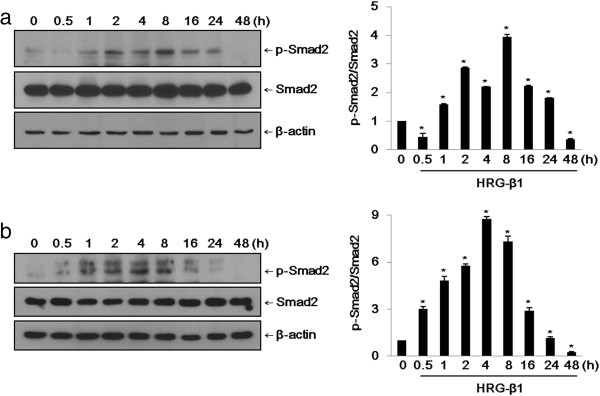
Heregulin (HRG; also known as neuregulin) is a ligand for ErbB3. One of its isotypes, HRG-β1, binds to ErbB3 and forms heterodimers with other ErbB family members, thereby enhancing the proliferation and tumorigenesis of breast cancer cells. HRG stimulation may contribute to the progression of epithelial-mesenchymal transition (EMT) and tumor metastasis in breast cancer. Majority of studies regarding EMT has been concentrated on TGF-β signaling. Therefore, we investigated whether the HRG-β1 and ErbB3 activate Smad2 signaling during process of EMT in breast cancer cells.
The SK-BR-3 and MCF7 breast cancer cell lines were used. The expressions of phospho-Smad2 and EMT markers were observed by western blotting and immunofluorescence assays after treatment with HRG-β1. The cell motility and invasiveness were determined by wound healing and matrigel invasion assays. Smad2 and ErbB3 small interfering RNA (siRNA) transfections were performed to assess the involvement of ErbB3 and Smad2 in HRG-β1-induced EMT.
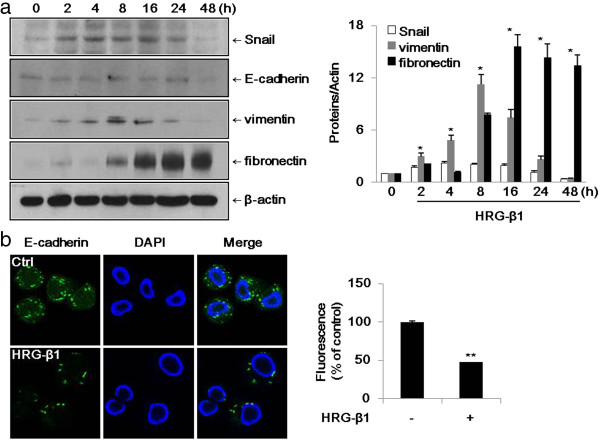
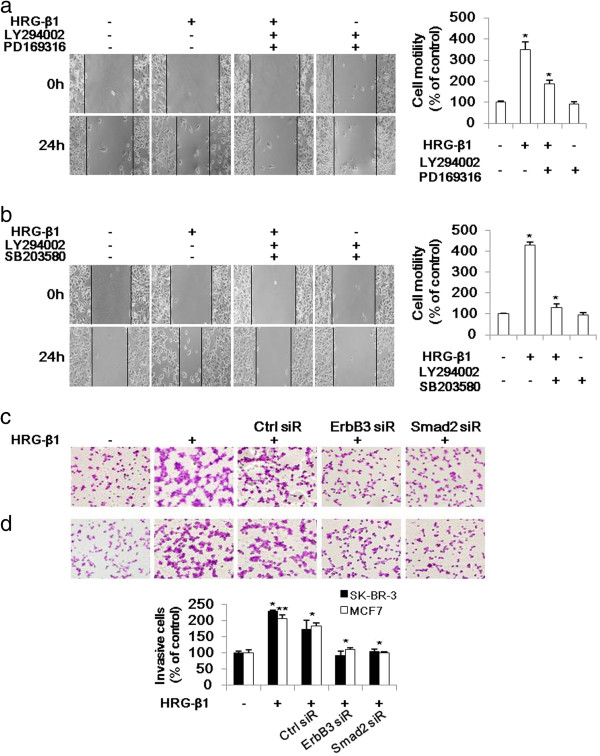
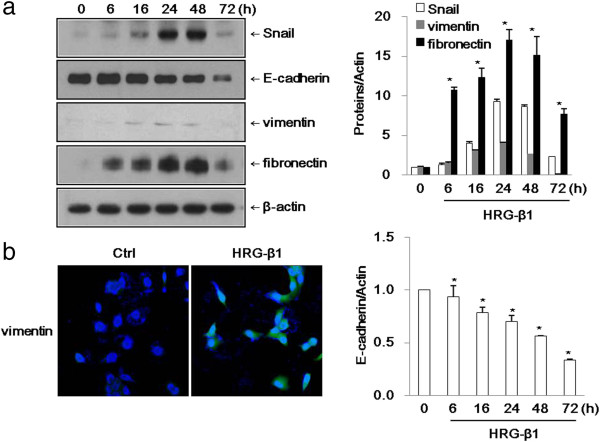
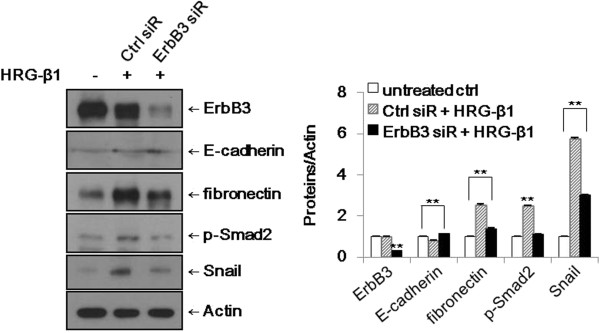
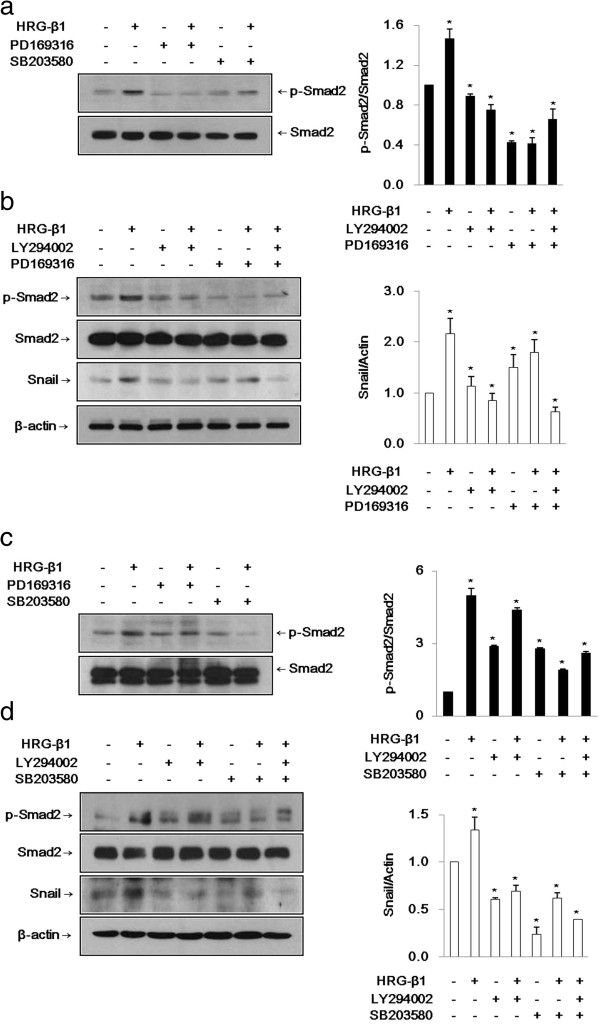
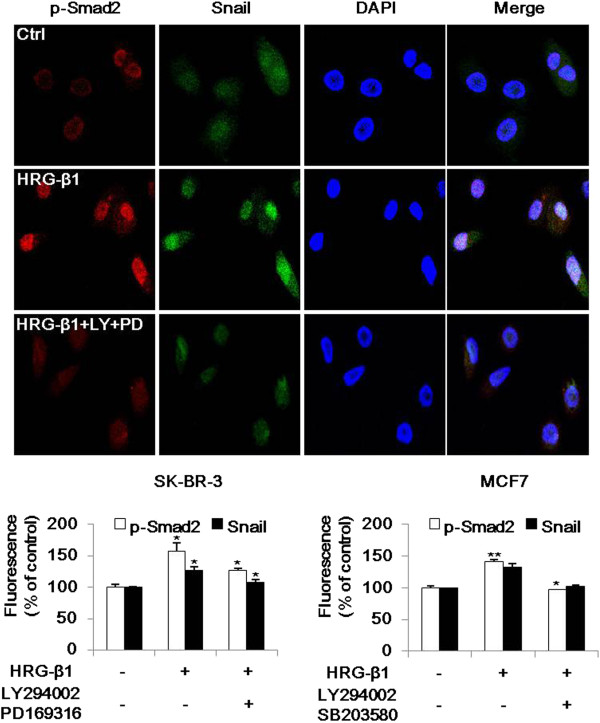
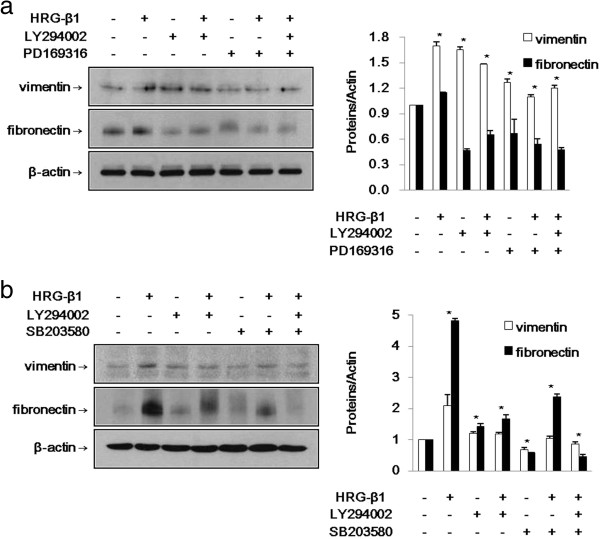
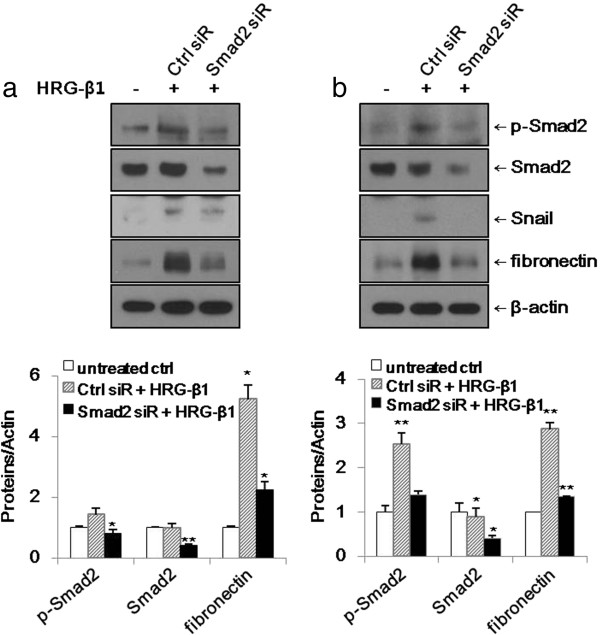
HRG-β1 induced EMT through activation of Smad2. The expression of E-cadherin was decreased after HRG-β1 treatment, while the expressions of Snail, vimentin, and fibronectin were increased. The HRG-β1-induced expressions of Snail, vimentin, and fibronectin, and nuclear colocalization of phospho-Smad2 and Snail were inhibited by pretreatment with a PI3k inhibitor, LY294002, or two phospho-Smad2 inhibitors, PD169316 or SB203580 and cancer cell migration by HRG-β1 was inhibited. Knockdown of Smad2 by siRNA transfection suppressed the expressions of Snail and fibronectin in response to HRG-β1 stimulation and knockdown of ErbB3 suppressed the expressions of phospho-Smad2, Snail, and fibronectin induced by HRG-β1, whereas E-cadherin was increased compared with control siRNA-transfected cells. Knockdown of ErbB3 and Smad2 also decreased SK-BR-3 and MCF7 cell invasion.
Our data suggest that HRG-β1 and ErbB3 induce EMT, cancer cell migration and invasion through the PI3k/Akt-phospho-Smad2-Snail signaling pathway in SK-BR-3 and MCF7 breast cancer cells.
人源表皮生长因子受体 3(HER3)配体在这里被称为神经调节蛋白(HRG)。其同种型之一 HRG-β1 与 HER3 结合,并与其他表皮生长因子受体家族成员形成异二聚体,从而增强乳腺癌细胞的增殖和致瘤性。HRG 刺激可能有助于乳腺癌中上皮间质转化(EMT)和肿瘤转移的进展。大多数关于 EMT 的研究都集中在 TGF-β 信号通路。因此,我们研究了 HRG-β1 和 HER3 是否在乳腺癌细胞 EMT 过程中激活 Smad2 信号通路。
使用 SK-BR-3 和 MCF7 乳腺癌细胞系。用 HRG-β1 处理后,通过 Western blot 和免疫荧光检测磷酸化 Smad2 和 EMT 标志物的表达。通过划痕愈合和基质胶侵袭实验测定细胞迁移和侵袭能力。进行 Smad2 和 HER3 小干扰 RNA(siRNA)转染,以评估 HER3 和 Smad2 在 HRG-β1 诱导的 EMT 中的作用。
HRG-β1 通过激活 Smad2 诱导 EMT。HRG-β1 处理后 E-钙黏蛋白表达减少,而 Snail、波形蛋白和纤维连接蛋白的表达增加。PI3K 抑制剂 LY294002 或两种磷酸化 Smad2 抑制剂 PD169316 或 SB203580 预处理可抑制 HRG-β1 诱导的 Snail、波形蛋白和纤维连接蛋白表达以及 HRG-β1 诱导的核内磷酸化 Smad2 和 Snail 共定位,并且 HRG-β1 诱导的癌细胞迁移被抑制。siRNA 转染下调 Smad2 表达可抑制 HRG-β1 刺激后的 Snail 和纤维连接蛋白表达,下调 HER3 表达可抑制 HRG-β1 诱导的磷酸化 Smad2、Snail 和纤维连接蛋白表达,而与对照 siRNA 转染细胞相比,E-钙黏蛋白表达增加。HER3 和 Smad2 的下调也降低了 SK-BR-3 和 MCF7 细胞的侵袭。
我们的数据表明,HRG-β1 和 HER3 通过 SK-BR-3 和 MCF7 乳腺癌细胞中的 PI3k/Akt-磷酸化 Smad2-Snail 信号通路诱导 EMT、癌细胞迁移和侵袭。