a Periodontology Unit, Institute of Clinical Sciences, College of Medical and Dental Sciences , The University of Birmingham , Edgbaston, Birmingham , UK.
d Oral Biology Unit, School of Dentistry, Institute of Clinical Sciences, College of Medical and Dental Sciences , The University of Birmingham , Edgbaston, Birmingham , UK.
Cell Adh Migr. 2018 Mar 4;12(2):127-137. doi: 10.1080/19336918.2017.1322253. Epub 2017 Sep 12.
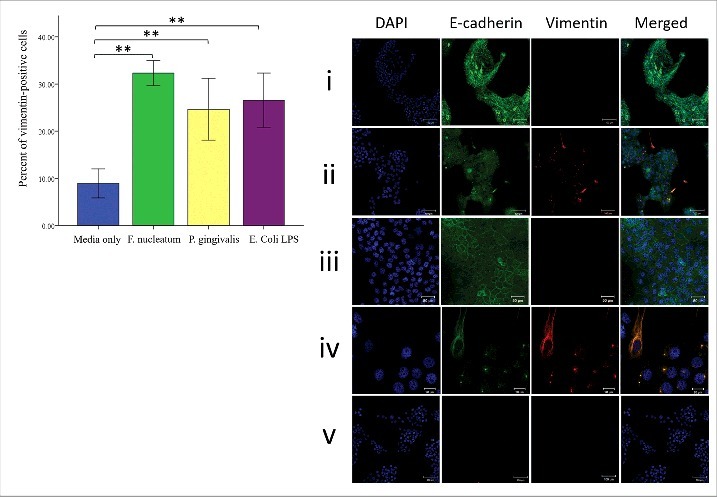
Epithelial-mesenchymal transition (EMT) is potentially involved in increasing metastasis of oral squamous cell carcinoma (OSCC). Periodontal pathogens are well-known for their ability to induce intense immune responses and here we investigated whether they are involved in inducing EMT. Cultures of OSCC cell line (H400) were treated separately with heat-killed periodontal pathogens F. nucleatum, or P. gingivalis or E. coli LPS for 8 d. EMT-associated features were assayed using sq-PCR and PCR-arrays, for EMT-related markers, and ELISAs for TGF-β1, TNF-α, and EGF. The migratory ability of cells was investigated using scratch and transwell migration assays. E-cadherin and vimentin expression was assessed using immunofluorescence while Snail activation was detected with immunocytochemistry. In addition, the integrity of the cultured epithelial layer was investigated using transepithelial electrical resistance (TEER). PCR data showed significant upregulation after 1, 5, and 8 d in transcription of mesenchymal markers and downregulation of epithelial ones compared with unstimulated controls, which were confirmed by immunofluorescence. Periodontal pathogens also caused a significant increase in level of all cytokines investigated which could be involved in EMT-induction and Snail activation. Exposure of cells to the bacteria increased migration and the rate of wound closure. Downregulation of epithelial markers also resulted in a significant decrease in impedance resistance of cell monolayers to passage of electrical current. These results suggested that EMT was likely induced in OSCC cells in response to stimulation by periodontal pathogens.
上皮-间充质转化(EMT)可能参与了口腔鳞状细胞癌(OSCC)转移的增加。牙周病原体以其诱导强烈免疫反应的能力而闻名,在这里我们研究了它们是否参与诱导 EMT。将 OSCC 细胞系(H400)分别用热灭活的牙周病原体 F. nucleatum、P. gingivalis 或 E. coli LPS 处理 8 天。使用 sq-PCR 和 PCR 阵列检测 EMT 相关特征,用于 EMT 相关标志物,以及 ELISA 检测 TGF-β1、TNF-α 和 EGF。使用划痕和 Transwell 迁移测定法研究细胞的迁移能力。使用免疫荧光法评估 E-钙粘蛋白和波形蛋白的表达,并用免疫细胞化学法检测 Snail 的激活。此外,还通过跨上皮电阻(TEER)检测培养上皮层的完整性。PCR 数据显示,与未刺激对照相比,在转录中,间充质标志物在 1、5 和 8 天时显著上调,而上皮标志物显著下调,免疫荧光法也证实了这一点。牙周病原体还导致所有研究细胞因子的水平显著增加,这些细胞因子可能参与 EMT 诱导和 Snail 激活。细菌暴露会增加细胞迁移和伤口闭合的速度。上皮标志物的下调也导致细胞单层对电流通过的阻抗显著降低。这些结果表明,牙周病原体刺激可能诱导 OSCC 细胞发生 EMT。