Department of Geography and Environmental Studies, University of Haifa, Mt. Carmel, Haifa 3498837, Israel.
Int J Environ Res Public Health. 2013 Aug 9;10(8):3543-62. doi: 10.3390/ijerph10083543.
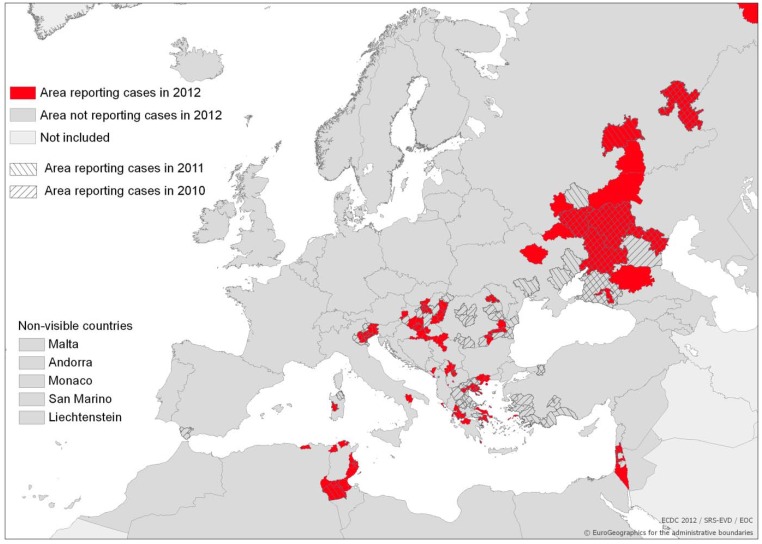
Abiotic and biotic conditions are both important determinants of West Nile Fever (WNF) epidemiology. Ambient temperature plays an important role in the growth rates of vector populations, the interval between blood meals, viral replication rates and transmission of West Nile Virus (WNV). The contribution of precipitation is more complex and less well understood. In this paper we discuss impacts of climatic parameters (temperature, relative humidity, precipitation) and other environmental drivers (such as bird migration, land use) on WNV transmission in Europe. WNV recently became established in southeastern Europe, with a large outbreak in the summer of 2010 and recurrent outbreaks in 2011 and 2012. Abundant competent mosquito vectors, bridge vectors, infected (viremic) migrating and local (amplifying) birds are all important characteristics of WNV transmission. In addition, certain key climatic factors, such as increased ambient temperatures, and by extension climate change, may also favor WNF transmission, and they should be taken into account when evaluating the risk of disease spread in the coming years. Monitoring epidemic precursors of WNF, such as significant temperature deviations in high risk areas, could be used to trigger vector control programs and public education campaigns.
非生物和生物条件都是西尼罗河热(WNF)流行病学的重要决定因素。环境温度对媒介种群的增长率、吸血间隔、病毒复制率和西尼罗河病毒(WNV)的传播起着重要作用。降水的作用更为复杂,也不太为人所知。本文讨论了气候参数(温度、相对湿度、降水)和其他环境驱动因素(如鸟类迁徙、土地利用)对欧洲 WNV 传播的影响。WNV 最近在东南欧建立了立足点,2010 年夏季爆发了大规模疫情,2011 年和 2012 年又反复爆发。丰富的有能力的蚊子媒介、桥梁媒介、感染(病毒血症)的迁徙和当地(扩增)鸟类都是 WNV 传播的重要特征。此外,某些关键气候因素,如环境温度升高,以及由此产生的气候变化,也可能有利于 WNF 的传播,在评估未来几年疾病传播的风险时,应考虑这些因素。监测西尼罗河热的流行前兆,如高风险地区的显著温度偏差,可用于启动媒介控制计划和公众教育活动。