Department of Genetics, IIS- Fundacion Jimenez Diaz, CIBERER, Madrid, Spain.
PLoS One. 2013 Jun 14;8(6):e65574. doi: 10.1371/journal.pone.0065574. Print 2013.
Retinal dystrophies (RD) are a group of hereditary diseases that lead to debilitating visual impairment and are usually transmitted as a Mendelian trait. Pathogenic mutations can occur in any of the 100 or more disease genes identified so far, making molecular diagnosis a rather laborious process. In this work we explored the use of whole exome sequencing (WES) as a tool for identification of RD mutations, with the aim of assessing its applicability in a diagnostic context.
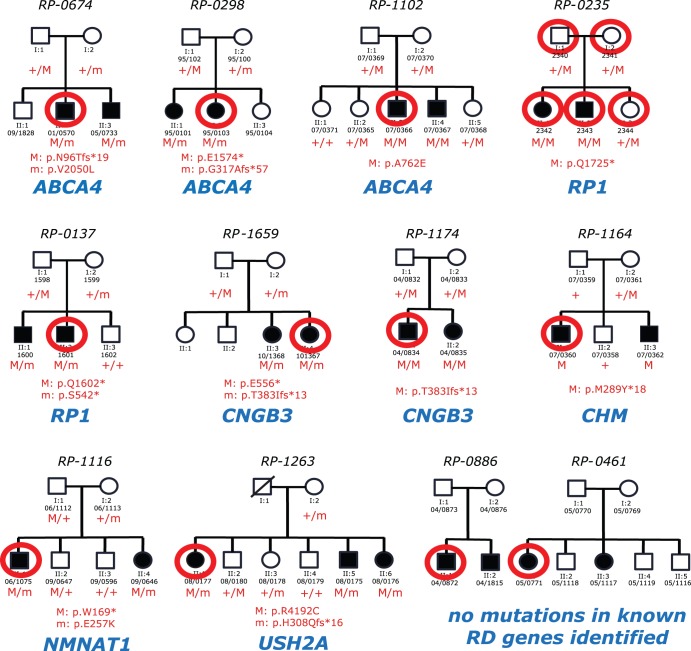
METHODOLOGY/PRINCIPAL FINDINGS: We ascertained 12 Spanish families with seemingly recessive RD. All of the index patients underwent mutational pre-screening by chip-based sequence hybridization and resulted to be negative for known RD mutations. With the exception of one pedigree, to simulate a standard diagnostic scenario we processed by WES only the DNA from the index patient of each family, followed by in silico data analysis. We successfully identified causative mutations in patients from 10 different families, which were later verified by Sanger sequencing and co-segregation analyses. Specifically, we detected pathogenic DNA variants (∼50% novel mutations) in the genes RP1, USH2A, CNGB3, NMNAT1, CHM, and ABCA4, responsible for retinitis pigmentosa, Usher syndrome, achromatopsia, Leber congenital amaurosis, choroideremia, or recessive Stargardt/cone-rod dystrophy cases.
CONCLUSIONS/SIGNIFICANCE: Despite the absence of genetic information from other family members that could help excluding nonpathogenic DNA variants, we could detect causative mutations in a variety of genes known to represent a wide spectrum of clinical phenotypes in 83% of the patients analyzed. Considering the constant drop in costs for human exome sequencing and the relative simplicity of the analyses made, this technique could represent a valuable tool for molecular diagnostics or genetic research, even in cases for which no genotypes from family members are available.
视网膜营养不良(RD)是一组遗传性疾病,导致严重的视力障碍,通常作为孟德尔特征遗传。迄今为止,已经确定了 100 多种疾病基因中的致病性突变可能发生在任何一种基因中,这使得分子诊断成为一项相当繁琐的工作。在这项工作中,我们探索了全外显子组测序(WES)作为识别 RD 突变的工具,旨在评估其在诊断中的适用性。
方法/主要发现:我们确定了 12 个具有明显隐性 RD 的西班牙家族。所有索引患者均通过基于芯片的序列杂交进行突变预筛选,结果为阴性,无已知 RD 突变。除了一个家族外,为了模拟标准的诊断情况,我们仅对每个家族的索引患者的 DNA 进行 WES 处理,然后进行计算机数据分析。我们成功地在 10 个不同家族的患者中鉴定出了致病突变,这些突变后来通过 Sanger 测序和共分离分析得到了验证。具体来说,我们在 RP1、USH2A、CNGB3、NMNAT1、CHM 和 ABCA4 基因中检测到致病性 DNA 变异(约 50%为新突变),这些基因分别导致视网膜色素变性、Usher 综合征、色盲、先天性黑蒙性视神经病、脉络膜视网膜变性或隐性斯塔加德特/视锥-视杆营养不良。
结论/意义:尽管缺乏其他家庭成员的遗传信息,无法排除非致病性 DNA 变异,但我们能够在 83%的分析患者中检测到已知代表广泛临床表型的多种基因的致病突变。考虑到人类外显子组测序成本的不断下降和分析的相对简单性,即使在没有家庭成员基因型的情况下,该技术也可能成为分子诊断或遗传研究的有价值工具。