AIDS Clinical Center, National Center for Global Health and Medicine, Tokyo, Japan.
PLoS One. 2013 Aug 5;8(8):e70611. doi: 10.1371/journal.pone.0070611. Print 2013.
Based on drug-drug interaction, dose reduction of rifabutin is recommended when co-administered with HIV protease inhibitors for human immunodeficiency virus (HIV)-associated mycobacterial infection. The aim of this study was to compare the pharmacokinetics of rifabutin administered at 300 mg/day alone to that at 150 mg every other day combined with lopinavir-ritonavir in Japanese patients with HIV/mycobacterium co-infection.
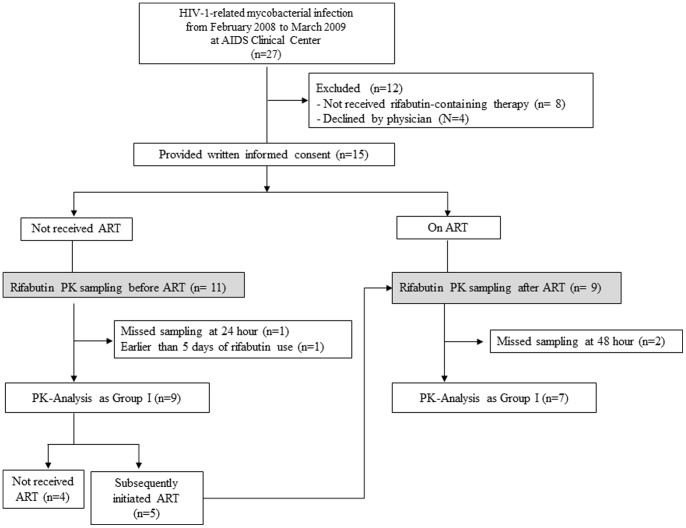
Plasma concentrations of rifabutin and its biologically active metabolite, 25-O-desacetyl rifabutin were measured in 16 cases with HIV-mycobacterial coinfection. Nine were treated with 300 mg/day rifabutin and 7 with 150 mg rifabutin every other day combined with lopinavir-ritonavir antiretroviral therapy (ART). Samples were collected at a median of 15 days (range, 5-63) of rifabutin use.
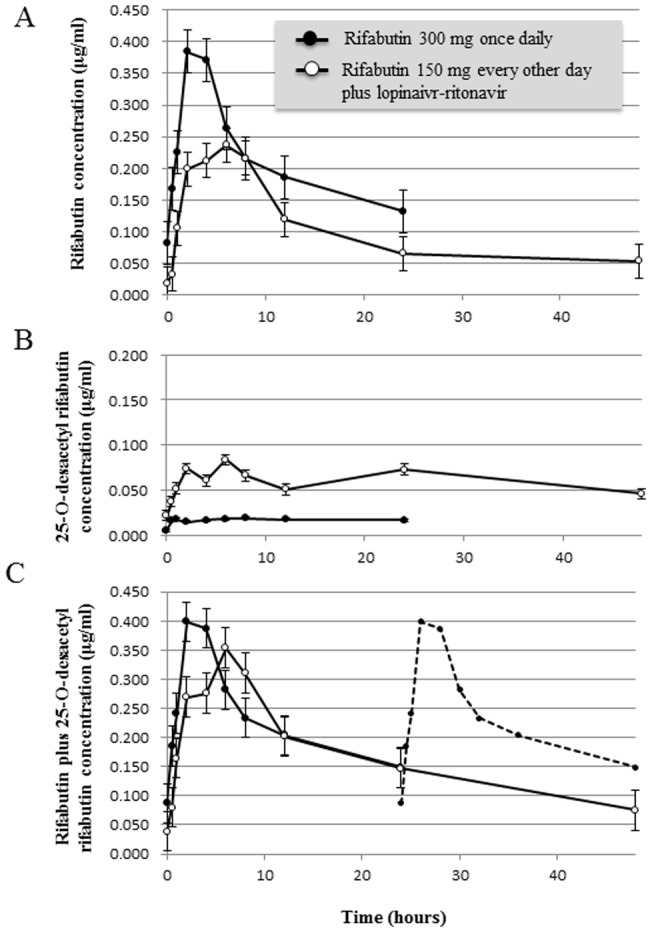
The mean Cmax and AUC0-24 of rifabutin in patients on rifabutin 150 mg every other day were 36% and 26% lower than on 300 mg/day rifabutin, while the mean Cmax and AUC0-24 of 25-O-desacetyl rifabutin were 186% and 152% higher, respectively. The plasma concentrations of rifabutin plus its metabolite were similar between the groups within the first 24 hours, but it remained low during subsequent 24 to 48 hours under rifabutin 150 mg alternate day dosing.
Rifabutin dose of 150 mg every other day combined with lopinavir-ritonavir seems to be associated with lower exposure to rifabutin and its metabolite compared with rifabutin 300 mg/day alone in Japanese patients. Further studies are needed to establish the optimal rifabutin dose during ART. The results highlight the importance of monitoring rifabutin plasma concentration during ART.
UMIN-CTR (https://upload.umin.ac.jp/cgi-open-bin/ctr/ctr.cgi?function=search&action=input&language=E) UMIN000001102.
基于药物相互作用,当利福布汀与 HIV 蛋白酶抑制剂联合用于治疗人类免疫缺陷病毒(HIV)相关分枝杆菌感染时,建议减少利福布汀的剂量。本研究旨在比较利福布汀 300mg/天单药治疗与利福布汀 150mg 每两天一次联合洛匹那韦/利托那韦治疗日本 HIV/分枝杆菌合并感染患者的药代动力学。
16 例 HIV-分枝杆菌合并感染患者接受利福布汀治疗。其中 9 例接受利福布汀 300mg/天治疗,7 例接受利福布汀 150mg 每两天一次联合洛匹那韦/利托那韦抗逆转录病毒治疗(ART)。在利福布汀使用的中位数为 15 天(范围为 5-63 天)时采集样本。
利福布汀 150mg 每两天一次组的利福布汀 Cmax 和 AUC0-24 分别为 300mg/天组的 36%和 26%,而 25-O-去乙酰基利福布汀的 Cmax 和 AUC0-24 分别为 186%和 152%。两组在前 24 小时内利福布汀及其代谢物的血浆浓度相似,但在利福布汀 150mg 每两天一次给药后 24 至 48 小时内,利福布汀及其代谢物的浓度仍然较低。
与利福布汀 300mg/天单药治疗相比,利福布汀 150mg 每两天一次联合洛匹那韦/利托那韦似乎与日本患者利福布汀及其代谢物的暴露量较低相关。需要进一步研究来确定 ART 期间利福布汀的最佳剂量。研究结果强调了在 ART 期间监测利福布汀血浆浓度的重要性。