School of Mathematics and Statistics, University of Sydney, Sydney, NSW, Australia.
J Math Neurosci. 2013 Aug 14;3(1):12. doi: 10.1186/2190-8567-3-12.
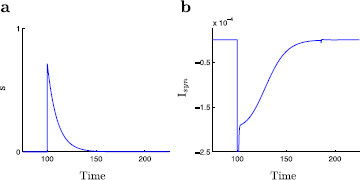
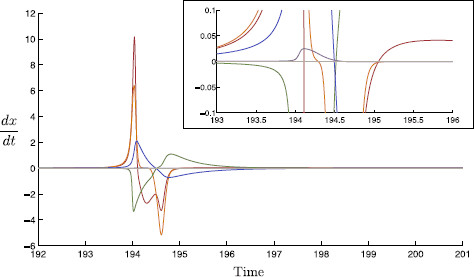
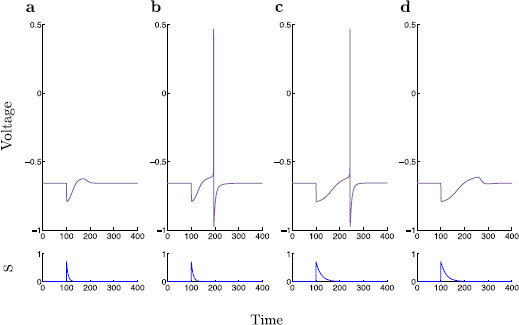
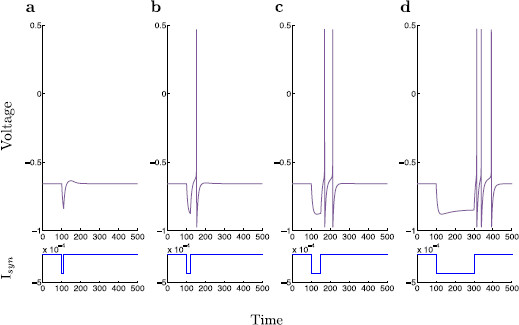
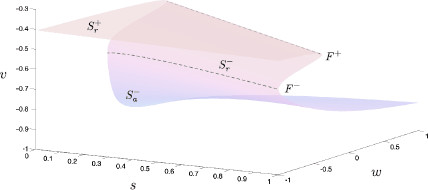
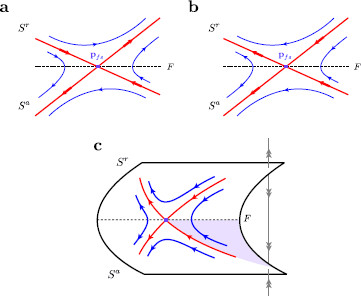
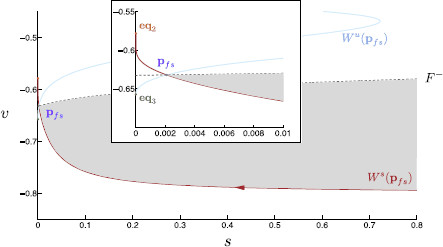
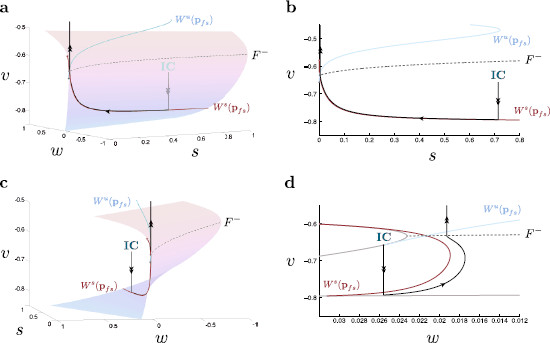
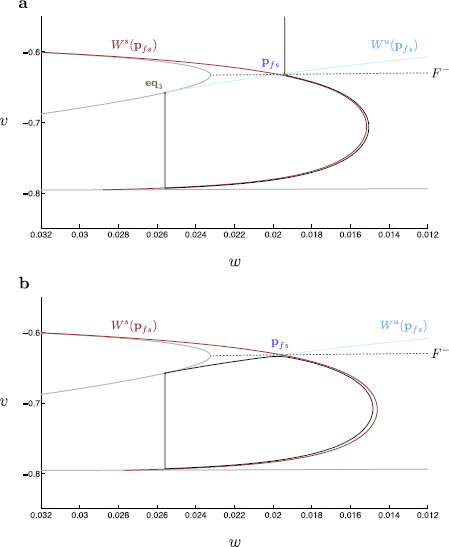
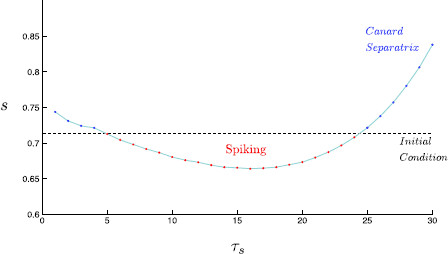
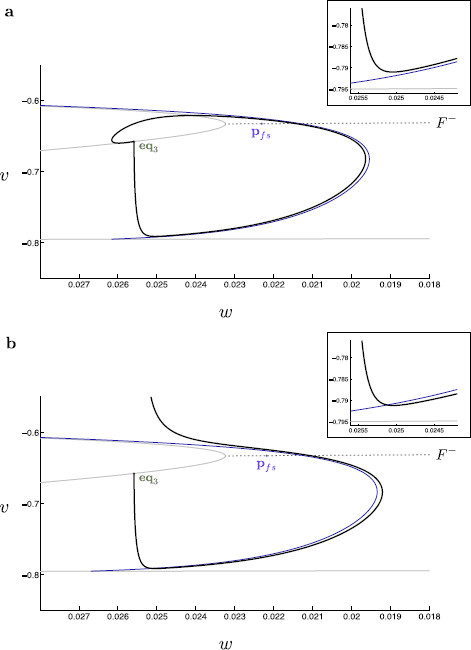
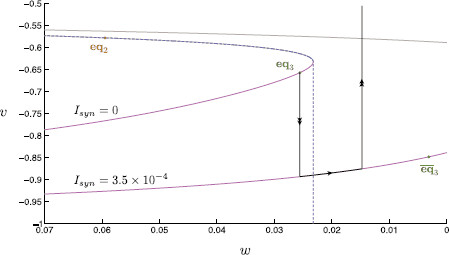
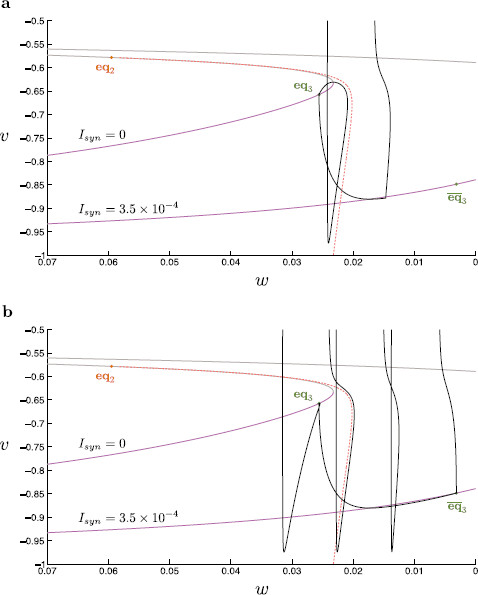
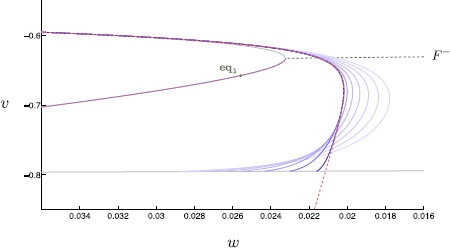
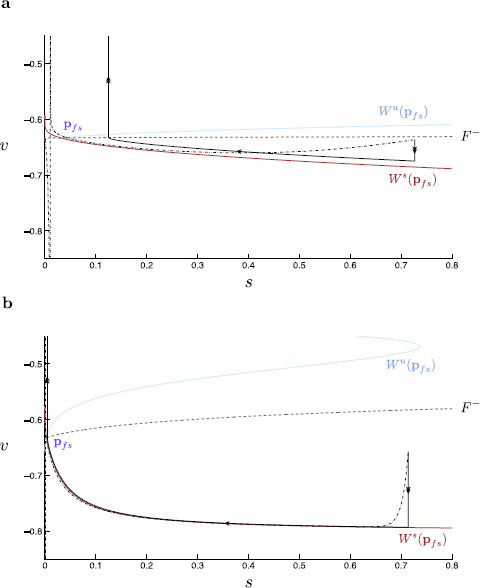
We investigate firing threshold manifolds in a mathematical model of an excitable neuron. The model analyzed investigates the phenomenon of post-inhibitory rebound spiking due to propofol anesthesia and is adapted from McCarthy et al. (SIAM J. Appl. Dyn. Syst. 11(4):1674-1697, 2012). Propofol modulates the decay time-scale of an inhibitory GABAa synaptic current. Interestingly, this system gives rise to rebound spiking within a specific range of propofol doses. Using techniques from geometric singular perturbation theory, we identify geometric structures, known as canards of folded saddle-type, which form the firing threshold manifolds. We find that the position and orientation of the canard separatrix is propofol dependent. Thus, the speeds of relevant slow synaptic processes are encoded within this geometric structure. We show that this behavior cannot be understood using a static, inhibitory current step protocol, which can provide a single threshold for rebound spiking but cannot explain the observed cessation of spiking for higher propofol doses. We then compare the analyses of dynamic and static synaptic inhibition, showing how the firing threshold manifolds of each relate, and why a current step approach is unable to fully capture the behavior of this model.
我们研究了兴奋神经元数学模型中的点火阈值流形。所分析的模型研究了异丙酚麻醉引起的后抑制反弹尖峰现象,改编自 McCarthy 等人(SIAM J. Appl. Dyn. Syst. 11(4):1674-1697, 2012)。异丙酚调节抑制性 GABAa 突触电流的衰减时间尺度。有趣的是,在特定的异丙酚剂量范围内,该系统会引发反弹尖峰。我们使用几何奇异摄动理论的技术,确定了点火阈值流形的几何结构,即折叠鞍型的拟轨。我们发现,拟轨分岔的位置和方向与异丙酚有关。因此,相关慢突触过程的速度被编码在这个几何结构中。我们表明,使用静态抑制电流阶跃方案无法理解这种行为,该方案可以为反弹尖峰提供单个阈值,但不能解释观察到的较高异丙酚剂量下尖峰停止的现象。然后,我们比较了动态和静态突触抑制的分析,展示了每个的点火阈值流形如何相关,以及为什么电流阶跃方法无法完全捕获该模型的行为。