Jo Kyung-Wook, Hong Yoonki, Park Jae Seuk, Bae In-Gyu, Eom Joong Sik, Lee Sang-Rok, Cho Oh-Hyun, Choo Eun Ju, Heo Jung Yeon, Woo Jun Hee, Shim Tae Sun
Division of Pulmonary and Critical Care Medicine, Asan Medical Center, University of Ulsan College of Medicine, Seoul, Korea.
Tuberc Respir Dis (Seoul). 2013 Jul;75(1):18-24. doi: 10.4046/trd.2013.75.1.18. Epub 2013 Jul 31.
We investigated the prevalence of latent tuberculosis infection (LTBI) among the health care workers (HCWs) and analyzed its risk factors in South Korea.
A standard questionnaire regarding the baseline demographics and risk factors for LTBI was given to each participant and tuberculin skin test (TST), QuantiFERON-TB GOLD In-Tube (QFT-GIT) assay, and chest radiography were performed.
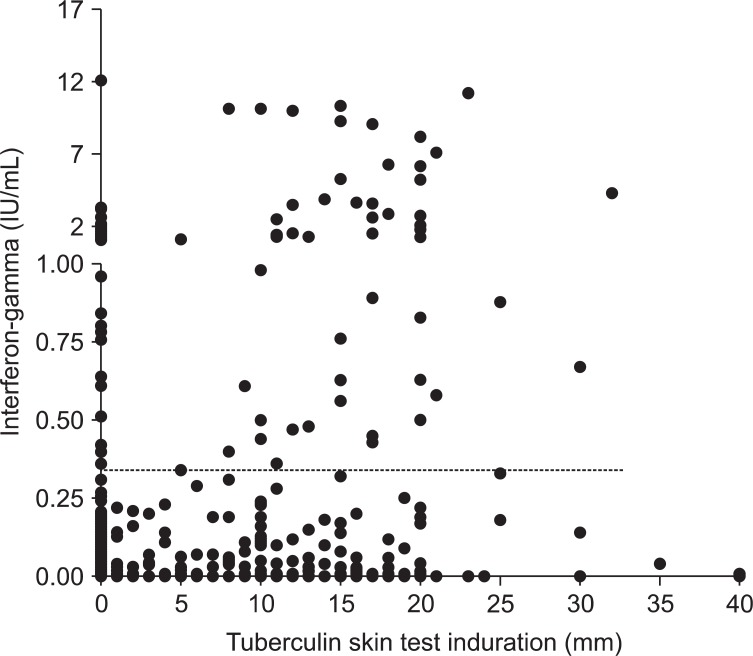
A total of 493 participants, 152 (30.8%) doctors and 341 (69.2%) nurses were enrolled in eight tertiary referral hospitals. The mean age of the subjects was 30.6 years old, and 383 (77.7%) were female. Of the 152 doctors, 63 (41.4%) and 36 (23.7%) were positive by TST and by QTF-GIT, respectively, and among the 341 nurses, 119 (34.9%) and 49 (14.4%) had positive TST and QFT-GIT results, respectively. Overall, the agreement between the two tests was 0.22 by the chance corrected proportional agreement rate (kappa coefficient) in 493 subjects. Experience of working in tuberculosis (TB)-related departments was significantly associated with positive LTBI test results by QFT-GIT assay, not by TST. In multivariate analysis, only age was independently associated with increased risk of a positive TST result, while age and experience of working in TB-related departments (odds ratio, 2.29; 95% confidence interval, 1.01-5.12) were independently associated with increased risk of a positive QFT-GIT result.
A high prevalence of LTBI was found among South Korean HCWs. Considering the association between the experience of working in TB-related departments and high risk of LTBI, QFT-GIT may be a better diagnostic test for LTBI than TST in HCWs.
我们调查了韩国医护人员中潜伏性结核感染(LTBI)的患病率,并分析了其危险因素。
向每位参与者发放一份关于LTBI基线人口统计学和危险因素的标准问卷,并进行结核菌素皮肤试验(TST)、全血γ干扰素释放试验(QFT-GIT)检测及胸部X线检查。
八家三级转诊医院共纳入493名参与者,其中医生152名(30.8%),护士341名(69.2%)。受试者的平均年龄为30.6岁,女性383名(77.7%)。152名医生中,TST和QFT-GIT检测阳性者分别为63名(41.4%)和36名(23.7%);341名护士中,TST和QFT-GIT检测阳性者分别为119名(34.9%)和49名(14.4%)。总体而言,在493名受试者中,两种检测方法的一致性经校正机遇比例一致率(kappa系数)为0.22。在结核病(TB)相关科室工作的经历与QFT-GIT检测LTBI阳性结果显著相关,而与TST无关。多因素分析显示,只有年龄与TST阳性结果风险增加独立相关,而年龄和在TB相关科室工作的经历(比值比,2.29;95%置信区间,1.01 - 5.12)与QFT-GIT阳性结果风险增加独立相关。
韩国医护人员中LTBI患病率较高。考虑到在TB相关科室工作的经历与LTBI高风险之间的关联,对于医护人员,QFT-GIT可能是比TST更好的LTBI诊断检测方法。