Zhang Yalei, Yang Haihong, Liu Jun, Deng Qiuhua, He Ping, Lin Yunen, Jiang Juhong, Gu Xia, Mo Mingcong, Pan Hui, Xiong Xinguo, Qiu Yuan, He Jianxing
Southern Medical University, Guangzhou, Guandong 510515; ; Department of Cardiothoracic Surgery, The First Affiliated Hospital of Guangzhou Medical College, Guangzhou, Guandong 510120;
Oncol Lett. 2013 Jul;6(1):220-226. doi: 10.3892/ol.2013.1323. Epub 2013 Apr 29.
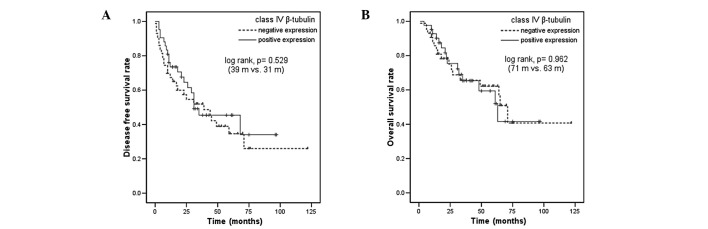
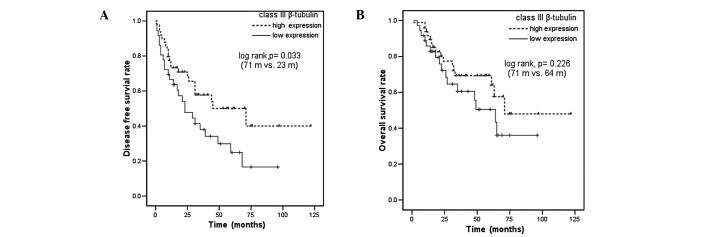
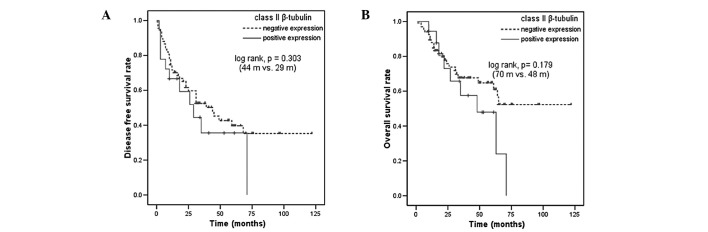
The aim of the present study was to determine the frequency and predictive value of the expression of tumor microtubule components in patients with resected non-small cell lung cancer (R-NSCLC) subsequently treated with vinorelbine-based adjuvant chemotherapy. The expression of the microtubule components was evaluated in 85 R-NSCLC tumor samples using immunohistochemistry. All patients received vinorelbine-based chemotherapy. The predictive value of microtubule protein expression for disease-free survival (DFS) and overall survival (OS) was assessed. The expression of the microtubule components was not associated with any baseline clinicopathological factors in the R-NSCLC patients. High tumor expression levels of class III β-tubulin were correlated with an improved DFS (P=0.033) and a trend towards a longer OS (P=0.226). Class II and IV β-tubulins were not correlated with patient outcome. Multivariate analysis of factors, including gender, age, histology, stage and class II, III and IV β-tubulin expression demonstrated that high levels of class III β-tubulin expression were correlated independently with DFS (P= 0.031). These findings suggest that high class III β-tubulin expression levels in resected tumors are predictive of improved DFS in R-NSCLC patients receiving vinorelbine-based chemotherapy.
本研究的目的是确定接受长春瑞滨辅助化疗的非小细胞肺癌(R-NSCLC)患者肿瘤微管成分表达的频率和预测价值。使用免疫组织化学方法在85例R-NSCLC肿瘤样本中评估微管成分的表达。所有患者均接受长春瑞滨化疗。评估微管蛋白表达对无病生存期(DFS)和总生存期(OS)的预测价值。微管成分的表达与R-NSCLC患者的任何基线临床病理因素均无关。III类β-微管蛋白的高肿瘤表达水平与改善的DFS相关(P=0.033),并且有OS延长的趋势(P=0.226)。II类和IV类β-微管蛋白与患者预后无关。对包括性别、年龄、组织学、分期以及II类、III类和IV类β-微管蛋白表达在内的因素进行多变量分析表明,高水平的III类β-微管蛋白表达与DFS独立相关(P=0.031)。这些发现表明,在接受长春瑞滨化疗的R-NSCLC患者中,切除肿瘤中高水平的III类β-微管蛋白表达可预测DFS改善。