Department of Global Health and Population, Harvard School of Public Health, Boston, MA 02120, USA.
J Int AIDS Soc. 2013 Aug 13;16(1):18022. doi: 10.7448/IAS.16.1.18022.
Anaemia is prevalent among children born to HIV-positive women, and it is associated with adverse effects on cognitive and motor development, growth, and increased risks of morbidity and mortality.
To examine the effect of daily multivitamin supplementation on haematologic status and mother-to-child transmission (MTCT) of HIV through breastfeeding.
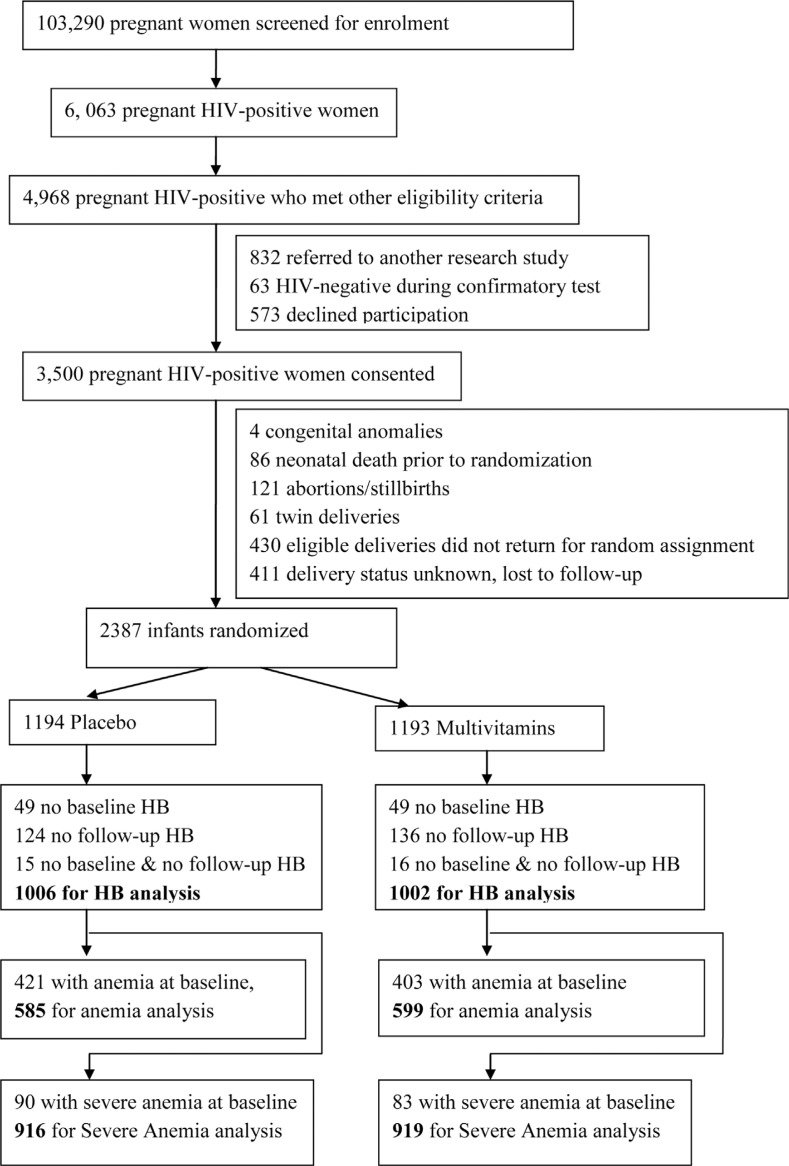
A total of 2387 infants born to HIV-positive women from Dar es Salaam, Tanzania were enrolled in a randomized, double-blind, placebo-controlled trial, and provided a daily oral supplement of multivitamins (vitamin B complex, C and E) or placebo at age 6 weeks for 24 months. Among them, 2008 infants provided blood samples and had haemoglobin concentrations measured at baseline and during a follow-up period. Anaemia was defined as haemoglobin concentrations <11 g/dL and severe anaemia <8.5 g/dL.
Haemoglobin concentrations among children in the treatment group were significantly higher than those in the placebo group at 12 (9.77 vs. 9.64 g/dL, p=0.03), 18 (9.76 vs. 9.57 g/dL, p=0.004), and 24 months (9.93 vs. 9.75 g/dL, p=0.02) of follow-up. Compared to those in the placebo group, children in the treatment group had a 12% lower risk of anaemia (hazard ratio (HR): 0.88; 95% CI: 0.79-0.99; p=0.03). The treatment was associated with a 28% reduced risk of severe anaemia among children born to women without anaemia (HR: 0.72; 95% CI: 0.56-0.92; p=0.008), but not among those born to women with anaemia (HR: 1.10; 95% CI: 0.79-1.54; p=0.57; p for interaction=0.007). One thousand seven hundred fifty three infants who tested HIV-negative at baseline and had HIV testing during follow-up were included in the analysis for MTCT of HIV. No association was found between multivitamin supplements and MTCT of HIV.
Multivitamin supplements improve haematologic status among children born to HIV-positive women. Further trials focusing on anaemia among HIV-exposed children are warranted in the context of antiretroviral therapy.
艾滋病毒阳性妇女所生的儿童中普遍存在贫血,贫血会对认知和运动发育、生长产生不利影响,并增加发病和死亡风险。
研究每日补充多种维生素对通过母乳喂养母婴传播艾滋病毒(HIV)和血液状况的影响。
坦桑尼亚达累斯萨拉姆的 2387 名艾滋病毒阳性妇女所生的婴儿参与了一项随机、双盲、安慰剂对照试验,这些婴儿在 6 周龄时每天口服补充多种维生素(维生素 B 复合物、C 和 E)或安慰剂,持续 24 个月。其中 2008 名婴儿提供了血液样本,并在基线和随访期间测量了血红蛋白浓度。贫血定义为血红蛋白浓度<11g/dL,严重贫血<8.5g/dL。
治疗组儿童的血红蛋白浓度在 12 个月(9.77 比 9.64g/dL,p=0.03)、18 个月(9.76 比 9.57g/dL,p=0.004)和 24 个月(9.93 比 9.75g/dL,p=0.02)时明显高于安慰剂组。与安慰剂组相比,治疗组儿童贫血的风险降低了 12%(风险比(HR):0.88;95%CI:0.79-0.99;p=0.03)。该治疗方法与不贫血的妇女所生儿童的严重贫血风险降低 28%相关(HR:0.72;95%CI:0.56-0.92;p=0.008),但与贫血妇女所生儿童的严重贫血风险无关联(HR:1.10;95%CI:0.79-1.54;p=0.57;p 交互=0.007)。在基线时 HIV 检测为阴性且在随访期间进行了 HIV 检测的 1753 名婴儿被纳入 HIV 母婴传播分析。未发现多种维生素补充剂与 HIV 母婴传播之间存在关联。
多种维生素补充剂可改善 HIV 阳性妇女所生儿童的血液状况。在抗逆转录病毒治疗背景下,有必要针对 HIV 暴露儿童的贫血开展进一步的试验。