Center of Functionally Integrative Neuroscience, Institute for Clinical Medicine, Aarhus University Aarhus, Denmark ; Centre for Languages and Literature, Lund University Lund, Sweden ; Medical Research Council, Cognition and Brain Sciences Unit Cambridge, UK.
Front Hum Neurosci. 2013 Aug 9;7:421. doi: 10.3389/fnhum.2013.00421. eCollection 2013.
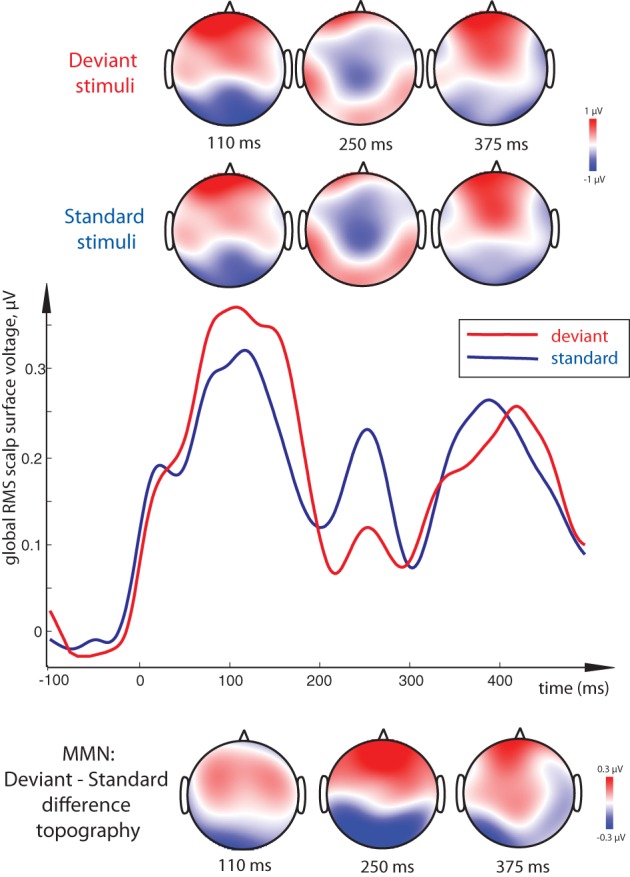
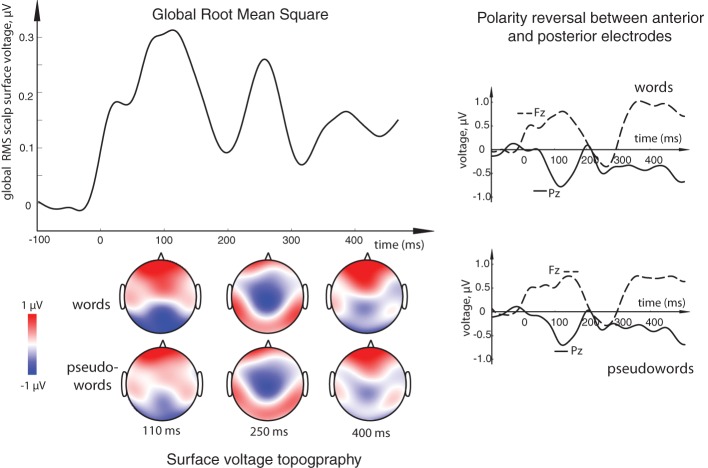
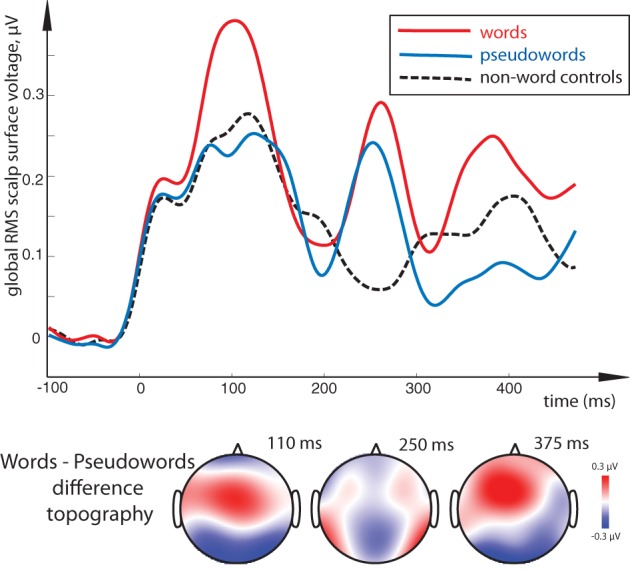
Previous electrophysiological studies of automatic language processing revealed early (100-200 ms) reflections of access to lexical characteristics of speech signal using the so-called mismatch negativity (MMN), a negative ERP deflection elicited by infrequent irregularities in unattended repetitive auditory stimulation. In those studies, lexical processing of spoken stimuli became manifest as an enhanced ERP in response to unattended real words, as opposed to phonologically matched but meaningless pseudoword stimuli. This lexical ERP enhancement was explained by automatic activation of word memory traces realized as distributed strongly intra-connected neuronal circuits, whose robustness guarantees memory trace activation even in the absence of attention on spoken input. Such an account would predict the automatic activation of these memory traces upon any presentation of linguistic information, irrespective of the presentation modality. As previous lexical MMN studies exclusively used auditory stimulation, we here adapted the lexical MMN paradigm to investigate early automatic lexical effects in the visual modality. In a visual oddball sequence, matched short word and pseudoword stimuli were presented tachistoscopically in perifoveal area outside the visual focus of attention, as the subjects' attention was concentrated on a concurrent non-linguistic visual dual task in the center of the screen. Using EEG, we found a visual analogue of the lexical ERP enhancement effect, with unattended written words producing larger brain response amplitudes than matched pseudowords, starting at ~100 ms. Furthermore, we also found significant visual MMN, reported here for the first time for unattended perifoveal lexical stimuli. The data suggest early automatic lexical processing of visually presented language which commences rapidly and can take place outside the focus of attention.
先前关于自动语言处理的电生理学研究表明,通过所谓的失匹配负波(MMN),可以在 100-200 毫秒的早期阶段反映出对语音信号的词汇特征的访问,失匹配负波是由未被注意的重复听觉刺激中的不频繁不规则性引起的负 ERP 偏移。在这些研究中,口语刺激的词汇处理表现为对未被注意的真实单词的 ERP 增强,而不是对语音匹配但无意义的伪单词刺激的 ERP 增强。这种词汇 ERP 增强可以通过单词记忆痕迹的自动激活来解释,这些记忆痕迹表现为分布强烈的内连接神经元回路,其稳健性保证了即使在没有注意口语输入的情况下,记忆痕迹也能被激活。这种解释预测了这些记忆痕迹会在任何语言信息呈现时自动激活,而与呈现模态无关。由于先前的词汇 MMN 研究仅使用听觉刺激,因此我们在此将词汇 MMN 范式改编为研究视觉模态中的早期自动词汇效应。在视觉异类序列中,匹配的短单词和伪单词刺激在周边区域以速示法呈现,而周边区域位于注意力焦点之外,同时,受试者的注意力集中在屏幕中心的并发非语言视觉双重任务上。使用 EEG,我们发现了视觉词汇增强效应的类似物,未被注意的书面单词比匹配的伪单词产生更大的大脑反应幅度,起始于约 100 毫秒。此外,我们还发现了显著的视觉 MMN,这是首次报道未被注意的周边词汇刺激的视觉 MMN。这些数据表明,视觉呈现的语言可以快速进行早期自动词汇处理,并且可以在注意力焦点之外进行。