Huang Zehao, Yang Shimeng, Xue Licheng, Yang Hang, Lv Yating, Zhao Jing
Jing Hengyi School of Education, Hangzhou Normal University, Hangzhou, China.
Zhejiang Key Laboratory for Research in Assessment of Cognitive Impairments, Hangzhou, China.
Front Neurosci. 2022 Feb 9;15:809574. doi: 10.3389/fnins.2021.809574. eCollection 2021.
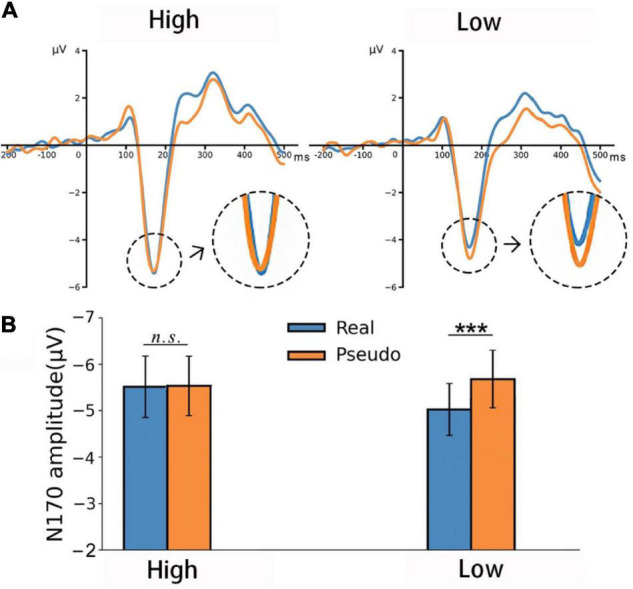
The brain generates predictions about visual word forms to support efficient reading. The "interactive account" suggests that the predictions in visual word processing can be strategic or automatic (non-strategic). Strategic predictions are frequently demonstrated in studies that manipulated task demands, however, few studies have investigated automatic predictions. Orthographic knowledge varies greatly among individuals and it offers a unique opportunity in revealing automatic predictions. The present study grouped the participants by level of orthographic knowledge and recorded EEGs in a non-linguistic color matching task. The visual word-selective N170 response was much stronger to pseudo than to real characters in participants with low orthographic knowledge, but not in those with high orthographic knowledge. Previous work on predictive coding has demonstrated that N170 is a good index for prediction errors, i.e., the mismatches between predictions and visual inputs. The present findings provide unambiguous evidence that automatic predictions modulate the early stage of visual word processing.
大脑生成关于视觉单词形式的预测以支持高效阅读。“交互账户”表明,视觉单词处理中的预测可以是策略性的或自动的(非策略性的)。策略性预测在操纵任务需求的研究中经常得到证明,然而,很少有研究调查自动预测。正字法知识在个体之间差异很大,它为揭示自动预测提供了独特的机会。本研究根据正字法知识水平对参与者进行分组,并在非语言颜色匹配任务中记录脑电图。在正字法知识水平较低的参与者中,视觉单词选择性N170对假字的反应比对真实字符的反应要强得多,但在正字法知识水平较高的参与者中并非如此。先前关于预测编码的研究表明,N170是预测误差的良好指标,即预测与视觉输入之间的不匹配。目前的研究结果提供了明确的证据,表明自动预测调节了视觉单词处理的早期阶段。