Wellcome Trust Centre for Human Genetics, University of Oxford, Oxford, United Kingdom.
PLoS One. 2013 Aug 7;8(8):e70735. doi: 10.1371/journal.pone.0070735. eCollection 2013.
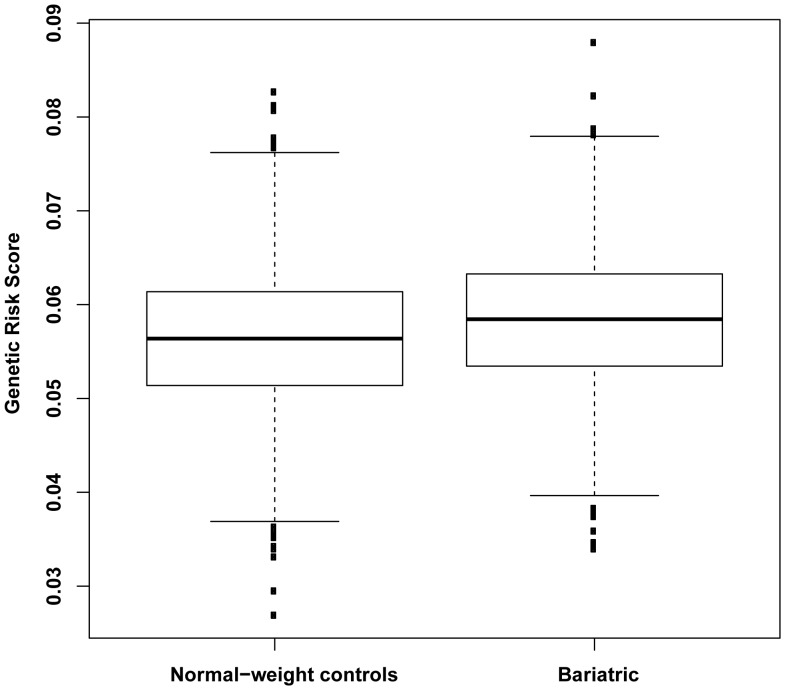
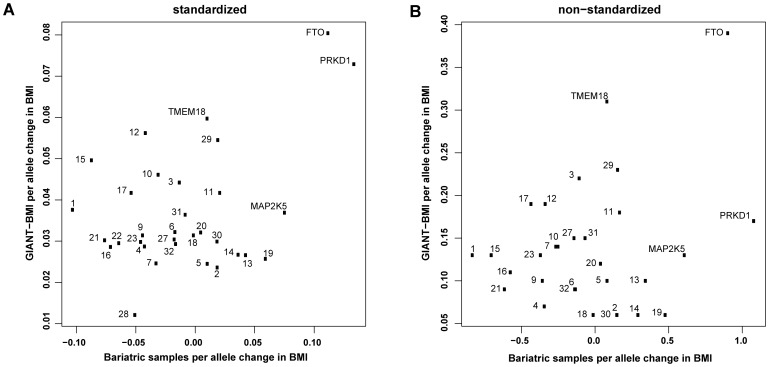
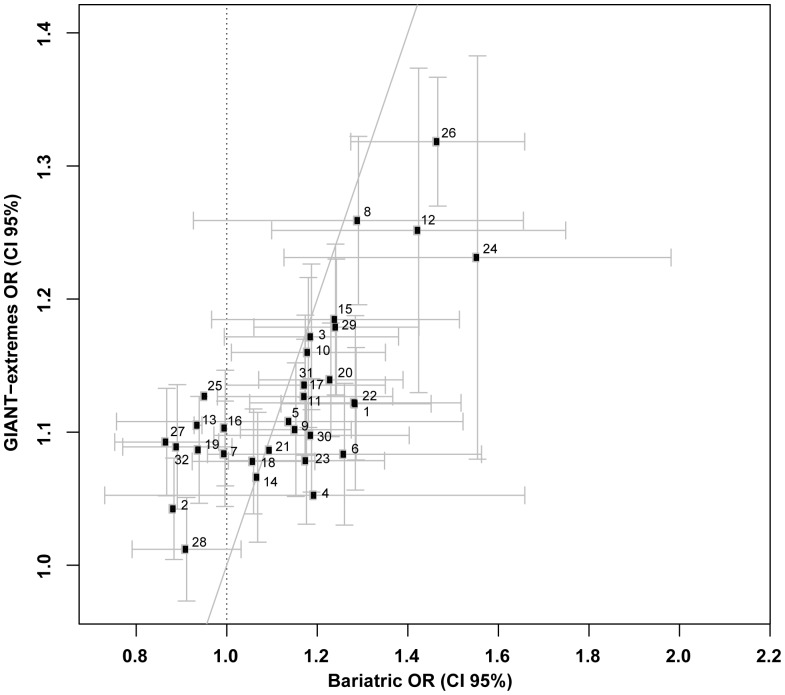
The prevalence of severe obesity, defined as body mass index (BMI) ≥ 35.0 kg/m(2), is rising rapidly. Given the disproportionately high health burden and healthcare costs associated with this condition, understanding the underlying aetiology, including predisposing genetic factors, is a biomedical research priority. Previous studies have suggested that severe obesity represents an extreme tail of the population BMI variation, reflecting shared genetic factors operating across the spectrum. Here, we sought to determine whether a panel of 32 known common obesity-susceptibility variants contribute to severe obesity in patients (n = 1,003, mean BMI 48.4 ± 8.1 kg/m(2)) attending bariatric surgery clinics in two European centres. We examined the effects of these 32 common variants on obesity risk and BMI, both as individual markers and in combination as a genetic risk score, in a comparison with normal-weight controls (n = 1,809, BMI 18.0-24.9 kg/m(2)); an approach which, to our knowledge, has not been previously undertaken in the setting of a bariatric clinic. We found strong associations with severe obesity for SNP rs9939609 within the FTO gene (P = 9.3 × 10(-8)) and SNP rs2815752 near the NEGR1 gene (P = 3.6 × 10(-4)), and directionally consistent nominal associations (P<0.05) for 12 other SNPs. The genetic risk score associated with severe obesity (P = 8.3 × 10(-11)) but, within the bariatric cohort, this score did not associate with BMI itself (P = 0.264). Our results show significant effects of individual BMI-associated common variants within a relatively small sample size of bariatric patients. Furthermore, the burden of such low-penetrant risk alleles contributes to severe obesity in this population. Our findings support that severe obesity observed in bariatric patients represents an extreme tail of the population BMI variation. Moreover, future genetic studies focused on bariatric patients may provide valuable insights into the pathogenesis of obesity at a population level.
严重肥胖的患病率正在迅速上升,其定义为体重指数(BMI)≥35.0kg/m²。鉴于这种疾病与不成比例的高健康负担和医疗保健费用相关,了解潜在病因,包括易患的遗传因素,是生物医学研究的重点。先前的研究表明,严重肥胖代表人群 BMI 变异的极端尾部,反映了在整个范围内起作用的共同遗传因素。在这里,我们试图确定一组 32 个已知的常见肥胖易感性变异是否会导致在两个欧洲中心的减肥手术诊所就诊的患者(n=1003,平均 BMI 为 48.4±8.1kg/m²)中出现严重肥胖。我们检查了这些 32 个常见变异在肥胖风险和 BMI 中的作用,无论是作为个体标志物还是作为遗传风险评分进行组合,与正常体重对照组(n=1809,BMI 为 18.0-24.9kg/m²)进行比较;据我们所知,这种方法以前在减肥诊所中没有进行过。我们发现 SNP rs9939609 在 FTO 基因内与严重肥胖强烈相关(P=9.3×10(-8)),SNP rs2815752 在 NEGR1 基因附近与严重肥胖强烈相关(P=3.6×10(-4)),并且 12 个其他 SNP 具有方向一致的名义关联(P<0.05)。与严重肥胖相关的遗传风险评分(P=8.3×10(-11)),但在减肥队列中,该评分本身与 BMI 不相关(P=0.264)。我们的结果表明,在相对较小的减肥患者样本中,个体 BMI 相关常见变异具有显著影响。此外,这种低外显率风险等位基因的负担会导致该人群出现严重肥胖。我们的研究结果表明,在减肥患者中观察到的严重肥胖代表人群 BMI 变异的极端尾部。此外,专注于减肥患者的未来遗传研究可能会为人群肥胖的发病机制提供有价值的见解。