Duarte R F, Greinix H, Rabin B, Mitchell S A, Basak G, Wolff D, Madrigal J A, Pavletic S Z, Lee S J
Department of Hematology, Catalan Institute of Oncology-Hospital Duran I Reynals, Barcelona, Spain.
Department of Internal Medicine I, Bone Marrow Transplantation, Medical University of Vienna, Vienna, Austria.
Bone Marrow Transplant. 2014 Jan;49(1):49-54. doi: 10.1038/bmt.2013.129. Epub 2013 Aug 19.
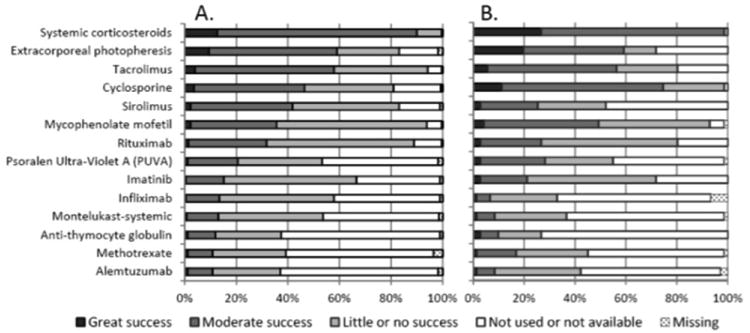
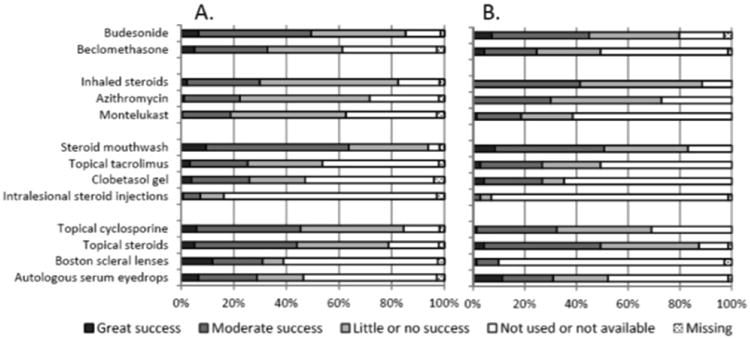
In 2005, the National Institutes of Health (NIH) consensus conference published a series of papers recommending methods to improve the conduct of clinical trials in chronic GVHD. Although the NIH recommendations were primarily aimed at strengthening research, several papers addressed issues relevant for clinical practice, particularly diagnosis, severity scoring, and ancillary and supportive care practices. We conducted an international survey to assess the uptake of these recommendations, identify barriers to greater use and document the use and perceived effectiveness of available treatments. The response rate for the American survey of 1387 practitioners was 21.8%, and it was 24.6% for 407 centers surveyed in Europe, Asia, Australia and Africa. Most respondents were familiar with the NIH consensus recommendations (94-96%) and used them in practice. Multiple barriers to greater use were reported. Besides lack of time (55-62%), unfamiliarity with the recommendations, scarcity of evidence supporting the impact of recommendations on outcomes, insufficient training/experience in chronic GVHD management and inaccessibility of subspecialists were also endorsed. Systemic corticosteroids were reported to be the most effective treatment for chronic GVHD, but many others were perceived to have moderate or great success. Therapeutic management of steroid-refractory chronic GVHD was identified as the highest priority for research.
2005年,美国国立卫生研究院(NIH)共识会议发表了一系列论文,推荐改善慢性移植物抗宿主病(GVHD)临床试验实施的方法。尽管NIH的建议主要旨在加强研究,但有几篇论文讨论了与临床实践相关的问题,特别是诊断、严重程度评分以及辅助和支持性护理实践。我们进行了一项国际调查,以评估这些建议的采纳情况,确定更多使用这些建议的障碍,并记录现有治疗方法的使用情况和感知到的有效性。美国对1387名从业者的调查回复率为21.8%,欧洲、亚洲、澳大利亚和非洲407个中心的调查回复率为24.6%。大多数受访者熟悉NIH共识建议(94 - 96%)并在实践中使用。报告了更多使用这些建议的多个障碍。除了时间不足(55 - 62%)外,不熟悉这些建议、缺乏支持建议对结果影响的证据、慢性GVHD管理方面的培训/经验不足以及难以获得专科医生的帮助也得到认可。据报告,全身皮质类固醇是治疗慢性GVHD最有效的方法,但许多其他方法也被认为有中度或很大的成功。难治性慢性GVHD的治疗管理被确定为研究的最高优先事项。