Replogle Rebecca A, Li Qiang, Wang Libo, Zhang Min, Fleet James C
Department of Nutrition Science, Purdue University, West Lafayette, IN, USA.
J Bone Miner Res. 2014 Mar;29(3):657-65. doi: 10.1002/jbmr.2065.
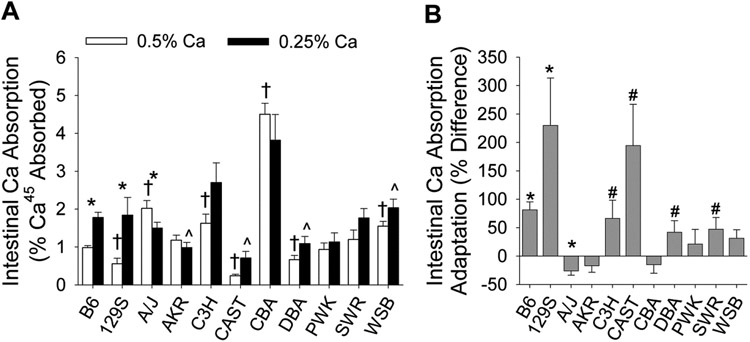
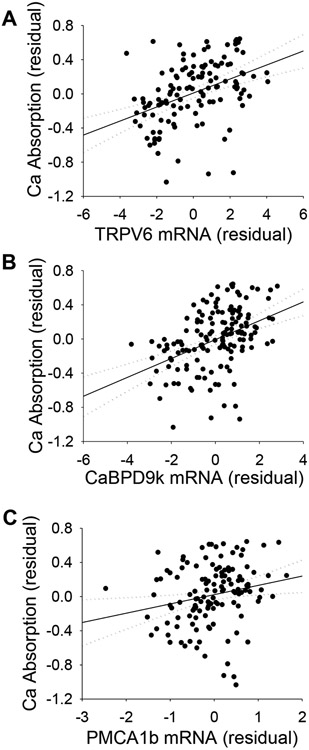
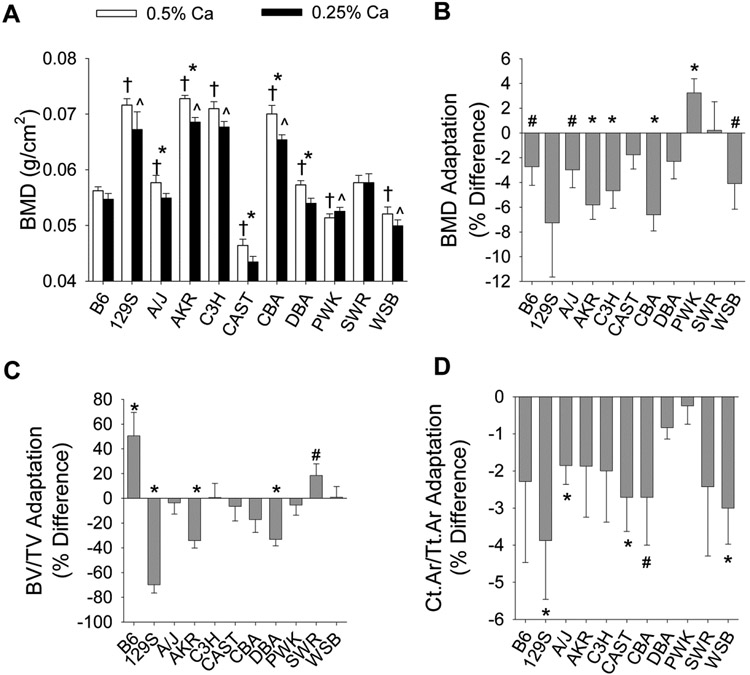
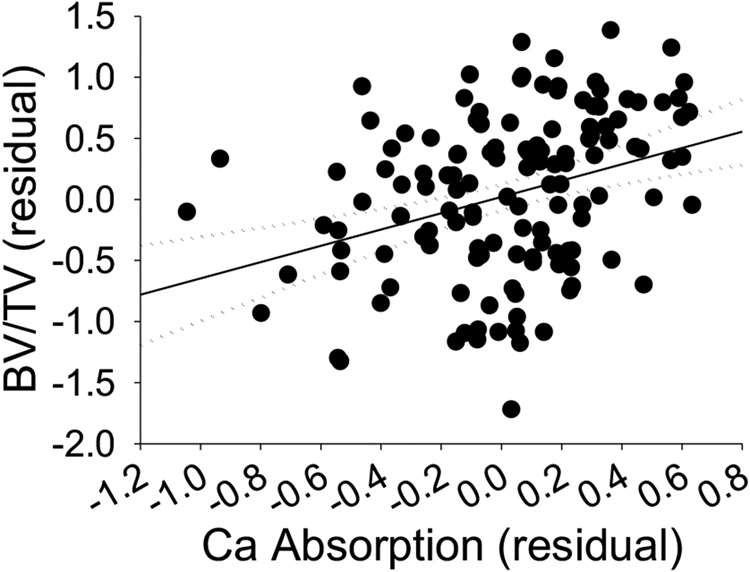
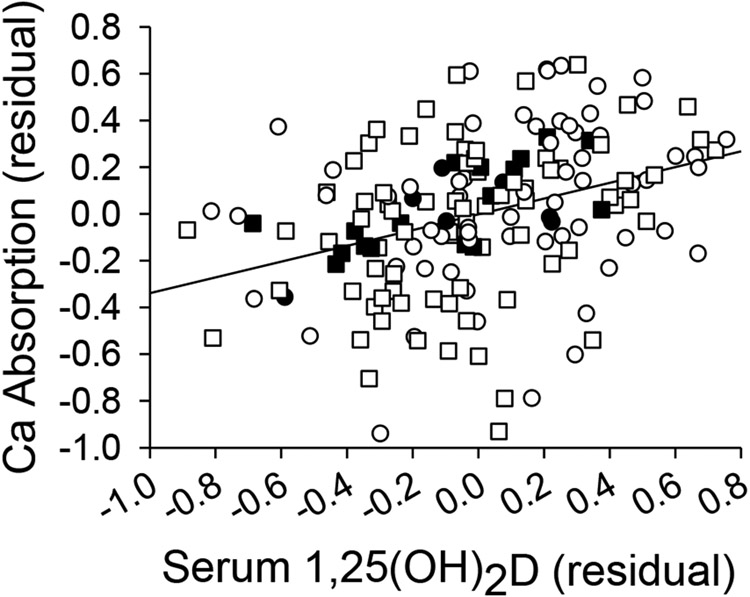
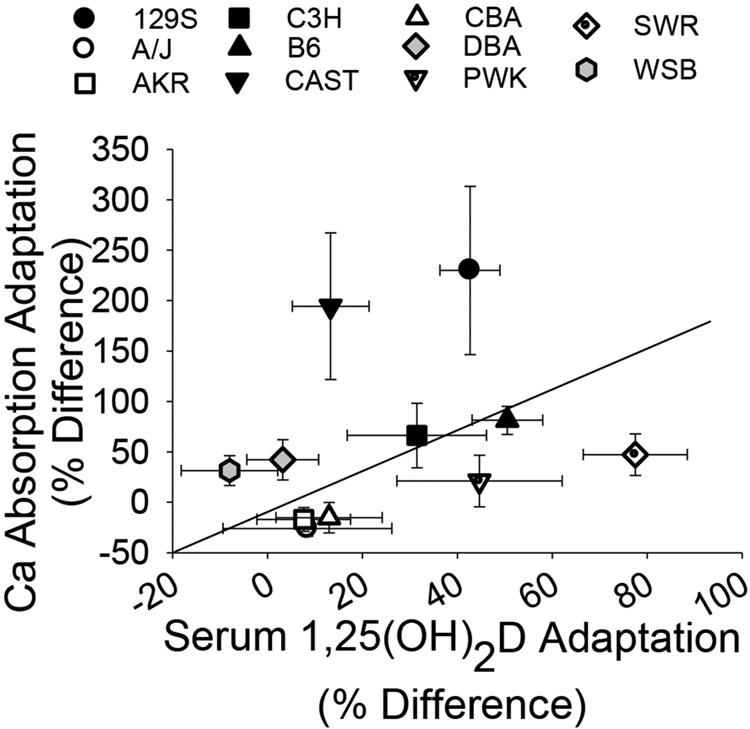
Dietary calcium (Ca) intake is needed to attain peak bone mineral density (BMD). Habitual low Ca intake increases intestinal Ca absorption efficiency to protect bone mass, but the mechanism controlling, and the impact of genetics on, this adaptive response is not clear. We fed 11 genetically diverse inbred mouse lines a normal (0.5%) or low (0.25%) Ca diet from 4 to 12 weeks of age (n = 8 per diet per line) and studied the independent and interacting effects of diet and genetics on Ca and bone metabolism. Significant genetic variation was observed in all bone, renal, and intestinal phenotypes measured including Ca absorption. Also, adaptation of Ca absorption and bone parameters to low dietary Ca was significantly different among the lines. Ca absorption was positively correlated to femur BMD (r = 0.17, p = 0.02), and distal femur bone volume/tissue volume (BV/TV) (r = 0.34, p < 0.0001). Although Ca absorption was correlated to 1,25 dihydroxyvitamin D (1,25(OH)2 D) (r = 0.35, p < 0.0001), the adaptation of Ca absorption to low Ca intake did not correlate to diet-induced adaptation of 1,25(OH)2 D across the 11 lines. Several intestinal proteins have been proposed to mediate Ca absorption: claudins 2 and 12, voltage gated Ca channel v1.3 (Cav1.3), plasma membrane Ca ATPase 1b (PMCA1b), transient receptor potential vanilloid member 6 (TRPV6), and calbindin D9k (CaBPD9k). Only the mRNA levels for TRPV6, CaBPD9k, and PMCA1b were related to Ca absorption (r = 0.42, 0.43, and 0.21, respectively). However, a significant amount of the variation in Ca absorption is not explained by the current model and suggests that novel mechanisms remain to be determined. These observations lay the groundwork for discovery-focused initiatives to identify novel genetic factors controlling gene-by-diet interactions affecting Ca/bone metabolism.
需要通过膳食钙(Ca)摄入来达到峰值骨矿物质密度(BMD)。习惯性低钙摄入会提高肠道钙吸收效率以保护骨量,但控制这种适应性反应的机制以及遗传学对其的影响尚不清楚。我们从4至12周龄开始,给11个遗传背景不同的近交系小鼠喂食正常(0.5%)或低(0.25%)钙饮食(每个品系每种饮食n = 8只),并研究饮食和遗传学对钙及骨代谢的独立和相互作用影响。在所有测量的骨、肾和肠道表型(包括钙吸收)中均观察到显著的遗传变异。此外,各品系间钙吸收和骨参数对低钙饮食的适应性存在显著差异。钙吸收与股骨BMD呈正相关(r = 0.17,p = 0.02),与股骨远端骨体积/组织体积(BV/TV)呈正相关(r = 0.34,p < 0.0001)。虽然钙吸收与1,25 - 二羟基维生素D(1,25(OH)₂D)相关(r = 0.35,p < 0.0001),但在这11个品系中,钙吸收对低钙摄入的适应性与饮食诱导的1,25(OH)₂D适应性不相关。已有几种肠道蛋白被认为可介导钙吸收:紧密连接蛋白2和12、电压门控钙通道v1.3(Cav1.3)、质膜钙ATP酶1b(PMCA1b)、瞬时受体电位香草酸亚型6(TRPV6)和钙结合蛋白D9k(CaBPD9k)。只有TRPV6、CaBPD9k和PMCA1b的mRNA水平与钙吸收相关(分别为r = 0.42、0.43和0.21)。然而,当前模型无法解释大量的钙吸收变异,这表明仍有待确定新的机制。这些观察结果为以发现为重点的研究计划奠定了基础,以识别控制影响钙/骨代谢的基因 - 饮食相互作用的新遗传因素。