Sadeghi Neda, Prastawa Marcel, Fletcher P Thomas, Vachet Clement, Wang Bo, Gilmore John, Gerig Guido
Scientific Computing and Imaging Institute, University of Utah, Salt Lake City, Utah 84112.
Proc IEEE Int Symp Biomed Imaging. 2013:1400-1403. doi: 10.1109/ISBI.2013.6556795.
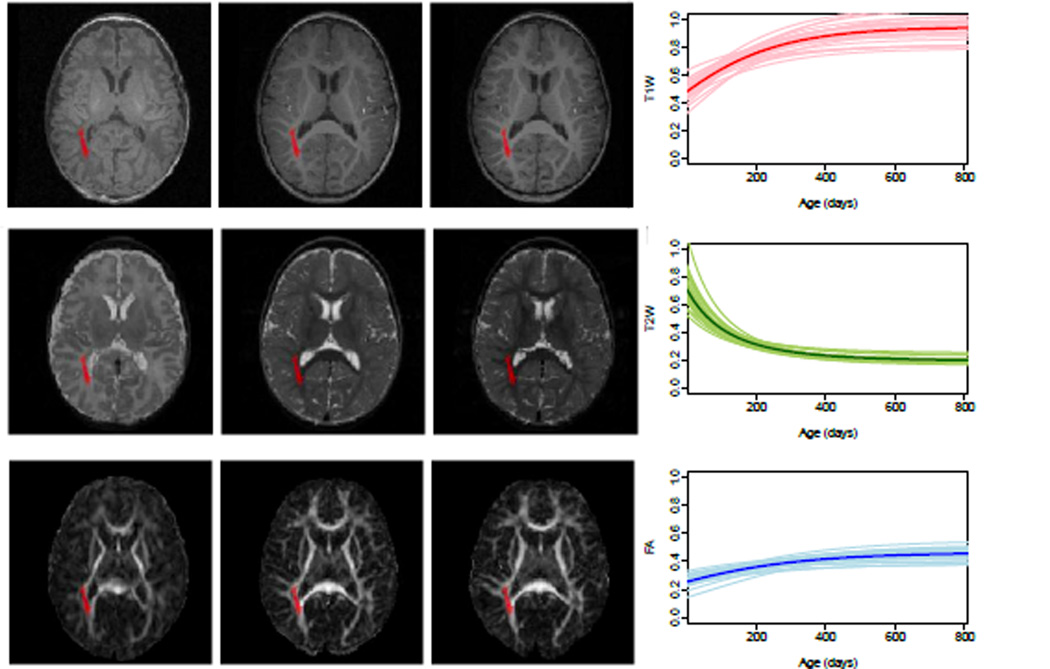
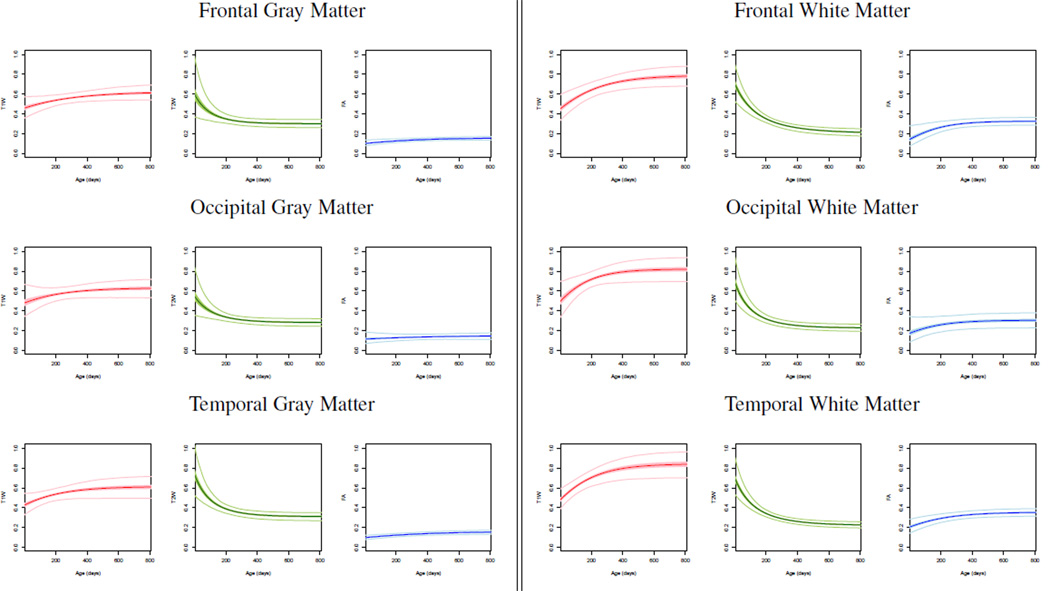
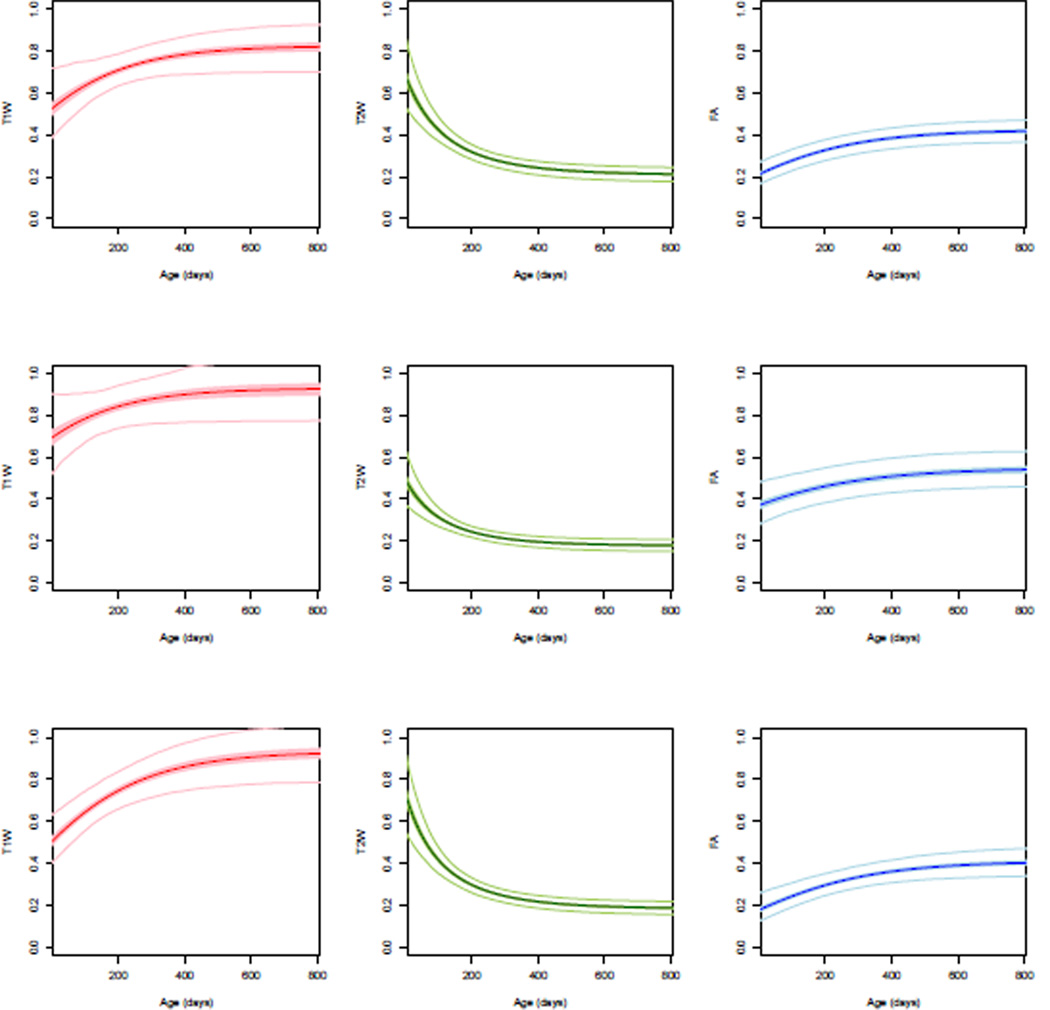
The human brain undergoes rapid organization and structuring early in life. Longitudinal imaging enables the study of these changes over a developmental period within individuals through estimation of population growth trajectory and its variability. In this paper, we focus on maturation of white and gray matter depicted in structural and diffusion MRI of healthy subjects with repeated scans. We provide a framework for joint analysis of both structural MRI and DTI (Diffusion Tensor Imaging) using multivariate nonlinear mixed effect modeling of temporal changes. Our framework constructs normative growth models for all the modalities, taking into account the correlation among the modalities and individuals, along with estimation of the variability of the population trends. We apply our method to study early brain development, and to our knowledge this is the first multimodel longitudinal modeling of diffusion and signal intensity changes for this growth stage. Results show the potential of our framework to study growth trajectories, as well as neurodevelopmental disorders through comparison against the constructed normative models of multimodal 4D MRI.
人类大脑在生命早期经历快速的组织和构建。纵向成像能够通过估计群体生长轨迹及其变异性,在个体的发育阶段研究这些变化。在本文中,我们聚焦于对健康受试者进行重复扫描的结构和扩散磁共振成像(MRI)中所描绘的白质和灰质的成熟过程。我们提供了一个框架,用于使用时间变化的多变量非线性混合效应模型对结构MRI和扩散张量成像(DTI)进行联合分析。我们的框架构建了所有模态的标准生长模型,同时考虑了模态之间以及个体之间的相关性,以及群体趋势变异性的估计。我们应用我们的方法来研究早期大脑发育,据我们所知,这是该生长阶段扩散和信号强度变化的首个多模型纵向建模。结果表明,我们的框架有潜力通过与构建的多模态4D MRI标准模型进行比较来研究生长轨迹以及神经发育障碍。