Department of Pediatrics, University of California, San Francisco, CA 94134-0136, USA.
BMC Nephrol. 2013 Aug 21;14:178. doi: 10.1186/1471-2369-14-178.
Hyperphosphatemia, serum phosphorus ≥ 4.4 mg/dL, is associated with increased risk for chronic kidney disease and cardiovascular disease. Previous studies have shown a weak association between dietary phosphorus intake and serum phosphorus concentrations. While much less common in the general population, hypophosphatemia (< 2.5 mg/dL) may be associated with metabolic syndrome and obesity.
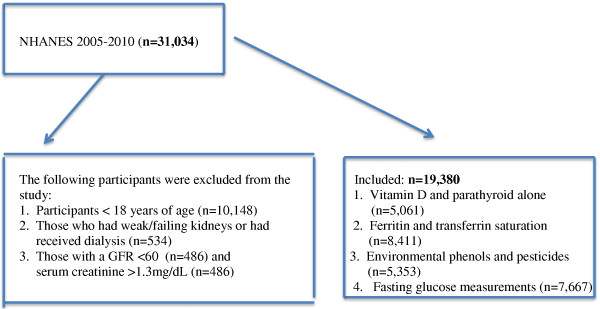
Using three cycles from the National Health and Nutrition Examination Survey (NHANES) (2005-2010), this study evaluated independent risk factors for hyperphosphatemia and hypophosphatemia.
Risk factors for hyperphosphatemia included higher adjusted calcium (OR 2.90, 95% CI 2.43-3.45), increasing cholesterol (OR 1.003, 95% CI 1.001-1.005), female gender (OR 1.61, 95% CI 1.39-1.87) and low hemoglobin (OR 1.52, 95% CI 1.17-1.98). Advanced age was protective (OR 0.98, 95% CI 0.977-0.987). Models that included fasting serum glucose found lower body mass index (BMI) to be protective (OR 0.97, 95% CI 0.96-0.99) and adjusting for serum vitamin D and parathyroid hormone removed the association with low hemoglobin and BMI. Risk factors for hypophosphatemia included the following protective factors: higher albumin (OR 0.56, 95% CI 0.35-0.93), higher BUN (OR 0.90, 95% CI 0.86, 0.95), corrected calcium (OR 0.38, 95% CI 0.23-0.63) and female gender (OR 0.47, 95% 0.24-0.94). In men, higher fasting glucose levels increased risk (OR 1.01, 95% CI 1.0004-1.01).
This study is the first to show an association between low hemoglobin levels and increased risk for hyperphosphatemia among individuals without chronic kidney disease. We did not find any association between diabetes mellitus, increasing BMI or fasting glucose levels and hypophosphatemia.
高磷血症(血清磷≥4.4mg/dL)与慢性肾脏病和心血管疾病风险增加相关。先前的研究表明,饮食磷摄入与血清磷浓度之间存在较弱的关联。虽然在普通人群中较少见,但低磷血症(<2.5mg/dL)可能与代谢综合征和肥胖有关。
本研究使用国家健康与营养调查(NHANES)的三个周期(2005-2010 年),评估了高磷血症和低磷血症的独立危险因素。
高磷血症的危险因素包括较高的校正钙(OR 2.90,95%CI 2.43-3.45)、胆固醇增加(OR 1.003,95%CI 1.001-1.005)、女性(OR 1.61,95%CI 1.39-1.87)和低血红蛋白(OR 1.52,95%CI 1.17-1.98)。高龄具有保护作用(OR 0.98,95%CI 0.977-0.987)。包含空腹血糖的模型发现,较低的体重指数(BMI)具有保护作用(OR 0.97,95%CI 0.96-0.99),并调整血清维生素 D 和甲状旁腺激素后,与低血红蛋白和 BMI 的关联被消除。低磷血症的危险因素包括以下保护因素:较高的白蛋白(OR 0.56,95%CI 0.35-0.93)、较高的尿素氮(OR 0.90,95%CI 0.86,0.95)、校正钙(OR 0.38,95%CI 0.23-0.63)和女性(OR 0.47,95%CI 0.24-0.94)。在男性中,较高的空腹血糖水平增加了风险(OR 1.01,95%CI 1.0004-1.01)。
本研究首次表明,在无慢性肾脏病的个体中,低血红蛋白水平与高磷血症风险增加之间存在关联。我们没有发现糖尿病、BMI 或空腹血糖水平增加与低磷血症之间存在任何关联。