Department of Epidemiology, Harvard School of Public Health, 677 Huntington Avenue, Boston, MA 02115, USA.
BMJ. 2013 Aug 21;347:f4877. doi: 10.1136/bmj.f4877.
To determine whether use of serotonin or non-serotonin reuptake inhibitors near to delivery is associated with postpartum hemorrhage.
Cohort study.
2000-07 nationwide Medicaid data (Medicaid Analytic eXtract).
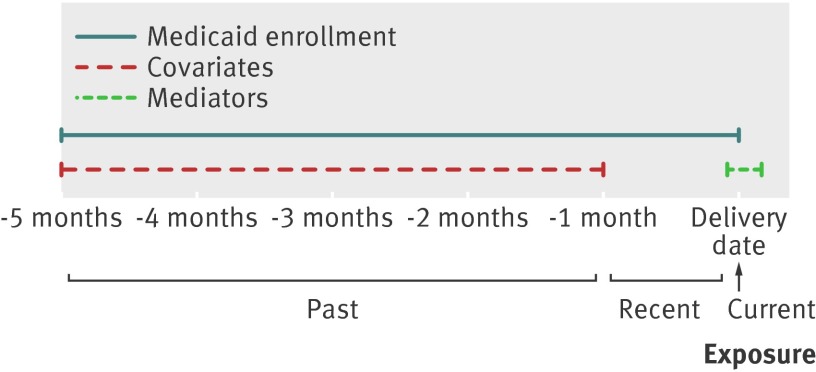
106,000 pregnant women aged 12-55 with a diagnosis of mood or anxiety disorder. Women were categorized into four mutually exclusive exposure groups according to pharmacy dispensing data: current (delivery date), recent (1-30 days before delivery date), past (1-5 months before delivery date), and no exposure (reference group).
Risk of postpartum hemorrhage by timing of exposure and by serotonin or non-serotonin reuptake inhibitors, classes of antidepressant, and antidepressant types. Relative risks and 95% confidence intervals adjusted for delivery year, risk factors for postpartum hemorrhage, indicators of severity of mood/anxiety disorder, other indications for antidepressants, and other drugs. High dimensional propensity score (hdPS) methods were used to empirically identify and adjust for additional factors.
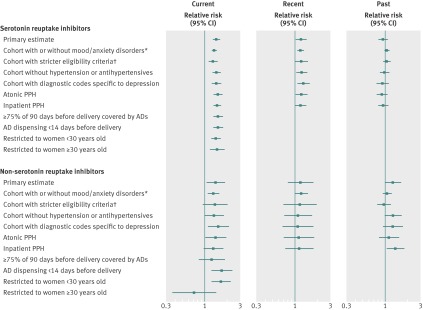
12,710 (12%) women had current exposure to serotonin reuptake inhibitor monotherapy, and 1495 (1.4%) women had current exposure to non-serotonin reuptake inhibitor monotherapy. The risk of postpartum hemorrhage was 2.8% among women with mood/anxiety disorders but no exposure to antidepressants, 4.0% in the current users of serotonin reuptake inhibitors, 3.8% in the current users of non-serotonin reuptake inhibitors, 3.2% in the recent users of serotonin reuptake inhibitors, 3.1% in the recent users of non-serotonin reuptake inhibitors, 2.5% in the past users of serotonin reuptake inhibitors, and 3.4% in the past users of non-serotonin reuptake inhibitors. Compared with no exposure, women with current exposure to serotonin reuptake inhibitors had a 1.47-fold increased risk of postpartum hemorrhage (95% confidence interval 1.33 to 1.62) and women with current non-serotonin reuptake inhibitor exposure had a 1.39-fold increased risk (1.07 to 1.81). Results were similar with hdPS adjustment. Women with current exposure to serotonin reuptake inhibitors had an adjusted excess risk of 1.26% (0.90% to 1.62%), with a number needed to harm of 80, and for women with current exposure to non-serotonin reuptake inhibitors the excess risk was 1.03% (0.07% to 1.99%), with a number needed to harm of 97. For exposure to serotonin reuptake inhibitors the relative risk was 1.19 (1.03 to 1.38) for recent exposure and 0.93 (0.82 to 1.06) for past exposure; for non-serotonin reuptake inhibitors the figures were 1.17 (0.80 to 1.70) and 1.26 (1.00 to 1.59), respectively. Current exposure to selective serotonin reuptake inhibitor monotherapy was also associated with postpartum hemorrhage (1.42, 1.27 to 1.57), as was current serotonin norepinephrine (noradrenaline) reuptake inhibitor (1.90, 1.37 to 2.63) and tricyclic monotherapy (1.77, 0.90 to 3.47). All types of selective serotonin reuptake inhibitors available for analysis and venlafaxine, a serotonin norepinephrine reuptake inhibitor, were significantly associated with postpartum hemorrhage.
Exposure to serotonin and non-serotonin reuptake inhibitors, including selective serotonin reuptake inhibitors, serotonin-norepinephrine reuptake inhibitors, and tricyclics, close to the time of delivery was associated with a 1.4 to 1.9-fold increased risk for postpartum hemorrhage. While potential confounding by unmeasured factors cannot be ruled out, these findings suggest that patients treated with antidepressants during late pregnancy are more likely to experience postpartum hemorrhage.
确定在分娩前后使用 5-羟色胺或非 5-羟色胺再摄取抑制剂是否与产后出血有关。
队列研究。
2000-07 年全国医疗补助数据(医疗补助分析提取)。
106000 名年龄在 12-55 岁之间的患有情绪或焦虑障碍的孕妇。根据药房配药数据,将女性分为四个互斥的暴露组:当前(分娩日期)、近期(分娩日期前 1-30 天)、过去(分娩日期前 1-5 个月)和无暴露(参照组)。
按暴露时间、5-羟色胺或非 5-羟色胺再摄取抑制剂、抗抑郁药类别和抗抑郁药类型划分的产后出血风险。调整分娩年份、产后出血风险因素、情绪/焦虑障碍严重程度指标、其他抗抑郁药适应证和其他药物后,计算相对风险和 95%置信区间。采用高维倾向评分(hdPS)方法实证识别和调整其他因素。
12710 名(12%)女性当前使用 5-羟色胺再摄取抑制剂单药治疗,1495 名(1.4%)女性当前使用非 5-羟色胺再摄取抑制剂单药治疗。在没有使用抗抑郁药的情绪/焦虑障碍女性中,产后出血的风险为 2.8%,当前使用 5-羟色胺再摄取抑制剂的女性为 4.0%,当前使用非 5-羟色胺再摄取抑制剂的女性为 3.8%,近期使用 5-羟色胺再摄取抑制剂的女性为 3.2%,近期使用非 5-羟色胺再摄取抑制剂的女性为 3.1%,过去使用 5-羟色胺再摄取抑制剂的女性为 2.5%,过去使用非 5-羟色胺再摄取抑制剂的女性为 3.4%。与无暴露相比,当前使用 5-羟色胺再摄取抑制剂的女性产后出血风险增加 1.47 倍(95%置信区间 1.33-1.62),当前使用非 5-羟色胺再摄取抑制剂的女性风险增加 1.39 倍(1.07-1.81)。hdPS 调整后结果相似。当前使用 5-羟色胺再摄取抑制剂的女性调整后过度风险为 1.26%(0.90%-1.62%),危害人数为 80,当前使用非 5-羟色胺再摄取抑制剂的女性过度风险为 1.03%(0.07%-1.99%),危害人数为 97。对于 5-羟色胺再摄取抑制剂的暴露,近期暴露的相对风险为 1.19(1.03-1.38),过去暴露的风险为 0.93(0.82-1.06);对于非 5-羟色胺再摄取抑制剂,相应的数字分别为 1.17(0.80-1.70)和 1.26(1.00-1.59)。当前选择性 5-羟色胺再摄取抑制剂单药治疗也与产后出血有关(1.42,1.27-1.57),5-羟色胺去甲肾上腺素(去甲肾上腺素)再摄取抑制剂(1.90,1.37-2.63)和三环单药治疗(1.77,0.90-3.47)也是如此。可分析的所有选择性 5-羟色胺再摄取抑制剂和文拉法辛(一种 5-羟色胺去甲肾上腺素再摄取抑制剂)均与产后出血显著相关。
分娩前后使用 5-羟色胺和非 5-羟色胺再摄取抑制剂,包括选择性 5-羟色胺再摄取抑制剂、5-羟色胺去甲肾上腺素再摄取抑制剂和三环类药物,与产后出血的风险增加 1.4 至 1.9 倍相关。虽然不能排除未测量因素混杂的可能性,但这些发现表明,在妊娠晚期接受抗抑郁治疗的患者更有可能经历产后出血。