Viet Linh Nguyen, Kikuchi Kazuhiro, Nakai Michiko, Tanihara Fuminori, Noguchi Junko, Kaneko Hiroyuki, Dang-Nguyen Thanh Quang, Men Nguyen Thi, Van Hanh Nguyen, Somfai Tamas, Nguyen Bui Xuan, Nagai Takashi, Manabe Noboru
Animal Resource Science Center, Graduate School of Agricultural and Life Sciences, The University of Tokyo, Ibaraki 319-0206, Japan.
J Reprod Dev. 2013 Dec 17;59(6):549-56. doi: 10.1262/jrd.2013-042. Epub 2013 Aug 22.
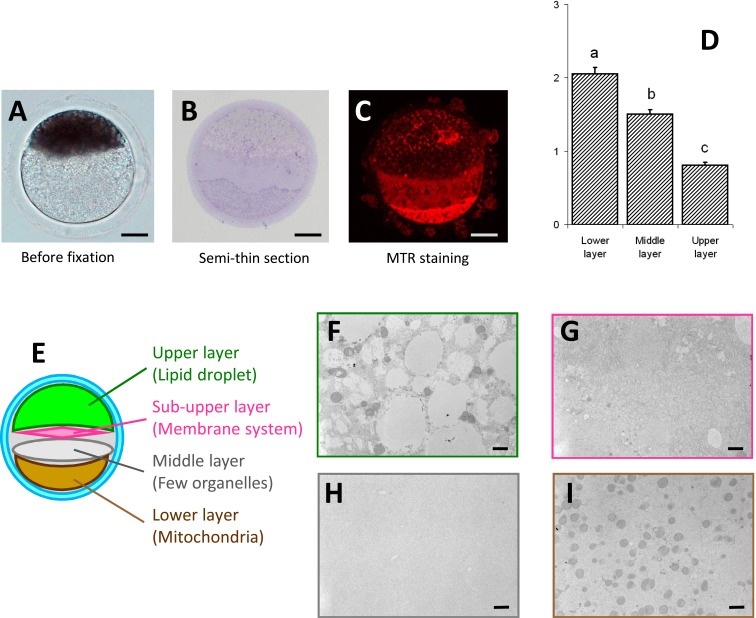
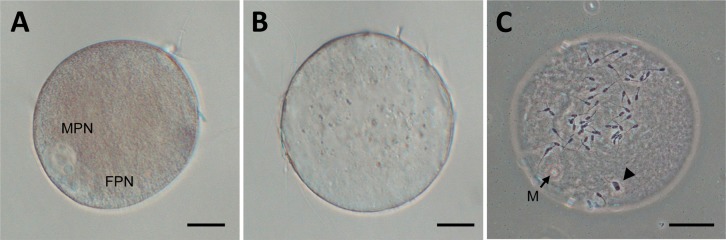
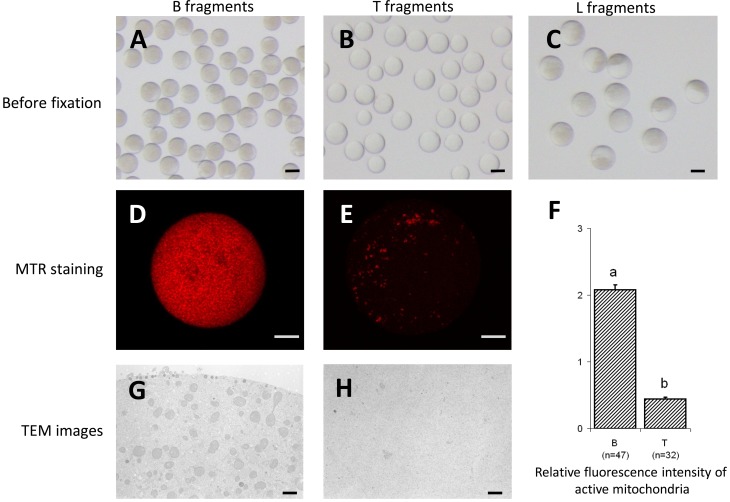
Mitochondria are reported to be critical in in vitro maturation of oocytes and subsequent embryo development after fertilization, but their contribution for fertilization has not been investigated in detail. In the present study, we investigate the contribution of mitochondria to fertilization using reconstructed porcine oocytes by fusion of ooplasmic fragments produced by serial centrifugations (centri-fusion). Firstly, we evaluated the characteristics of ooplasmic fragments. Three types of fragments were obtained by centrifugation of porcine oocytes matured in vitro for 46 h: brownish (B), transparent (T) and large (L) fragments containing both B and T parts in a fragment. The production efficiencies of these types of fragments were 71.7, 91.0 and 17.8 fragments/100 oocytes, respectively. In experiments, L fragments were excluded because they contained both brownish and transparent components that were apparently intermediate between B and T fragments. Observations by confocal microscopy after staining with MitoTracker Red CMXRos® and transmission electron microscopy revealed highly condensed active mitochondria in B fragments in contrast to T fragments that contained only sparse organelles. We reconstructed oocytes by fusion of a karyoplast and two cytoplasts from B and T fragments (B and T oocytes, respectively). The B oocytes showed higher sperm penetration (95.8%) and male pronuclear formation rates (94.2%) by in vitro fertilization than T oocytes (66.7% and 50.0%, respectively). These results suggest that the active mitochondria in oocytes may be related to their ability for fertilization.
据报道,线粒体在卵母细胞的体外成熟以及受精后的后续胚胎发育过程中起着关键作用,但其对受精的贡献尚未得到详细研究。在本研究中,我们通过对连续离心产生的卵质片段进行融合(离心融合),利用重构猪卵母细胞来研究线粒体对受精的贡献。首先,我们评估了卵质片段的特征。通过对体外成熟46小时的猪卵母细胞进行离心,获得了三种类型的片段:褐色(B)、透明(T)以及在一个片段中同时包含B和T部分的大(L)片段。这些类型片段的产生效率分别为71.7、91.0和17.8个片段/100个卵母细胞。在实验中,L片段被排除,因为它们包含褐色和透明成分,明显介于B片段和T片段之间。用MitoTracker Red CMXRos®染色后通过共聚焦显微镜观察以及透射电子显微镜观察发现,与只含有稀疏细胞器的T片段相比,B片段中存在高度浓缩的活性线粒体。我们通过将来自B片段和T片段的一个核质体和两个细胞质体融合来重构卵母细胞(分别为B卵母细胞和T卵母细胞)。体外受精后,B卵母细胞的精子穿透率(95.8%)和雄原核形成率(94.2%)高于T卵母细胞(分别为66.7%和50.0%)。这些结果表明,卵母细胞中的活性线粒体可能与其受精能力有关。