From the Epilepsy Research Group, Institute of Neuroscience and Physiology (A.E., B.R., K.M.), and Department of Paediatrics, Institute of Clinical Sciences (I.O.), Sahlgrenska Academy at Gothenburg University; Departments of Clinical Neurophysiology (R.F.) and Neurology (E.K.), Uppsala University Hospital; and Department of Neurology (K.K.), Institution of Clinical Neurosciences, Lund University, Sweden.
Neurology. 2013 Oct 1;81(14):1244-51. doi: 10.1212/WNL.0b013e3182a6ca7b. Epub 2013 Aug 21.
To investigate prospective, population-based long-term outcomes concerning seizures and antiepileptic drug (AED) treatment after resective epilepsy surgery in Sweden.
Ten- and 5-year follow-ups were performed in 2005 to 2007 for 278/327 patients after resective epilepsy surgery from 1995 to 1997 and 2000 to 2002, respectively. All patients had been prospectively followed in the Swedish National Epilepsy Surgery Register. Ninety-three patients, who were presurgically evaluated but not operated, served as controls.
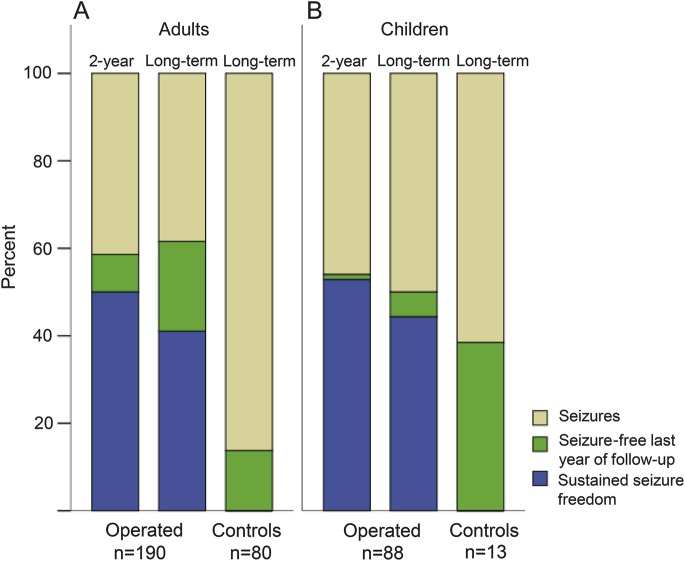
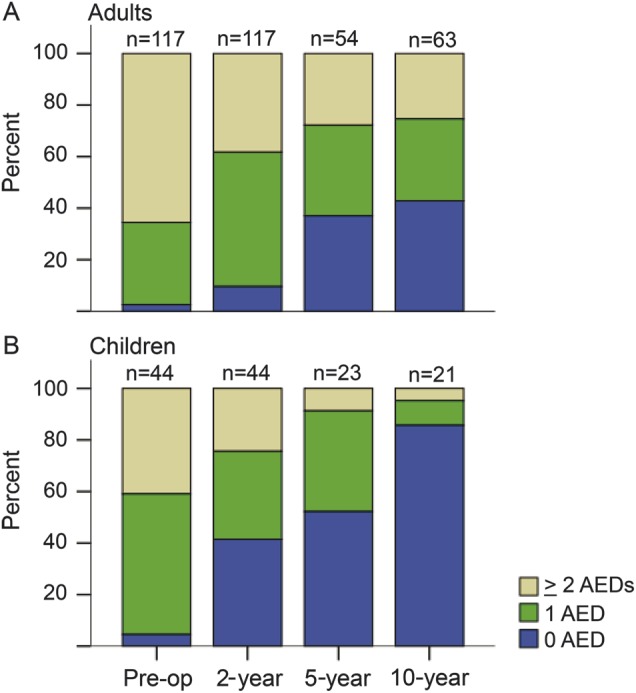
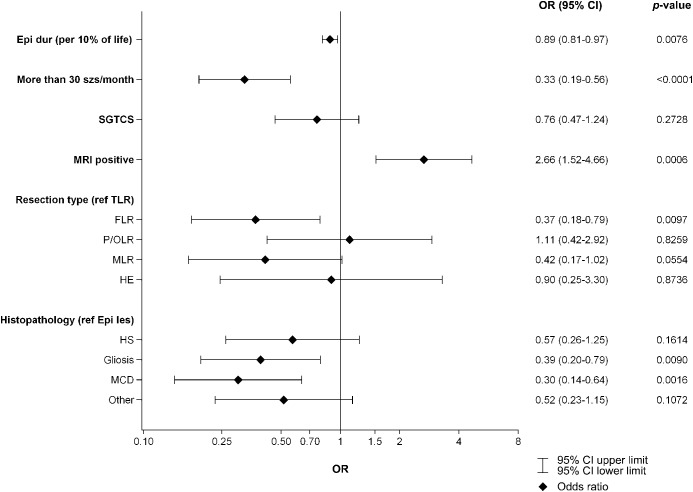
In the long term (mean 7.6 years), 62% of operated adults and 50% of operated children were seizure-free, compared to 14% of nonoperated adults (p < 0.001) and 38% of nonoperated children (not significant). Forty-one percent of operated adults and 44% of operated children had sustained seizure freedom since surgery, compared to none of the controls (p < 0.0005). Multivariate analysis identified ≥30 seizures/month at baseline and long epilepsy duration as negative predictors and positive MRI to be a positive predictor of long-term seizure-free outcome. Ten years after surgery, 86% of seizure-free children and 43% of seizure-free adults had stopped AEDs in the surgery groups compared to none of the controls (p < 0.0005).
This population-based, prospective study shows good long-term seizure outcomes after resective epilepsy surgery. The majority of the patients who are seizure-free after 5 and 10 years have sustained seizure freedom since surgery. Many patients who gain seizure freedom can successfully discontinue AEDs, more often children than adults.
This study provides Class III evidence that more patients are seizure-free and have stopped AED treatment in the long term after resective epilepsy surgery than nonoperated epilepsy patients.
研究瑞典切除性癫痫手术后前瞻性、基于人群的长期癫痫发作和抗癫痫药物(AED)治疗结果。
对 1995 年至 1997 年和 2000 年至 2002 年进行的 278/327 例切除性癫痫手术后患者进行了 10 年和 5 年随访。所有患者均前瞻性随访于瑞典国家癫痫手术登记处。93 例术前评估但未手术的患者作为对照组。
长期(平均 7.6 年),278 例手术成人和 327 例手术儿童中 62%和 50%无癫痫发作,而非手术成人中为 14%(p < 0.001),非手术儿童中为 38%(无显著差异)。41%的手术成人和 44%的手术儿童自手术后一直无癫痫发作,而对照组均无(p < 0.0005)。多变量分析显示基线时≥30 次/月发作和较长癫痫持续时间为负预测因素,而 MRI 阳性为长期无癫痫发作结局的正预测因素。手术后 10 年,手术组无癫痫发作的儿童中 86%和成人中 43%停止了 AED 治疗,而对照组均无(p < 0.0005)。
本基于人群的前瞻性研究显示切除性癫痫手术后有良好的长期癫痫发作结果。5 年和 10 年后无癫痫发作的大多数患者自手术后一直无癫痫发作。许多癫痫发作得到控制的患者可以成功停用 AED,儿童比成人更常见。
本研究提供 III 级证据,表明与未手术的癫痫患者相比,切除性癫痫手术后长期有更多的患者无癫痫发作并停止 AED 治疗。