Department of Gastroenterology and Hepatology, People's Republic of China.
Onco Targets Ther. 2013 Aug 2;6:1041-5. doi: 10.2147/OTT.S49597. eCollection 2013.
Single nucleotide polymorphisms (SNPs) accumulated frequently in the mitochondrial displacement loop (D-loop) in many cancers. We had identified cancer risk-associated SNPs in the D-loop of non-Hodgkin lymphoma (NHL) patients previously, in this study, we investigated the association of age at onset and D-loop SNPs in NHL patients.
The D-loop region of mtDNA was sequenced for 133 NHL patients recorded at the Fourth Hospital of Hebei Medical University. The Kaplan-Meier method was used to identify age at onset-associated SNPs in the D-loop of NHL patients. The Cox proportional hazards model was used to identify independent risk factors for age at onset.
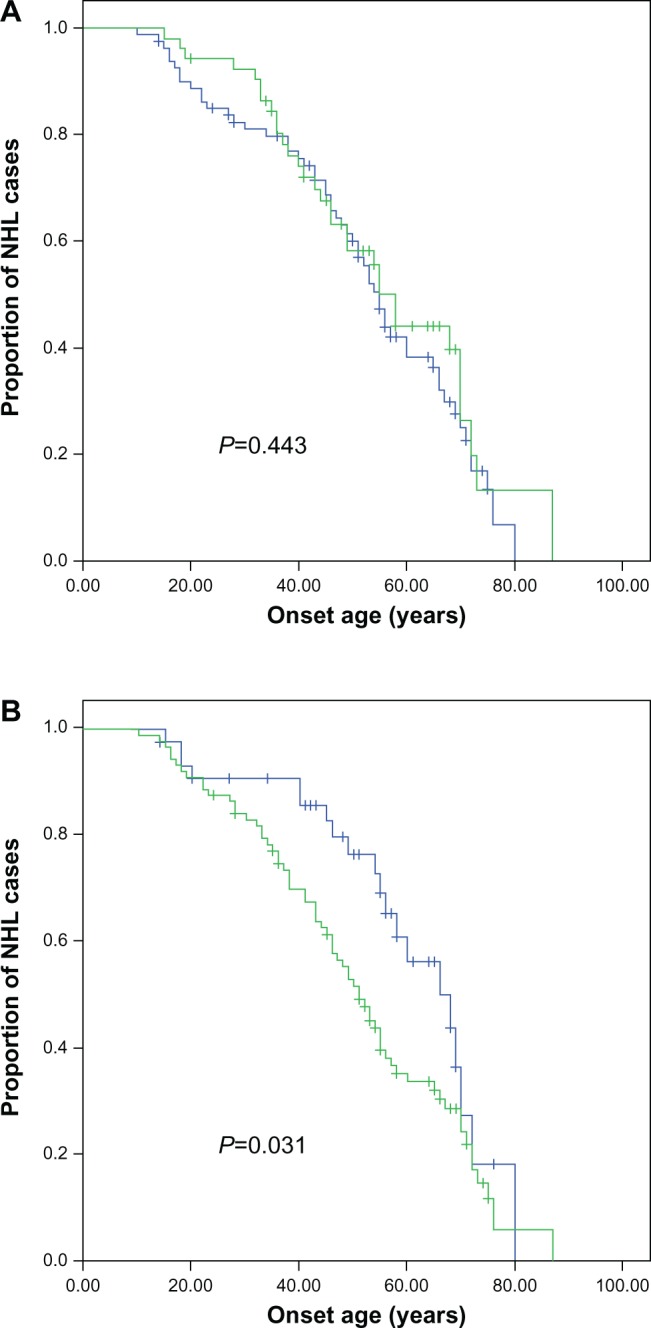
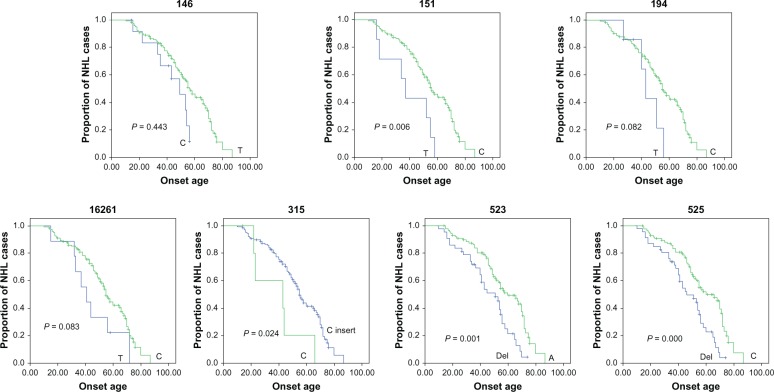
The SNP sites of nucleotides 146C/T, 151T/C, 194T/C, 315C/C insert, 523Del/A, and 525Del/C were identified for their association with age at onset, by the logrank test. In an overall multivariate analysis, allele 146 (relative risk, 0.403; 95% confidence interval [CI]: 0.182-0.895) (P = 0.026), allele 151 (relative risk, 0.378; 95% CI: 0.165-0.868) (P = 0.022), and allele 315 (relative risk, 3.554; 95% CI: 1.344-9.400) (P = 0.011) were identified as independent predictors for age at onset in NHL patients.
SNPs in the D-loop can predict age at onset in NHL patients. Analysis of the D-loop SNPs can help identify NHL patient subgroups at high risk of early onset.
单核苷酸多态性(SNPs)在许多癌症中频繁积累在线粒体置换环(D 环)中。我们之前已经在非霍奇金淋巴瘤(NHL)患者的 D 环中鉴定出与癌症风险相关的 SNPs,在这项研究中,我们研究了 NHL 患者的发病年龄与 D 环 SNPs 的关系。
对河北医科大学第四医院记录的 133 例 NHL 患者的 mtDNA D 环进行测序。使用 Kaplan-Meier 方法鉴定 NHL 患者 D 环中与发病年龄相关的 SNPs。使用 Cox 比例风险模型鉴定发病年龄的独立危险因素。
通过对数秩检验,确定核苷酸 146C/T、151T/C、194T/C、315C/C 插入、523Del/A 和 525Del/C 的 SNP 位点与发病年龄相关。在总体多变量分析中,等位基因 146(相对风险,0.403;95%置信区间[CI]:0.182-0.895)(P=0.026)、等位基因 151(相对风险,0.378;95%CI:0.165-0.868)(P=0.022)和等位基因 315(相对风险,3.554;95%CI:1.344-9.400)(P=0.011)被鉴定为 NHL 患者发病年龄的独立预测因子。
D 环中的 SNPs 可以预测 NHL 患者的发病年龄。D 环 SNPs 的分析有助于识别发病年龄早的 NHL 患者高危亚组。