Toi Masakazu, Hirota Saya, Tomotaki Ai, Sato Nobuaki, Hozumi Yasuo, Anan Keisei, Nagashima Takeshi, Tokuda Yutaka, Masuda Norikazu, Ohsumi Shozo, Ohno Shinji, Takahashi Masato, Hayashi Hironori, Yamamoto Seiichiro, Ohashi Yasuo
Department of Biostatistics, School of Public Health, The University of Tokyo, 7-3-1 Hongou, Bunkyo-ku, Tokyo, 113-0033 Japan.
Curr Nutr Food Sci. 2013 Aug;9(3):194-200. doi: 10.2174/15734013113099990001.
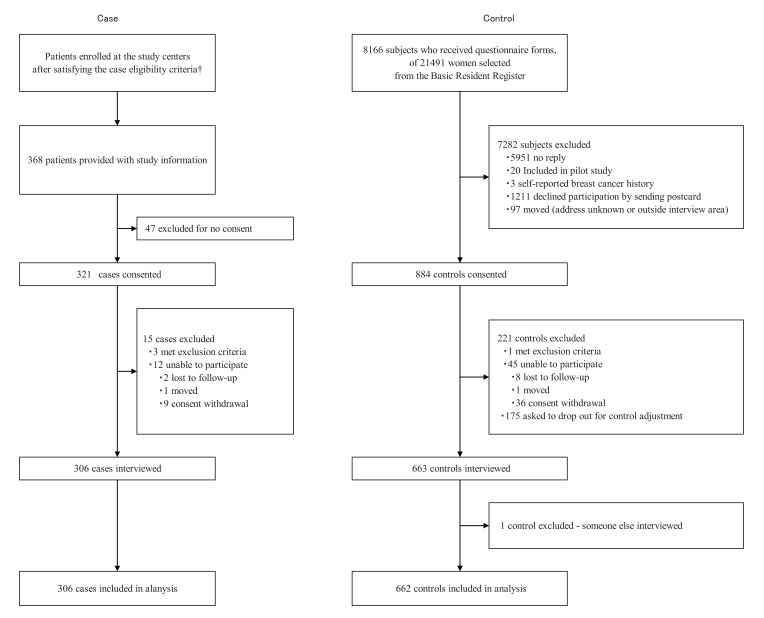
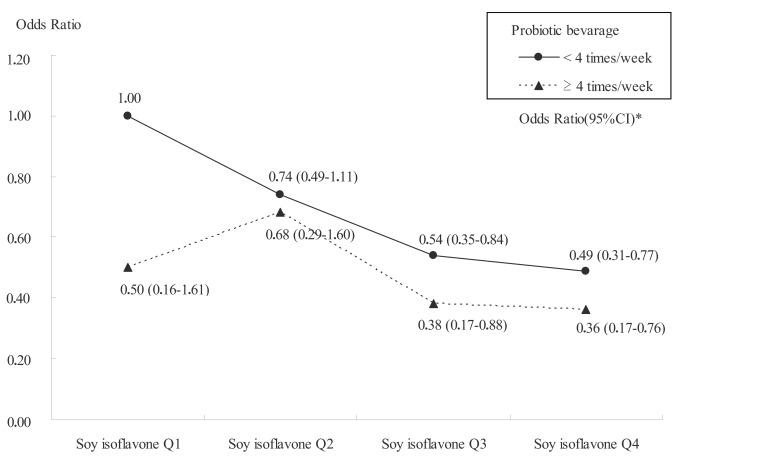
The purpose of this study is to evaluate how beverages containing Shirota (BLS) and soy isoflavone consumption since adolescence affected the incidence of breast cancer. In a population-based case-control study, three hundred and six cases with breast cancer and 662 controls aged 40 to 55 were matched for age and residential area and included in the analyses. Diet, lifestyle and other breast cancer risk factors were investigated using the self-administered questionnaire and interview. Odds ratios (ORs) of BLS and soy isoflavone consumption for breast cancer incidence were independently and jointly estimated using a conditional logistic regression. The ORs of BLS consumption (≥ four times a week against < four times a week) was 0.65 and statistically significant (p = 0.048). The analysis of association between soy consumption and breast cancer incidence showed the more the isoflavone consumption is, the lower the odds of breast cancer becomes. Adjusted ORs for breast cancer in the second, the third and the fourth quartiles of soy consumption against the first quartile were 0.76, 0.53 and 0.48, respectively (trend test, p = 0.0002). The BLS-isoflavone interaction was not statistically significant; however, a biological interaction was suggested. Regular consumption of BLS and isoflavones since adolescence was inversely associated with the incidence of breast cancer in Japanese women.
本研究旨在评估自青春期起饮用含养乐多(BLS)饮料及摄入大豆异黄酮如何影响乳腺癌发病率。在一项基于人群的病例对照研究中,选取了306例年龄在40至55岁之间的乳腺癌患者及662例对照,按照年龄和居住地区进行匹配,并纳入分析。通过自填问卷和访谈调查饮食、生活方式及其他乳腺癌风险因素。使用条件逻辑回归独立并联合估计饮用BLS和摄入大豆异黄酮与乳腺癌发病率的比值比(OR)。饮用BLS(每周≥4次与每周<4次相比)的OR为0.65,具有统计学意义(p = 0.048)。大豆摄入量与乳腺癌发病率的关联分析显示,大豆异黄酮摄入量越高,患乳腺癌的几率越低。大豆摄入量第二、第三和第四四分位数相对于第一四分位数的乳腺癌校正OR分别为0.76、0.53和0.48(趋势检验,p = 0.0002)。BLS与异黄酮的相互作用无统计学意义;然而,提示存在生物学相互作用。日本女性自青春期起经常饮用BLS和摄入异黄酮与乳腺癌发病率呈负相关。