Suntory Foundation for Life Sciences, Bioorganic Research Institute , Osaka , Japan.
Front Endocrinol (Lausanne). 2013 Aug 15;4:100. doi: 10.3389/fendo.2013.00100. eCollection 2013.
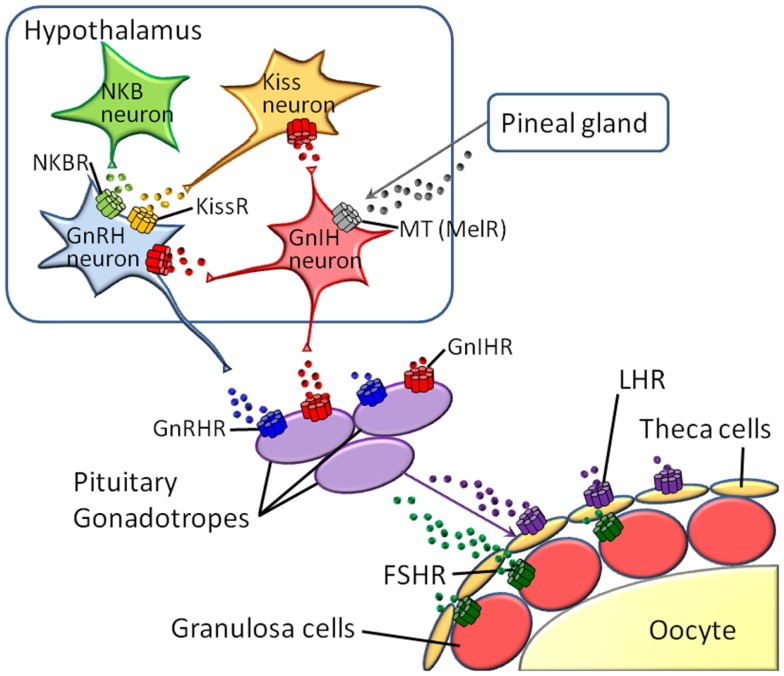
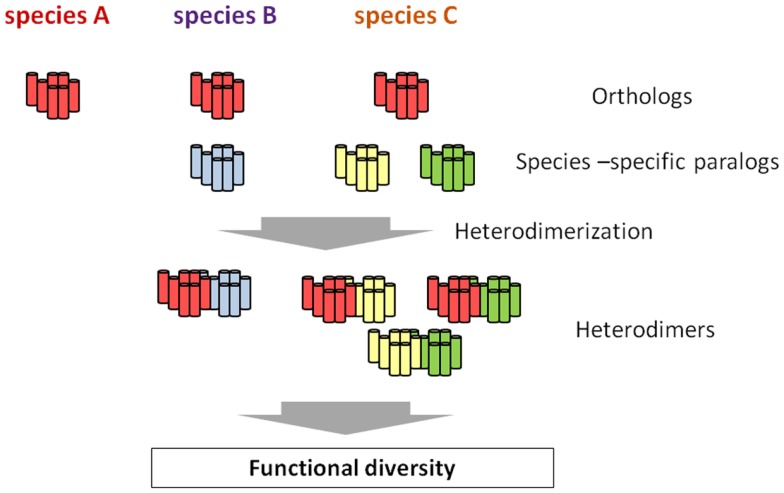
A G protein-coupled receptor (GPCR) functions not only as a monomer or homodimer but also as a heterodimer with another GPCR. GPCR heterodimerization results in the modulation of the molecular functions of the GPCR protomer, including ligand binding affinity, signal transduction, and internalization. There has been a growing body of reports on heterodimerization of multiple GPCRs expressed in the reproductive system and the resultant functional modulation, suggesting that GPCR heterodimerization is closely associated with reproduction including the secretion of hormones and the growth and maturation of follicles and oocytes. Moreover, studies on heterodimerization among paralogs of gonadotropin-releasing hormone (GnRH) receptors of a protochordate, Ciona intestinalis, verified the species-specific regulation of the functions of GPCRs via multiple GnRH receptor pairs. These findings indicate that GPCR heterodimerization is also involved in creating biodiversity. In this review, we provide basic and current knowledge regarding GPCR heterodimers and their functional modulation, and explore the biological significance of GPCR heterodimerization.
G 蛋白偶联受体(GPCR)不仅可以作为单体或同源二聚体发挥作用,还可以与另一个 GPCR 形成异源二聚体。GPCR 异源二聚化导致 GPCR 原聚体的分子功能发生调制,包括配体结合亲和力、信号转导和内化。越来越多的报道表明,在生殖系统中表达的多种 GPCR 发生异源二聚化,并导致功能调制,这表明 GPCR 异源二聚化与包括激素分泌以及卵泡和卵母细胞生长和成熟在内的生殖密切相关。此外,对原肠动物文昌鱼促性腺激素释放激素(GnRH)受体的 paralogs 之间的异源二聚化的研究证实了通过多个 GnRH 受体对 GPCR 功能的种特异性调节。这些发现表明 GPCR 异源二聚化也参与了生物多样性的形成。在这篇综述中,我们提供了关于 GPCR 异源二聚体及其功能调制的基本和最新知识,并探讨了 GPCR 异源二聚化的生物学意义。