Children's Hospital, Fudan University, Shanghai, China.
PLoS One. 2013 Aug 14;8(8):e72640. doi: 10.1371/journal.pone.0072640. eCollection 2013.
Several studies have suggested a difference in clinical features of intellectual ability and psychiatric illness in the Prader-Willi syndrome (PWS) with the 15q11-q13 paternal deletion and maternal uniparental disomy (mUPD). Our objective was to appraise evidence on this association through a meta-analysis.
The electronic records PubMed and EMBASE from 1956 to 2012 were extracted for meta-analysis. Meta-analyses were performed by using fixed effect model. Mean difference, odds ratio, and 95% confidence interval were calculated.
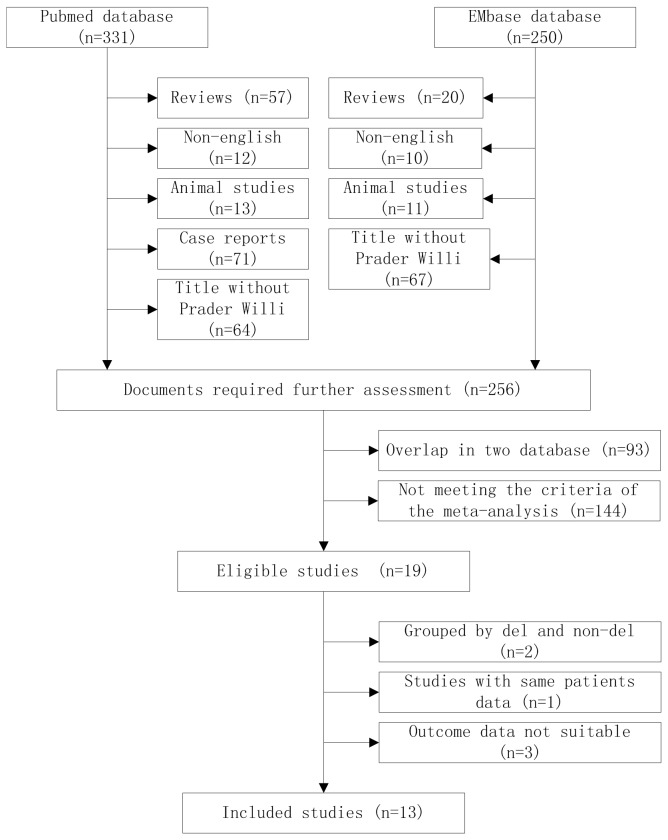
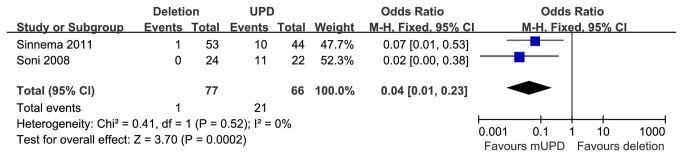
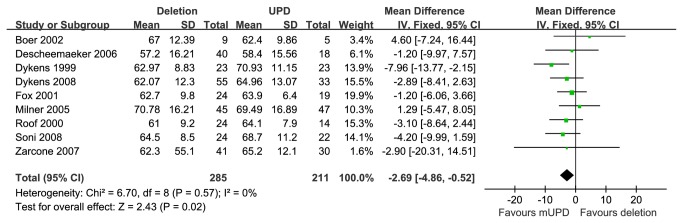
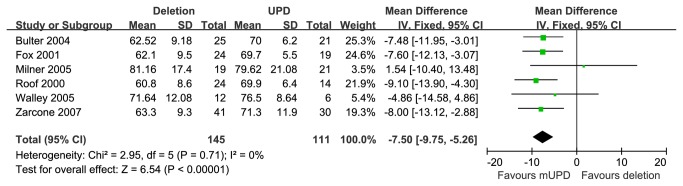
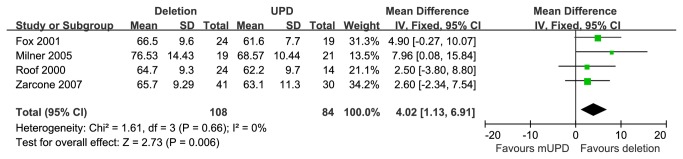
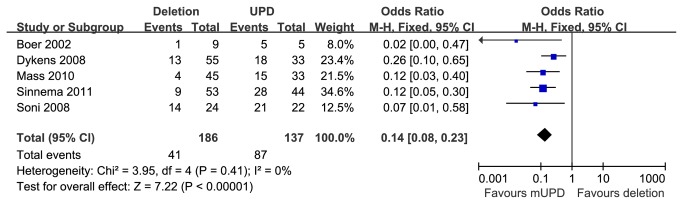
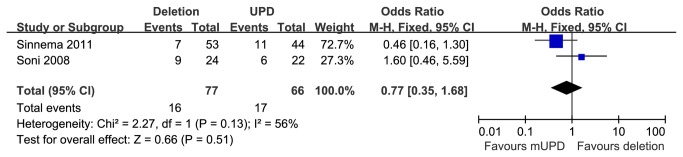
We retrieved a total of 744 PWS cases from 13 studies. These include 423 cases with paternal 15q11-q13 deletions and 318 cases of mUPD. Compare to the PWS cases with mUPD, PWS patients with the paternal 15q11-q13 deletion associated with significantly lower full scale IQ (FSIQ) [mean difference (MD), -2.69; 95%CI, -4.86 to -0.52; p=0.02] and verbal IQ (VIQ) (MD, -7.5; 95%CI, -9.75 to -5.26; p<0.00001) but higher performance IQ (PIQ) (MD, 4.02; 95%CI, 1.13 to 6.91; p=0.006). In contrast, PWS patients with mUPD are associated with significantly higher risk of psychiatric illness [odds rate (OR), 0.14; 95%CI, 0.08 to 0.23; p<0.00001] and higher risk of bipolar disorder (OR, 0.04; 95%CI, 0.01 to 0.23; p=0.0002).
Significant different clinical features of cognitive development and psychiatric illness are associated with PWS with different molecular defects. These findings provide support for evidence based practice to evaluate and manage the PWS syndrome with different molecular defects.
一些研究表明,在 Prader-Willi 综合征(PWS)中,15q11-q13 父源缺失和母源单亲二体(mUPD)患者的智力能力和精神疾病的临床特征存在差异。我们的目的是通过荟萃分析评估这种关联的证据。
从 1956 年至 2012 年,我们通过电子检索PubMed 和 EMBASE 记录进行荟萃分析。使用固定效应模型进行荟萃分析。计算了均值差、优势比和 95%置信区间。
我们从 13 项研究中总共检索到 744 例 PWS 病例。其中包括 423 例父源 15q11-q13 缺失和 318 例 mUPD。与 mUPD 的 PWS 病例相比,父源 15q11-q13 缺失的 PWS 患者的总体智商(FSIQ)明显较低[平均差异(MD),-2.69;95%置信区间,-4.86 至 -0.52;p=0.02]和言语智商(VIQ)(MD,-7.5;95%置信区间,-9.75 至 -5.26;p<0.00001),但执行智商(PIQ)较高(MD,4.02;95%置信区间,1.13 至 6.91;p=0.006)。相反,mUPD 的 PWS 患者与精神疾病的风险显著增加相关[优势比(OR),0.14;95%置信区间,0.08 至 0.23;p<0.00001],以及双相障碍的风险较高(OR,0.04;95%置信区间,0.01 至 0.23;p=0.0002)。
认知发育和精神疾病的显著不同的临床特征与不同分子缺陷的 PWS 相关。这些发现为基于证据的实践提供了支持,以评估和管理具有不同分子缺陷的 PWS 综合征。