Banerji Anna, Panzov Val, Robinson Joan, Young Michael, Ng Kaspar, Mamdani Muhammad
Li Ka Shing Knowledge Institute, St. Michael's Hospital, Toronto, ON, Canada.
Int J Circumpolar Health. 2013 Aug 5;72. doi: 10.3402/ijch.v72i0.21595. eCollection 2013.
Inuit infants who reside in the Nunavut (NU) regions of Arctic Canada have extremely high rates of lower respiratory tract infections (LRTIs) associated with significant health expenditures, but the costs in other regions of Arctic Canada have not been documented.
This prospective surveillance compares, across most of Arctic Canada, the rates and costs associated with LRTI admissions in infants less than 1 year of age, and the days of hospitalization and costs adjusted per live birth.
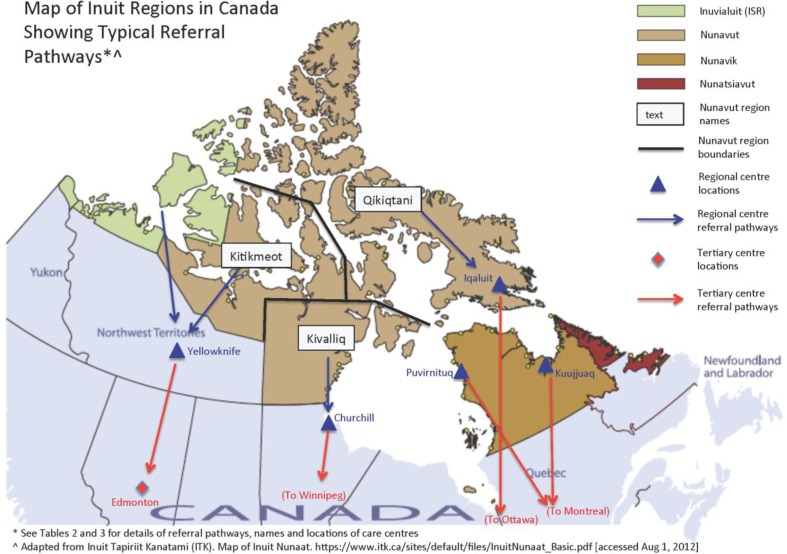
This was a hospital-based surveillance of LRTI admissions of infants less than 1 year of age, residing in Northwest Territories (NT), the 3 regions of Nunavut (NU); [Kitikmeot (KT), Kivalliq (KQ) and Qikiqtani (QI)] and Nunavik (NK) from 1 January 2009 to 30 June 2010. Costs were obtained from the territorial or regional governments and hospitals, and included transportation, hospital stay, physician fees and accommodation costs. The rates of LRTI hospitalizations, days of hospitalization and associated costs were calculated per live birth in each of the 5 regions.
There were 513 LRTI admissions during the study period. For NT, KT, KQ, QI and NK, the rates of LRTI hospitalization per 1000 live births were 38, 389, 230, 202 and 445, respectively. The total days of LRTI admission per live birth were 0.25, 3.3, 2.6, 1.7 and 3 for the above regions. The average cost per live birth for LRTI admission for these regions was $1,412, $22,375, $14,608, $8,254 and $10,333. The total cost for LRTI was $1,498,232 in NT, $15,662,968 in NU and $3,874,881 in NK. Medical transportation contributed to a significant proportion of the costs.
LRTI admission rates in NU and Nunavik are much higher than that in NT and remain among the highest rates globally. The costs of these admissions are exceptionally high due to the combination of very high rates of admission, very expensive medical evacuations and prolonged hospitalizations. Decreasing the rates of LRTI in this population could result in substantial health savings.
居住在加拿大北极地区努纳武特(NU)地区的因纽特婴儿下呼吸道感染(LRTIs)发生率极高,这带来了巨额医疗支出,但加拿大北极地区其他地方的相关成本尚无记录。
本前瞻性监测在加拿大北极地区大部分地区比较了1岁以下婴儿因下呼吸道感染入院的发生率及成本,以及按每例活产计算的住院天数和成本。
这是一项基于医院的监测,针对2009年1月1日至2010年6月30日期间居住在西北地区(NT)、努纳武特地区(NU)的3个区域[基蒂克米奥特(KT)、基瓦利克(KQ)和奇克塔尼(QI)]以及努纳维克(NK)的1岁以下婴儿因下呼吸道感染入院情况。成本数据来自地区或区域政府及医院,包括交通、住院、医生费用和住宿成本。计算了5个地区中每个地区每例活产的下呼吸道感染住院率、住院天数及相关成本。
研究期间有513例下呼吸道感染入院病例。对于NT、KT、KQ、QI和NK,每1000例活产的下呼吸道感染住院率分别为38、389、230、202和445。上述地区每例活产的下呼吸道感染总住院天数分别为0.25、3.3、2.6、1.7和3天。这些地区每例活产的下呼吸道感染住院平均成本分别为1412美元、22375美元、14608美元、8254美元和10333美元。NT地区下呼吸道感染的总成本为1498232美元,NU地区为15662968美元,NK地区为3874881美元。医疗运输占成本的很大一部分。
NU和努纳维克的下呼吸道感染入院率远高于NT地区,且仍是全球最高的比率之一。由于入院率极高、医疗后送费用昂贵以及住院时间延长,这些入院的成本异常高昂。降低该人群的下呼吸道感染率可大幅节省医疗费用。