U,S, Geological Survey, Western Fisheries Research Center, 6505 NE 65th Street, Seattle, WA 98115, USA.
BMC Genomics. 2013 Aug 22;14:570. doi: 10.1186/1471-2164-14-570.
Introgressive hybridization is an important evolutionary process that can lead to the creation of novel genome structures and thus potentially new genetic variation for selection to act upon. On the other hand, hybridization with introduced species can threaten native species, such as cutthroat trout (Oncorhynchus clarkii) following the introduction of rainbow trout (O. mykiss). Neither the evolutionary consequences nor conservation implications of rainbow trout introgression in cutthroat trout is well understood. Therefore, we generated a genetic linkage map for rainbow-Yellowstone cutthroat trout (O. clarkii bouvieri) hybrids to evaluate genome processes that may help explain how introgression affects hybrid genome evolution.
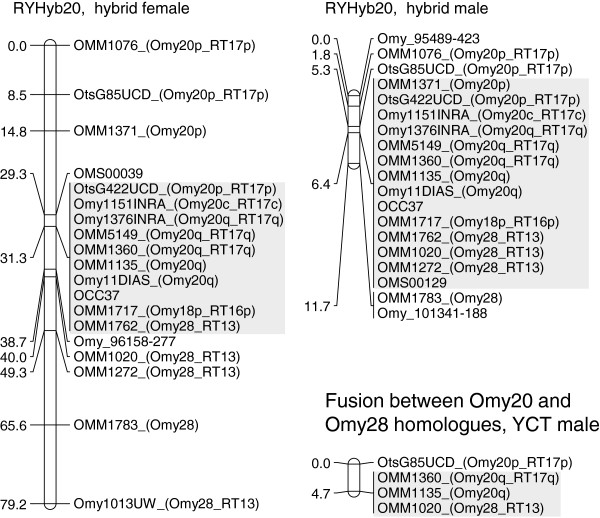
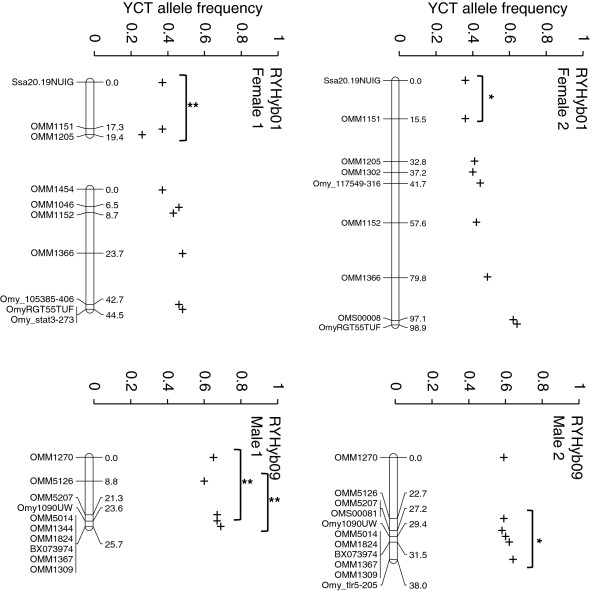
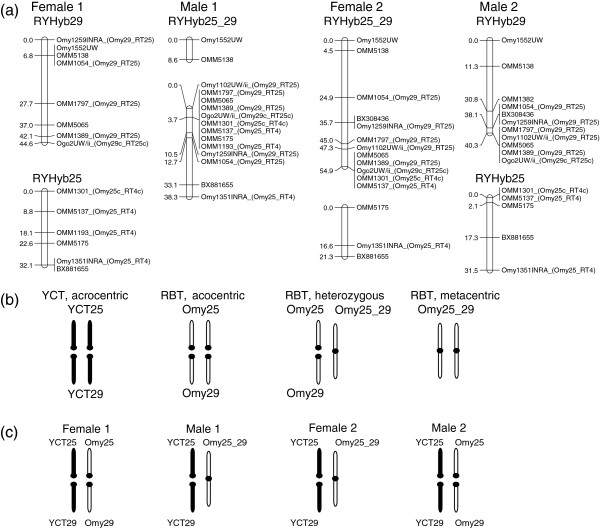
The hybrid map closely aligned with the rainbow trout map (a cutthroat trout map does not exist), sharing all but one linkage group. This linkage group (RYHyb20) represented a fusion between an acrocentric (Omy28) and a metacentric chromosome (Omy20) in rainbow trout. Additional mapping in Yellowstone cutthroat trout indicated the two rainbow trout homologues were fused in the Yellowstone genome. Variation in the number of hybrid linkage groups (28 or 29) likely depended on a Robertsonian rearrangement polymorphism within the rainbow trout stock. Comparison between the female-merged F₁ map and a female consensus rainbow trout map revealed that introgression suppressed recombination across large genomic regions in 5 hybrid linkage groups. Two of these linkage groups (RYHyb20 and RYHyb25_29) contained confirmed chromosome rearrangements between rainbow and Yellowstone cutthroat trout indicating that rearrangements may suppress recombination. The frequency of allelic and genotypic segregation distortion varied among parents and families, suggesting few incompatibilities exist between rainbow and Yellowstone cutthroat trout genomes.
Chromosome rearrangements suppressed recombination in the hybrids. This result supports several previous findings demonstrating that recombination suppression restricts gene flow between chromosomes that differ by arrangement. Conservation of synteny and map order between the hybrid and rainbow trout maps and minimal segregation distortion in the hybrids suggest rainbow and Yellowstone cutthroat trout genomes freely introgress across chromosomes with similar arrangement. Taken together, these results suggest that rearrangements impede introgression. Recombination suppression across rearrangements could enable large portions of non-recombined chromosomes to persist within admixed populations.
渐渗杂交是一个重要的进化过程,它可以导致新的基因组结构的产生,从而为选择提供潜在的新遗传变异。另一方面,与引入物种的杂交可能会威胁到本地物种,例如在虹鳟鱼(Oncorhynchus mykiss)引入后,大口黑鲈(Oncorhynchus clarkii)。虹鳟鱼渐渗到大口黑鲈中的进化后果和保护意义尚不清楚。因此,我们生成了虹鳟-Yellowstone 大口黑鲈(Oncorhynchus clarkii bouvieri)杂种的遗传连锁图谱,以评估可能有助于解释渐渗如何影响杂种基因组进化的基因组过程。
杂种图谱与虹鳟鱼图谱紧密匹配(没有大口黑鲈图谱),除了一个连锁群之外,其他的都共享。这个连锁群(RYHyb20)代表了虹鳟鱼中一个近端着丝粒(Omy28)和一个着丝粒(Omy20)的融合。在 Yellowstone 大口黑鲈中的进一步作图表明,两个虹鳟鱼同源物在 Yellowstone 基因组中融合。杂种连锁群数量的变化(28 或 29)可能取决于虹鳟鱼种群中的罗伯逊易位多态性。雌性融合的 F₁ 图谱与雌性共识虹鳟鱼图谱之间的比较表明,渐渗在 5 个杂种连锁群中抑制了大基因组区域的重组。这两个连锁群(RYHyb20 和 RYHyb25_29)包含了虹鳟鱼和 Yellowstone 大口黑鲈之间确认的染色体重排,表明重排可能抑制了重组。等位基因和基因型分离失真的频率在父母和家族之间各不相同,这表明虹鳟鱼和 Yellowstone 大口黑鲈之间的基因组很少存在不兼容。
染色体重排抑制了杂种的重组。这一结果支持了几个先前的发现,即重组抑制限制了通过排列差异的染色体之间的基因流动。杂种与虹鳟鱼图谱之间的同线性和图谱顺序的保守性以及杂种中最小的分离失真表明,虹鳟鱼和 Yellowstone 大口黑鲈的基因组可以自由地在排列相似的染色体之间渐渗。总的来说,这些结果表明重排阻碍了渐渗。重组抑制跨越重排可以使大量未重组的染色体在混合种群中得以保留。