Department of Microbiology and Immunology, Biosciences Institute, Universidade Estadual Paulista (UNESP), 18618-070 Botucatu, SP, Brazil.
Mediators Inflamm. 2013;2013:519627. doi: 10.1155/2013/519627. Epub 2013 Jun 26.
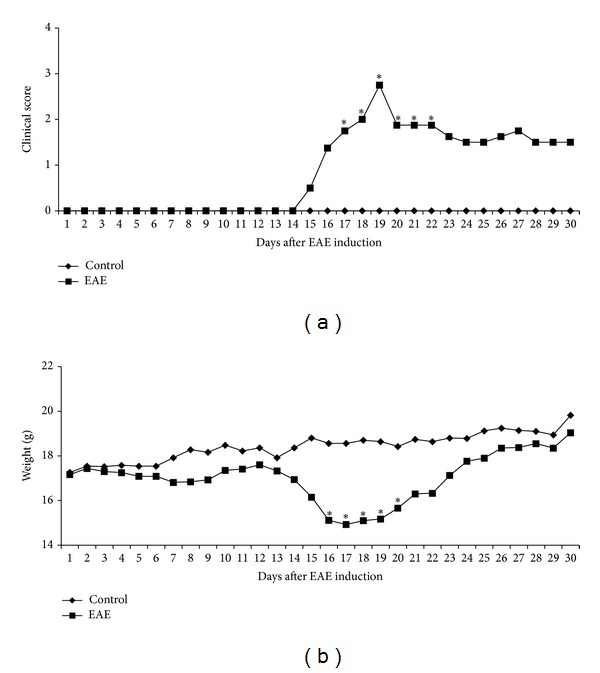
Experimental autoimmune encephalomyelitis (EAE) is an artificially induced demyelination of the central nervous system (CNS) that resembles multiple sclerosis in its clinical, histopathological, and immunological features. Activated Th1 and Th17 cells are thought to be the main immunological players during EAE development. This study was designed to evaluate peripheral and local contribution of IL-17 to acute and chronic EAE stages. C57BL/6 mice were immunized with MOG plus complete Freund's adjuvant followed by pertussis toxin. Mice presented an initial acute phase characterized by accentuated weight loss and high clinical score, followed by a partial recovery when the animals reached normal body weight and smaller clinical scores. Spleen cells stimulated with MOG produced significantly higher levels of IFN- γ during the acute period whereas similar IL-17 levels were produced during both disease stages. CNS-infiltrating cells stimulated with MOG produced similar amounts of IFN- γ but, IL-17 was produced only at the acute phase of EAE. The percentage of Foxp3+ Treg cells, at the spleen and CNS, was elevated during both phases. The degree of inflammation was similar at both disease stages. Partial clinical recovery observed during chronic EAE was associated with no IL-17 production and presence of Foxp3+ Treg cells in the CNS.
实验性自身免疫性脑脊髓炎(EAE)是一种人为诱导的中枢神经系统脱髓鞘疾病,其临床、组织病理学和免疫学特征与多发性硬化症相似。激活的 Th1 和 Th17 细胞被认为是 EAE 发展过程中的主要免疫细胞。本研究旨在评估外周和局部 IL-17 在急性和慢性 EAE 阶段的贡献。C57BL/6 小鼠用 MOG 加完全弗氏佐剂免疫,然后用百日咳毒素处理。小鼠出现初始的急性阶段,表现为体重明显减轻和临床评分高,当动物恢复到正常体重和较小的临床评分时,部分恢复。用 MOG 刺激的脾细胞在急性期产生明显更高水平的 IFN-γ,而在两个疾病阶段产生相似水平的 IL-17。用 MOG 刺激的中枢神经系统浸润细胞产生相似量的 IFN-γ,但仅在 EAE 的急性阶段产生 IL-17。在脾和中枢神经系统中,Foxp3+Treg 细胞的百分比在两个阶段均升高。在两个疾病阶段,炎症程度相似。在慢性 EAE 期间观察到的部分临床恢复与 CNS 中无 IL-17 产生和 Foxp3+Treg 细胞存在有关。