Wageningen UR Plant Breeding, Wageningen University and Research, Centre, P,O, Box 386, Wageningen, AJ 6700, The Netherlands.
BMC Evol Biol. 2013 Aug 24;13:175. doi: 10.1186/1471-2148-13-175.
The Galapagos Islands constitute a highly diverse ecosystem and a unique source of variation in the form of endemic species. There are two endemic tomato species, Solanum galapagense and S. cheesmaniae and two introduced tomato species, S. pimpinellifolium and S. lycopersicum. Morphologically the two endemic tomato species of the Galapagos Islands are clearly distinct, but molecular marker analysis showed no clear separation. Tomatoes on the Galapagos are affected by both native and exotic herbivores. Bemisia tabaci is an important introduced insect species that feeds on a wide range of plants. In this article, we address the question whether the differentiation between S. galapagense and S. cheesmaniae may be related to differences in susceptibility towards phloem-feeders and used B. tabaci as a model to evaluate this.
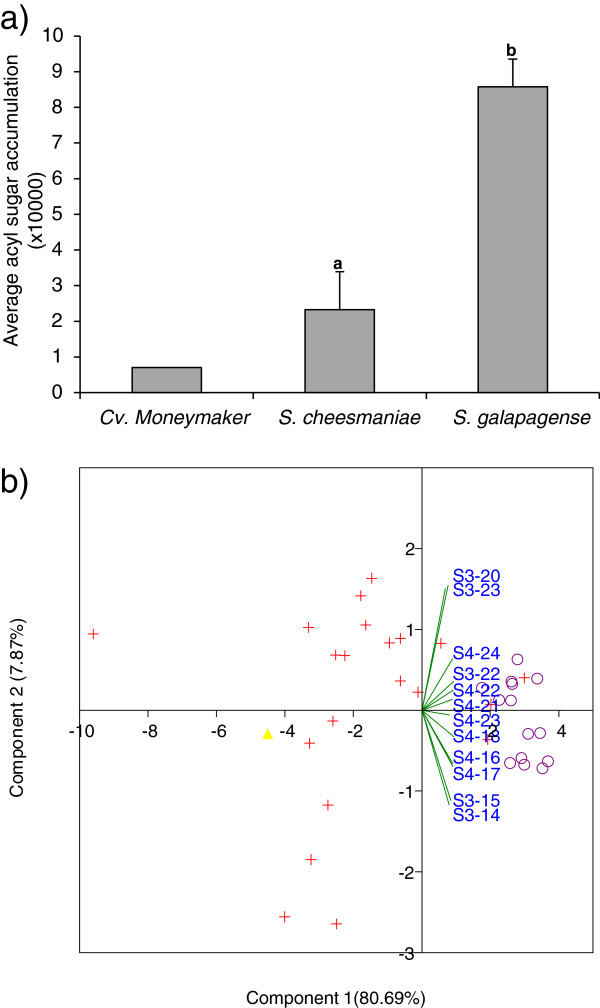
We have characterized 12 accessions of S. galapagense, 22 of S. cheesmaniae, and one of S. lycopersicum as reference for whitefly resistance using no-choice experiments. Whitefly resistance was found in S. galapagense only and was associated with the presence of relatively high levels of acyl sugars and the presence of glandular trichomes of type I and IV. Genetic fingerprinting using 3316 SNP markers did not show a clear differentiation between the two endemic species. Acyl sugar accumulation as well as the climatic and geographical conditions at the collection sites of the accessions did not follow the morphological species boundaries.
Our results suggest that S. galapagense and S. cheesmaniae might be morphotypes rather than two species and that their co-existence is likely the result of selective pressure.
加拉帕戈斯群岛构成了一个高度多样化的生态系统,是特有物种形式的变异的独特来源。这里有两个特有番茄物种,即 S. galapagense 和 S. cheesmaniae,以及两个引入番茄物种,即 S. pimpinellifolium 和 S. lycopersicum。从形态上看,加拉帕戈斯群岛的这两个特有番茄物种明显不同,但分子标记分析显示它们没有明显的分离。加拉帕戈斯群岛上的番茄受到本地和外来食草动物的影响。烟粉虱是一种重要的引入昆虫物种,它以广泛的植物为食。在本文中,我们提出了这样一个问题,即 S. galapagense 和 S. cheesmaniae 的分化是否与对韧皮部取食者的易感性差异有关,并使用烟粉虱作为模型来评估这一点。
我们使用非选择实验,对 12 个 S. galapagense 、22 个 S. cheesmaniae 和 1 个 S. lycopersicum 品系进行了特征描述,作为对白粉虱抗性的参考。仅在 S. galapagense 中发现了对白粉虱的抗性,这与相对高水平的酰基糖的存在以及 I 型和 IV 型腺毛的存在有关。使用 3316 个 SNP 标记的遗传指纹图谱没有显示出这两个特有物种之间的明显分化。酰基糖积累以及访问的收集地点的气候和地理条件都没有遵循形态物种边界。
我们的结果表明,S. galapagense 和 S. cheesmaniae 可能是形态型而不是两个物种,它们的共存很可能是选择压力的结果。