Lucatti Alejandro F, Meijer-Dekens Fien R G, Mumm Roland, Visser Richard G F, Vosman Ben, van Heusden Sjaak
Wageningen UR Plant Breeding, Wageningen University and Research Centre, PO Box 386, 6700, AJ, Wageningen, The Netherlands.
Graduate School Experimental Plant Sciences, Wageningen Campus. Droevendaalsesteeg 1, 6708, PB, Wageningen, The Netherlands.
BMC Genet. 2014 Dec 24;15:142. doi: 10.1186/s12863-014-0142-3.
Host plant resistance has been proposed as one of the most promising approaches in whitefly management. Already in 1995 two quantitative trait loci (Tv-1 and Tv-2) originating from S. habrochaites CGN1.1561 were identified that reduced the oviposition rate of the greenhouse whitefly (Trialeurodes vaporariorum). After this first study, several others identified QTLs affecting whitefly biology as well. Generally, the QTLs affecting oviposition were highly correlated with a reduction in whitefly survival and the presence of high densities of glandular trichomes type IV. The aim of our study was to further characterize Tv-1 and Tv-2, and to determine their role in resistance against Bemisia tabaci.
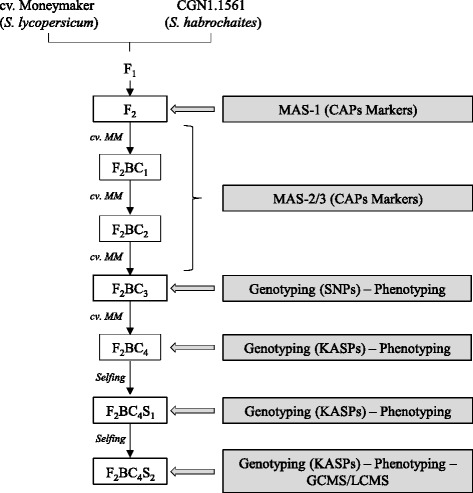
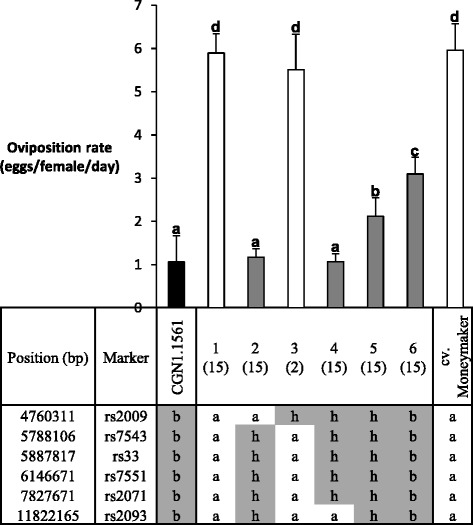
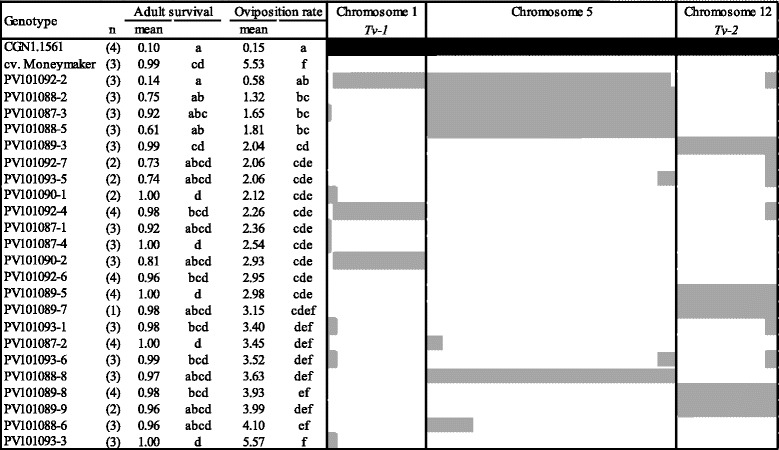
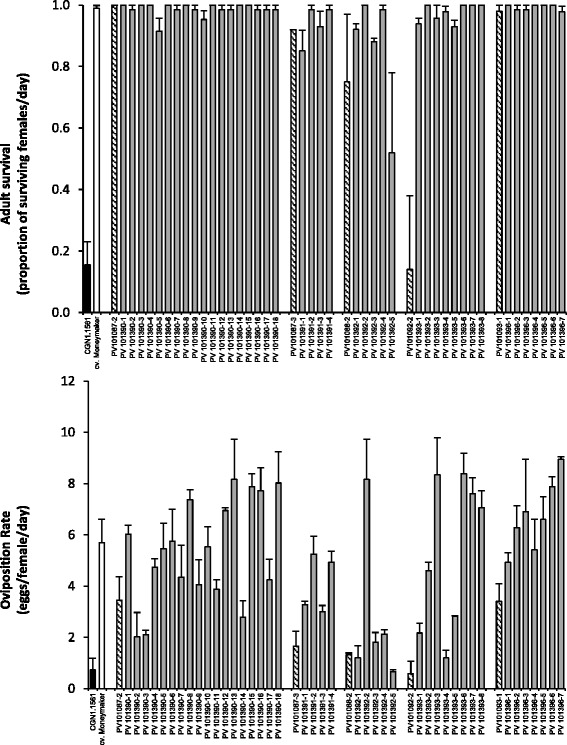
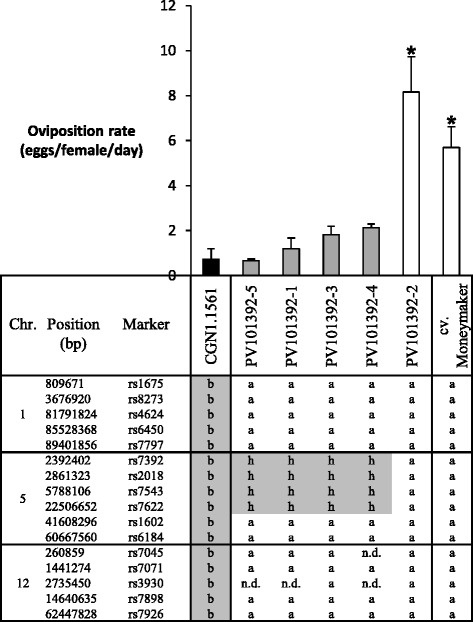
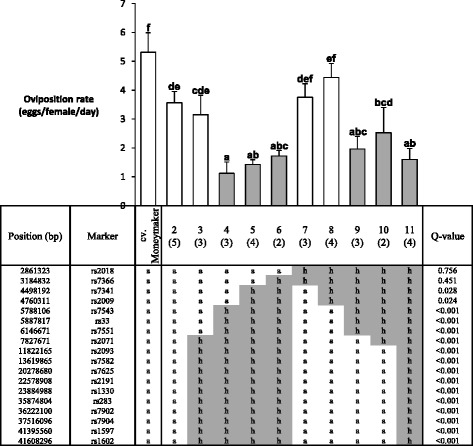
We selected F2 plants homozygous for the Tv-1 and Tv-2 QTL regions and did three successive backcrosses without phenotypic selection. Twenty-three F2BC3 plants were phenotyped for whitefly resistance and differences were found in oviposition rate of B. tabaci. The F2BC3 plants with the lowest oviposition rate had an introgression on Chromosome 5 in common. Further F2BC4, F2BC4S1 and F2BC4S2 families were developed, genotyped and phenotyped for adult survival, oviposition rate and trichome type and density. It was possible to confirm that an introgression on top of Chr. 5 (OR-5), between the markers rs-2009 and rs-7551, was responsible for reducing whitefly oviposition rate.
We found a region of 3.06 Mbp at the top of Chr. 5 (OR-5) associated with a reduction in the oviposition rate of B. tabaci. This reduction was independent of the presence of the QTLs Tv-1 and Tv-2 as well as of the presence of trichomes type IV. The OR-5 locus will provide new opportunities for resistance breeding against whiteflies, which is especially relevant in greenhouse cultivation.
寄主植物抗性已被认为是粉虱治理中最具前景的方法之一。早在1995年,就已鉴定出源自多毛番茄CGN1.1561的两个数量性状基因座(Tv-1和Tv-2),它们可降低温室粉虱(烟粉虱)的产卵率。在这项首次研究之后,其他一些研究也鉴定出了影响粉虱生物学特性的数量性状基因座。一般来说,影响产卵的数量性状基因座与粉虱存活率的降低以及IV型腺毛的高密度存在高度相关。我们研究的目的是进一步表征Tv-1和Tv-2,并确定它们在抗烟粉虱中的作用。
我们选择了Tv-1和Tv-2数量性状基因座区域纯合的F2植株,并进行了三次连续回交,未进行表型选择。对23株F2BC3植株进行了粉虱抗性表型分析,发现烟粉虱的产卵率存在差异。产卵率最低的F2BC3植株在第5号染色体上有一个共同的渗入片段。进一步培育了F2BC4、F2BC4S1和F2BC4S2家系,对其进行基因分型,并对成虫存活率、产卵率以及毛状体类型和密度进行了表型分析。可以确认,在标记rs-2009和rs-7551之间,第5号染色体顶部的一个渗入片段(OR-5)导致了粉虱产卵率的降低。
我们在第5号染色体顶部发现了一个3.06 Mbp的区域(OR-5),它与烟粉虱产卵率的降低有关。这种降低与数量性状基因座Tv-1和Tv-2的存在以及IV型毛状体的存在无关。OR-5基因座将为粉虱抗性育种提供新的机会,这在温室栽培中尤为重要。