State Key Laboratory of Forest and Soil Ecology, Institute of Applied Ecology, Chinese Academy of Sciences, Shenyang, China ; Graduate University of Chinese Academy of Sciences, Beijing, China.
PLoS One. 2013 Aug 20;8(8):e71749. doi: 10.1371/journal.pone.0071749. eCollection 2013.
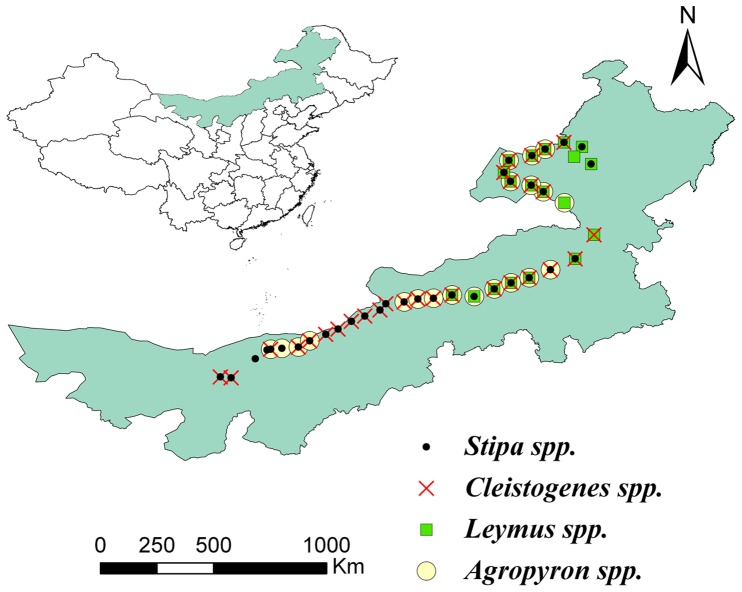
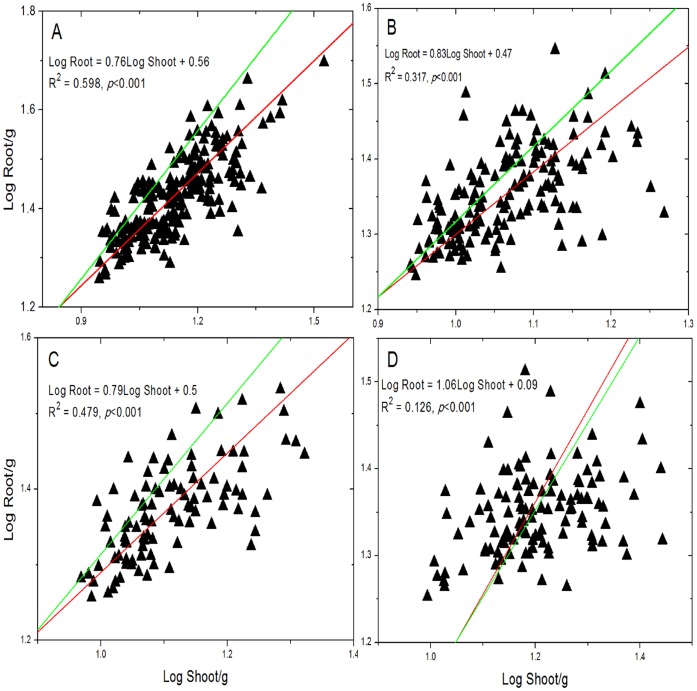
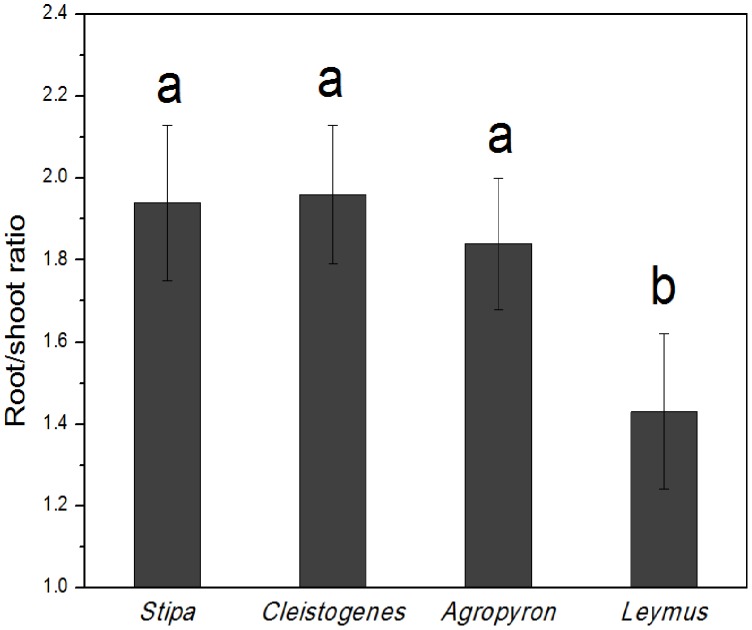
Plant biomass allocation between below- and above-ground parts can actively adapt to the ambient growth conditions and is a key parameter for estimating terrestrial ecosystem carbon (C) stocks. To investigate how climatic variations affect patterns of plant biomass allocation, we sampled 548 plants belonging to four dominant genera (Stipa spp., Cleistogenes spp., Agropyron spp., and Leymus spp.) along a large-scale (2500 km) climatic gradient across the temperate grasslands from west to east in northern China. Our results showed that Leymus spp. had the lowest root/shoot ratios among the each genus. Root/shoot ratios of each genera were positively correlated with mean annual temperature (MAT), and negatively correlated with mean annual precipitation (MAP) across the transect. Temperature contributed more to the variation of root/shoot ratios than precipitation for Cleistogenes spp. (C4 plants), whereas precipitation exerted a stronger influence than temperature on their variations for the other three genera (C3 plants). From east to west, investment of C into the belowground parts increased as precipitation decreased while temperature increased. Such changes in biomass allocation patterns in response to climatic factors may alter the competition regimes among co-existing plants, resulting in changes in community composition, structure and ecosystem functions. Our results suggested that future climate change would have great impact on C allocation and storage, as well as C turnover in the grassland ecosystems in northern China.
植物地上部分和地下部分的生物量分配可以主动适应环境生长条件,是估计陆地生态系统碳(C)储量的关键参数。为了研究气候变异如何影响植物生物量分配模式,我们沿中国北方温带草原从西到东的大尺度(2500 公里)气候梯度,对属于四个主要属(芨芨草属、冰草属、冰草属和羊草属)的 548 株植物进行了采样。我们的研究结果表明,羊草属植物的根/冠比在每个属中最低。每个属的根/冠比与沿样带的年平均温度(MAT)呈正相关,与年平均降水量(MAP)呈负相关。温度对冰草属(C4 植物)根/冠比的变异贡献大于降水,而降水对其他三个属(C3 植物)根/冠比的变异影响大于温度。从东到西,随着降水减少和温度升高,植物将更多的 C 投入到地下部分。这种对生物量分配模式的响应气候因子的变化可能会改变共存植物之间的竞争格局,从而导致群落组成、结构和生态系统功能的变化。我们的研究结果表明,未来气候变化将对中国北方草原生态系统的 C 分配和储存以及 C 周转产生重大影响。