Sluchanko Nikolai N, Chebotareva Natalia A, Gusev Nikolai B
Laboratory of Molecular Organization of Biological Structures, AN Bach Institute of Biochemistry of the Russian Academy of Sciences, Moscow, Russian Federation.
PLoS One. 2013 Aug 19;8(8):e72597. doi: 10.1371/journal.pone.0072597. eCollection 2013.
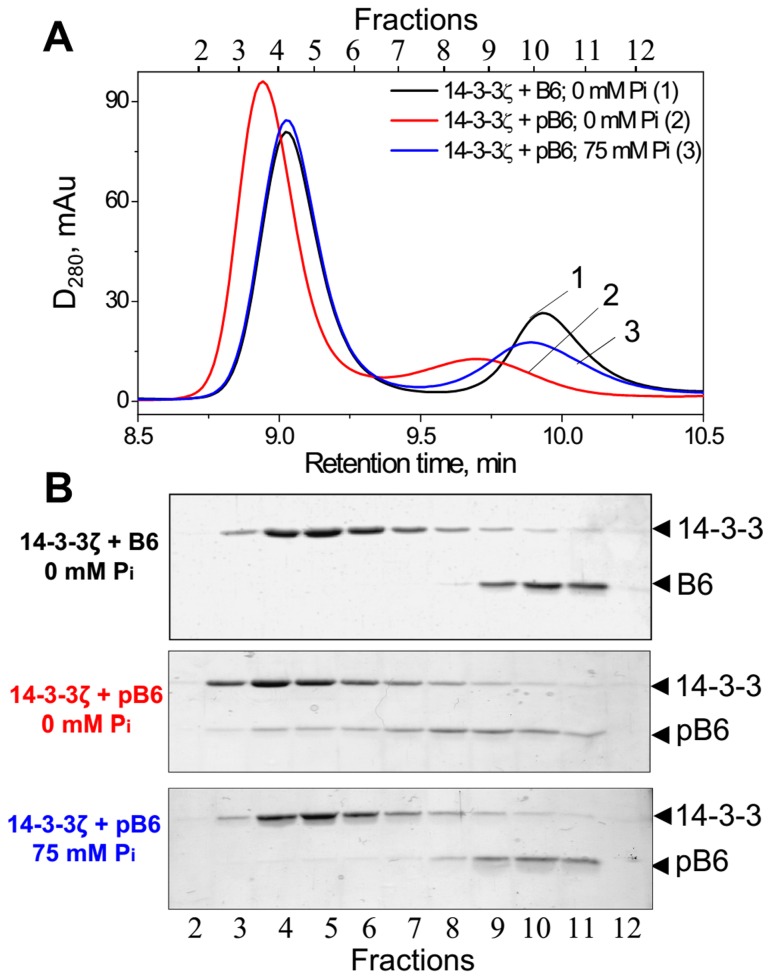
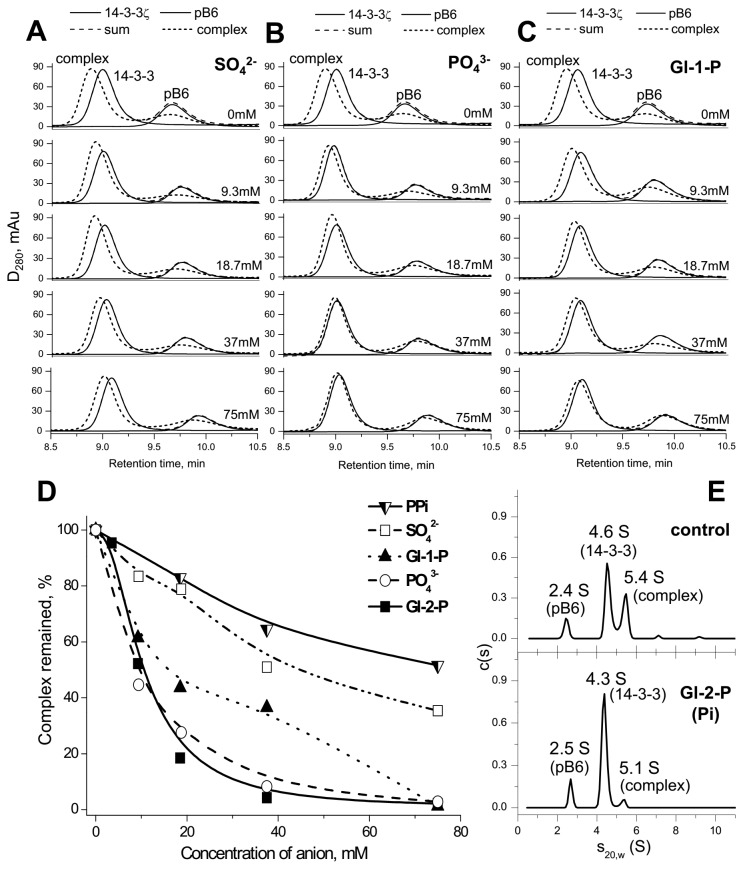
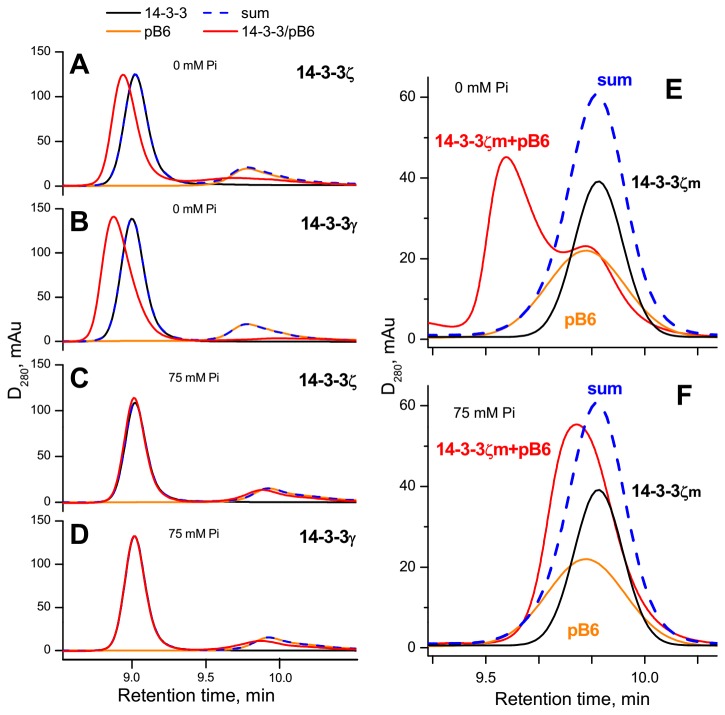
Molecular mechanisms governing selective binding of a huge number of various phosphorylated protein partners to 14-3-3 remain obscure. Phosphate can bind to 14-3-3 and therefore being present at high intracellular concentration, which undergoes significant changes under physiological conditions, phosphate can theoretically regulate interaction of 14-3-3 with phosphorylated targets. In order to check this hypothesis we analyzed effect of phosphate and other natural abundant anions on interaction of 14-3-3 with phosphorylated human small heat shock protein HspB6 (Hsp20) participating in regulation of different intracellular processes. Inorganic phosphate, glycerol-1-phosphate and glycerol-2-phosphate at physiologically relevant concentrations (5-15 mM) significantly destabilized complexes formed by 14-3-3ζ and phosphorylated HspB6 (pHspB6), presumably, via direct interaction with the substrate-binding site of 14-3-3. Phosphate also destabilized complexes between pHspB6 and 14-3-3γ or the monomeric mutant form of 14-3-3ζ. Inorganic sulfate and pyrophosphate were less effective in modulation of 14-3-3 interaction with its target protein. The inhibitory effect of all anions on pHspB6/14-3-3 interaction was concentration-dependent. It is hypothesized that physiological changes in phosphate anions concentration can modulate affinity and specificity of interaction of 14-3-3 with its multiple targets and therefore the actual phosphointeractome of 14-3-3.
大量不同磷酸化蛋白伴侣与14-3-3选择性结合的分子机制仍不清楚。磷酸可与14-3-3结合,由于其在细胞内浓度较高,且在生理条件下会发生显著变化,因此理论上磷酸可调节14-3-3与磷酸化靶标的相互作用。为了验证这一假设,我们分析了磷酸和其他天然丰富阴离子对14-3-3与参与不同细胞内过程调节的磷酸化人小分子热休克蛋白HspB6(Hsp20)相互作用的影响。生理相关浓度(5-15 mM)的无机磷酸、甘油-1-磷酸和甘油-2-磷酸显著破坏了由14-3-3ζ和磷酸化HspB6(pHspB6)形成的复合物,推测是通过与14-3-3的底物结合位点直接相互作用。磷酸还破坏了pHspB6与14-3-3γ或14-3-3ζ的单体突变形式之间的复合物。无机硫酸根和焦磷酸在调节14-3-3与其靶蛋白相互作用方面效果较差。所有阴离子对pHspB6/14-3-3相互作用的抑制作用均呈浓度依赖性。据推测,磷酸根阴离子浓度的生理变化可调节14-3-3与其多个靶标的相互作用亲和力和特异性,从而调节14-3-3的实际磷酸化相互作用组。