Bahrami Adam K, Zhang Yun
Department of Organismic and Evolutionary Biology, Center for Brain Science, Harvard University, Cambridge, Massachusetts 02138.
G3 (Bethesda). 2013 Oct 3;3(10):1851-9. doi: 10.1534/g3.113.007914.
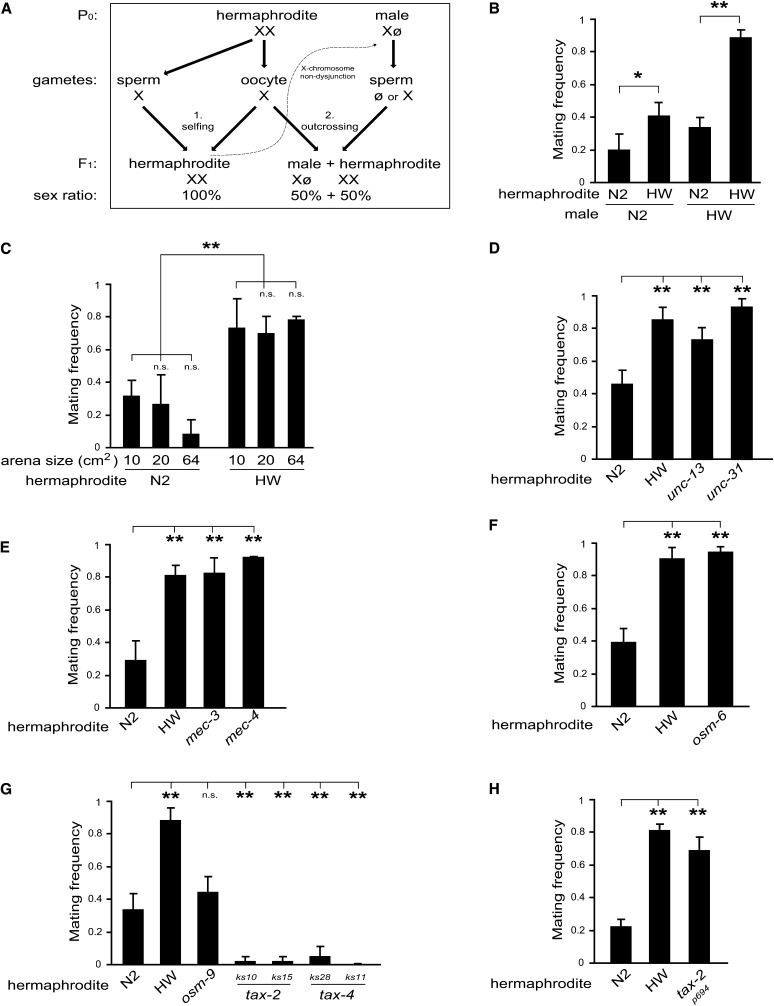
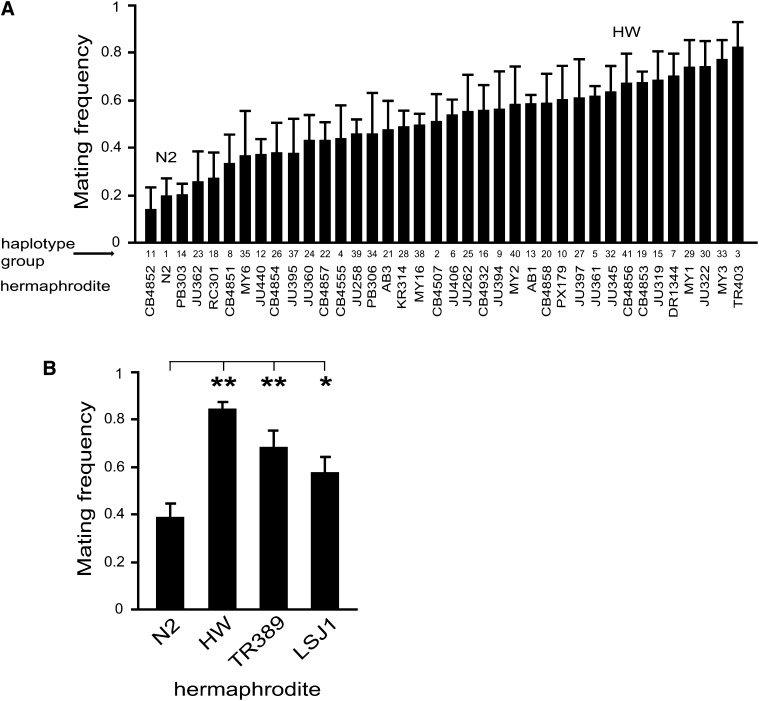
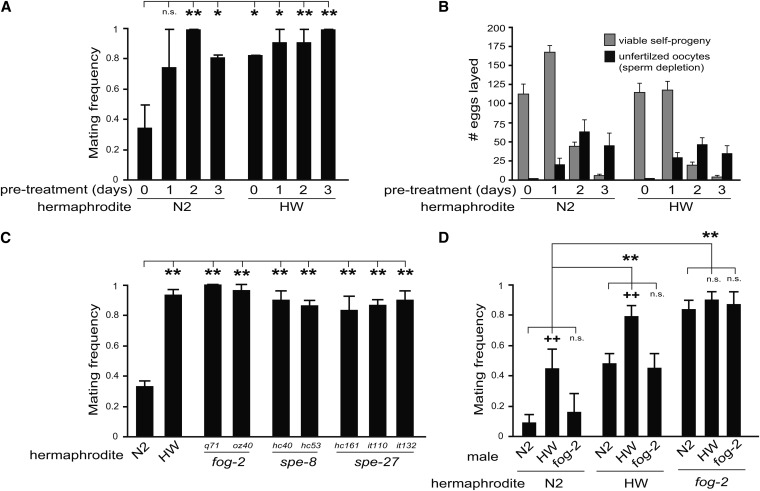
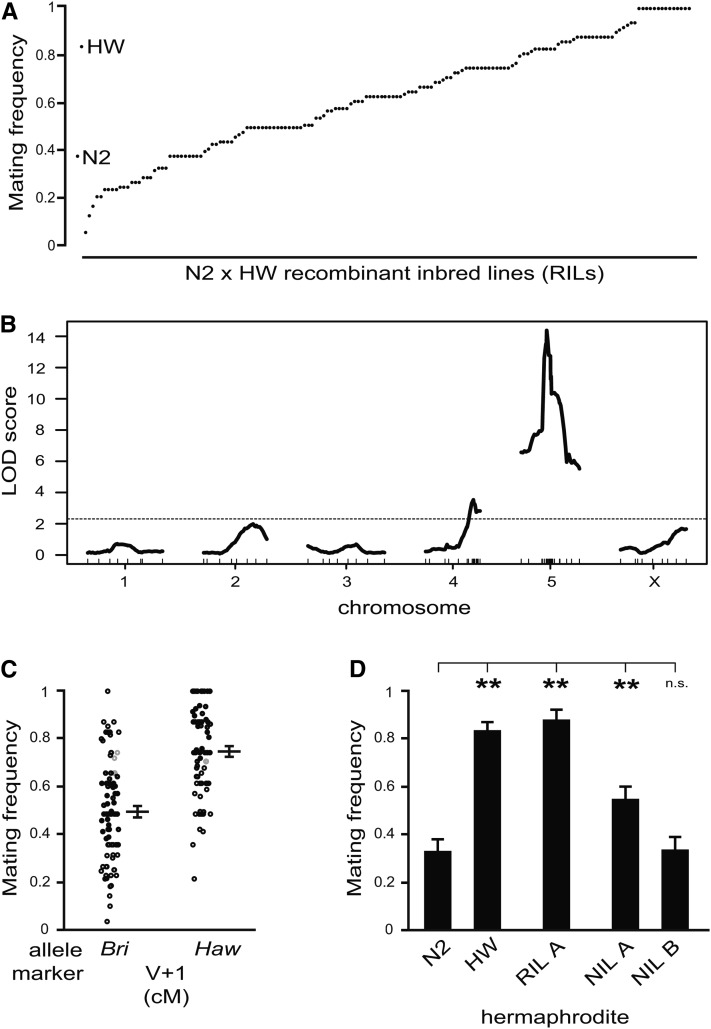
Reproductive behaviors have manifold consequences on evolutionary processes. Here, we explore mechanisms underlying female reproductive choice in the nematode Caenorhabditis elegans, a species in which females have evolved the ability to produce their own self-fertilizing sperm, thereby allowing these "hermaphrodites" the strategic choice to self-reproduce or outcross with males. We report that hermaphrodites of the wild-type laboratory reference strain N2 favor self-reproduction, whereas a wild isolate CB4856 (HW) favors outcrossing. To characterize underlying neural mechanisms, we show that N2 hermaphrodites deficient in mechanosensation or chemosensation (e.g., mec-3 and osm-6 mutants) exhibit high mating frequency, implicating hermaphrodite perception of males as a requirement for low mating frequency. Within chemosensory networks, we find opposing roles for different sets of neurons that express the cyclic GMP-gated nucleotide channel, suggesting both positive and negative sensory-mediated regulation of hermaphrodite mating frequency. We also show that the ability to self-reproduce negatively regulates hermaphrodite mating. To map genetic variation, we created recombinant inbred lines and identified two QTL that explain a large portion of N2 × HW variation in hermaphrodite mating frequency. Intriguingly, we further show that ∼40 wild isolates representing C. elegans global diversity exhibit extensive and continuous variation in hermaphrodite reproductive outcome. Together, our findings demonstrate that C. elegans hermaphrodites actively regulate the choice between selfing and crossing, highlight the existence of natural variation in hermaphrodite choice, and lay the groundwork for molecular dissection of this evolutionarily important trait.
生殖行为对进化过程具有多方面的影响。在此,我们探究秀丽隐杆线虫雌性生殖选择背后的机制,在该物种中,雌性已进化出产生自身自交精子的能力,从而使这些“雌雄同体”能够在自我繁殖或与雄性杂交之间做出策略性选择。我们报告称,野生型实验室参考菌株N2的雌雄同体倾向于自我繁殖,而野生分离株CB4856(HW)则倾向于杂交。为了表征潜在的神经机制,我们发现缺乏机械感觉或化学感觉的N2雌雄同体(例如,mec-3和osm-6突变体)表现出高交配频率,这表明雌雄同体对雄性的感知是低交配频率的必要条件。在化学感觉网络中,我们发现表达环鸟苷酸门控核苷酸通道的不同神经元组发挥着相反的作用,这表明化学感觉介导的对雌雄同体交配频率既有正向调节也有负向调节。我们还表明,自我繁殖的能力对雌雄同体的交配具有负调节作用。为了定位遗传变异,我们创建了重组自交系,并确定了两个数量性状位点,它们解释了N2×HW雌雄同体交配频率变异的很大一部分。有趣的是,我们进一步表明,代表秀丽隐杆线虫全球多样性的约40个野生分离株在雌雄同体的生殖结果上表现出广泛且连续的变异。总之,我们的研究结果表明秀丽隐杆线虫雌雄同体能够积极调节自交和杂交之间的选择,突出了雌雄同体选择中自然变异的存在,并为这一具有进化重要性的性状的分子剖析奠定了基础。