Laboratory of Translational Physiology, Health Sciences Center, Federal University of Espirito Santo (UFES), Vitoria, Brazil.
Lipids Health Dis. 2013 Aug 28;12:128. doi: 10.1186/1476-511X-12-128.
It is well known that enhanced production of reactive oxygen species (ROS) leads to oxidative stress observed in atherosclerosis and that ROS can also cause damage in cellular macromolecules, including DNA. Considering previous report that sildenafil, an inhibitor of phosphodiesterase 5 (PDE5), has antioxidant effects, in the present study we evaluated the effect of this drug on genotoxicity of blood mononuclear cells (MNC) and liver cells from atherosclerotic apolipoprotein E knockout mice (apoE(-/-)).
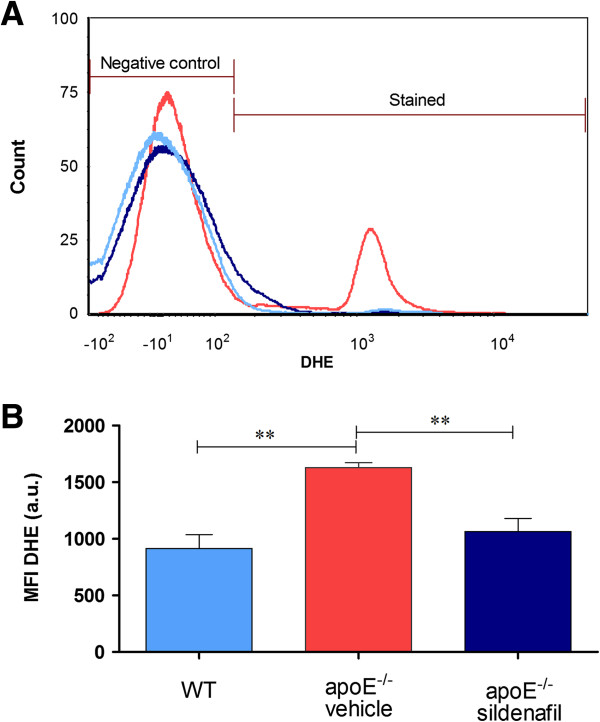
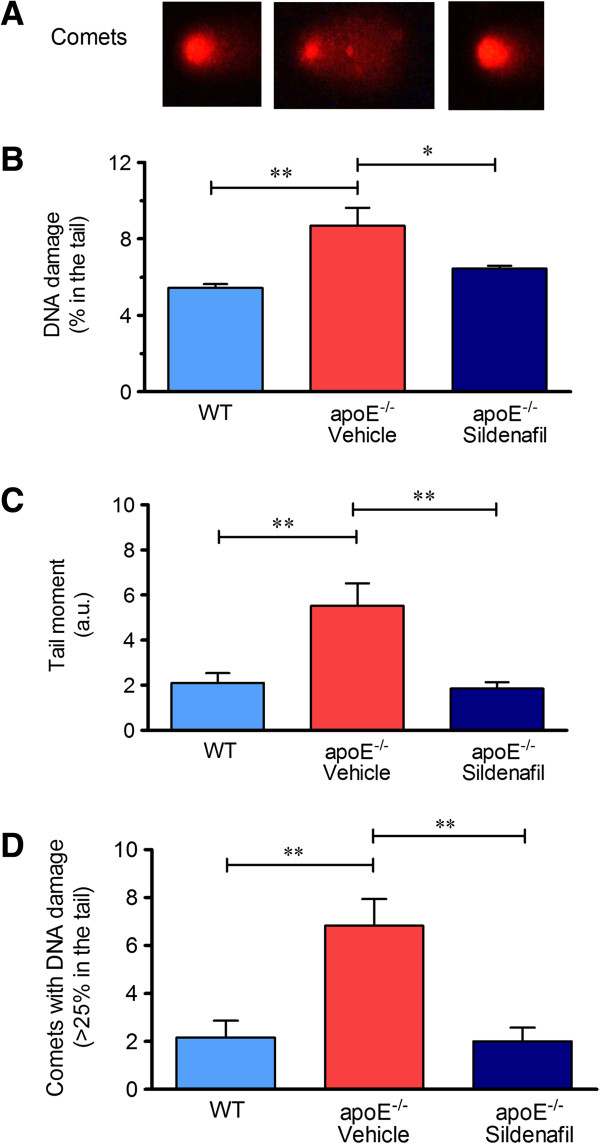
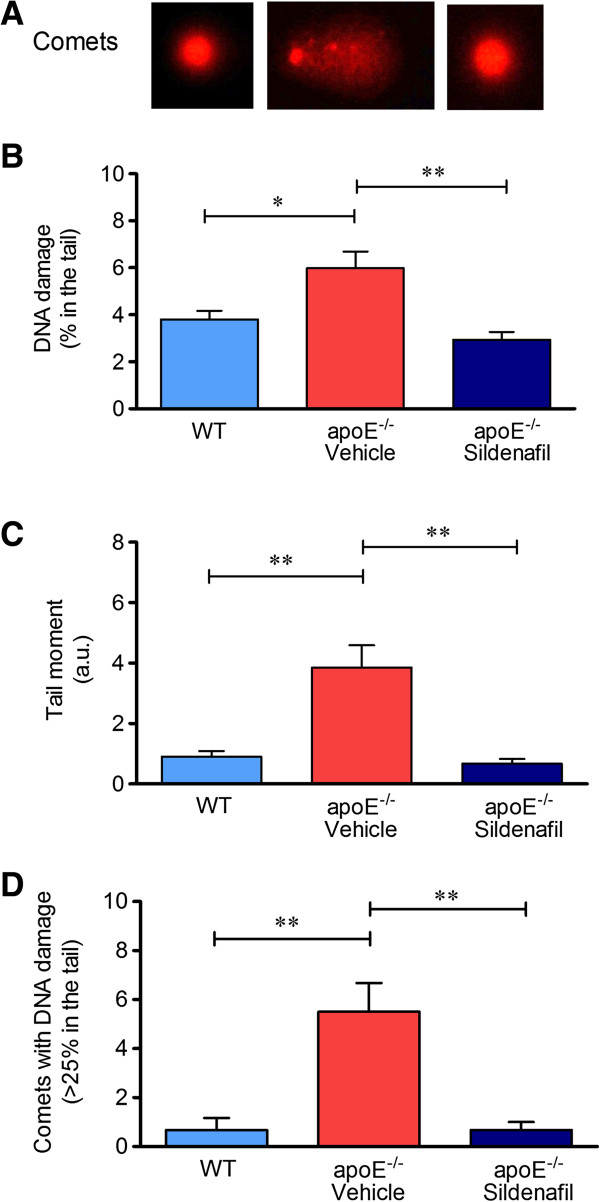
ROS production in MNC was evaluated by flow cytometry with the fluorescent dye dihydroethidium (DHE), a method that has been used to quantify the production of superoxide anion, and DNA damage was evaluated in both MNC and liver cells using the alkaline comet assay. Sildenafil-administered apoE(-/-) mice were compared with strain-matched mice administered with vehicle and with C57BL/6 wild-type (WT) mice.
MNC from apoE(-/-) vehicle exhibited a 2-fold increase in production of superoxide anion in comparison with WT. In contrast, sildenafil-administered apoE(-/-) mice showed superoxide anion levels similar to those observed in WT mice. Similarly, MNC and liver cells from apoE(-/-) vehicle mice showed a 4-fold and 2-fold augmented DNA fragmentation compared with WT, respectively, and sildenafil-administered apoE(-/-) mice exhibited minimal DNA damage in those cells similar to WT mice.
ApoE(-/-) mice chronically administered with sildenafil exhibited reduced levels of superoxide anion in MNC and less DNA fragmentation in MNC and liver cells, which are biomarkers of genotoxicity. Therefore, sildenafil may offer a new perspective to the use of PDE5 inhibitors to protect against DNA damage, in cells involved in the inflammatory and dyslipidemic processes that accompany atherosclerosis.
众所周知,活性氧(ROS)的产生增加会导致动脉粥样硬化中观察到的氧化应激,而 ROS 也会导致包括 DNA 在内的细胞大分子损伤。考虑到先前有报道称,磷酸二酯酶 5(PDE5)抑制剂西地那非具有抗氧化作用,本研究评估了该药物对动脉粥样硬化载脂蛋白 E 基因敲除(apoE(-/-))小鼠血液单核细胞(MNC)和肝细胞的遗传毒性的影响。
通过用荧光染料二氢乙啶(DHE)进行流式细胞术评估 MNC 中的 ROS 产生,该方法已用于定量超氧阴离子的产生,并用碱性彗星试验评估 MNC 和肝细胞中的 DNA 损伤。西地那非给药的 apoE(-/-)小鼠与给予载体的同系小鼠和 C57BL/6 野生型(WT)小鼠进行比较。
与 WT 相比,apoE(-/-)载体 MNC 的超氧阴离子产生增加了 2 倍。相比之下,西地那非给药的 apoE(-/-)小鼠的超氧阴离子水平与 WT 小鼠相似。同样,apoE(-/-)载体小鼠的 MNC 和肝细胞的 DNA 片段化分别增加了 4 倍和 2 倍,而西地那非给药的 apoE(-/-)小鼠的这些细胞中的 DNA 损伤最小,与 WT 小鼠相似。
长期给予西地那非的 apoE(-/-)小鼠的 MNC 中超氧阴离子水平降低,MNC 和肝细胞中的 DNA 片段化减少,这是遗传毒性的生物标志物。因此,西地那非可能为使用 PDE5 抑制剂提供新的视角,以防止与动脉粥样硬化相关的炎症和血脂异常过程中涉及的细胞中的 DNA 损伤。