A. N. Belozersky Institute for Physico-Chemical Biology, Lomonosov Moscow State University, Moscow 119991, Russia Institute of Gene Biology, Russian Academy of Sciences, Moscow 119334, Russia Institute of Protein Research, Russian Academy of Sciences, Moscow 117334, Russia.
Mol Biol Cell. 2013 Oct;24(20):3205-14. doi: 10.1091/mbc.E13-03-0137. Epub 2013 Aug 28.
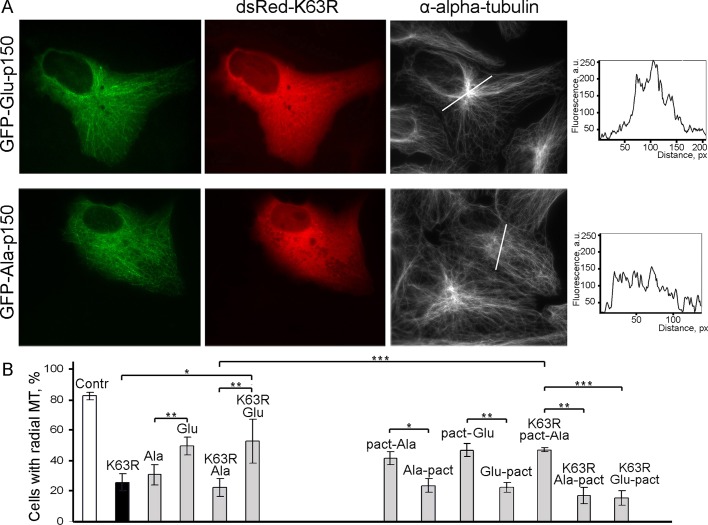
The microtubule- and centrosome-associated Ste20-like kinase (SLK; long Ste20-like kinase [LOSK]) regulates cytoskeleton organization and cell polarization and spreading. Its inhibition causes microtubule disorganization and release of centrosomal dynactin. The major function of dynactin is minus end-directed transport along microtubules in a complex with dynein motor. In addition, dynactin is required for maintenance of the microtubule radial array in interphase cells, and depletion of its centrosomal pool entails microtubule disorganization. Here we demonstrate that SLK (LOSK) phosphorylates the p150(Glued) subunit of dynactin and thus targets it to the centrosome, where it maintains microtubule radial organization. We show that phosphorylation is required only for centrosomal localization of p150(Glued) and does not affect its microtubule-organizing properties: artificial targeting of nonphosphorylatable p150(Glued) to the centrosome restores microtubule radial array in cells with inhibited SLK (LOSK). The phosphorylation site is located in a microtubule-binding region that is variable for two isoforms (1A and 1B) of p150(Glued) expressed in cultured fibroblast-like cells (isoform 1B lacks 20 amino acids in the basic microtubule-binding domain). The fact that SLK (LOSK) phosphorylates only a minor isoform 1A of p150(Glued) suggests that transport and microtubule-organizing functions of dynactin are distinctly divided between the two isoforms. We also show that dynactin phosphorylation is involved in Golgi reorientation in polarized cells.
微管和中心体相关的 Ste20 样激酶(SLK;长 Ste20 样激酶 [LOSK])调节细胞骨架组织和细胞极化和扩展。其抑制导致微管解聚和中心体动力蛋白释放。动力蛋白的主要功能是在微管上沿微管的负端进行运输,与动力蛋白马达形成复合物。此外,动力蛋白对于间期细胞中微管的径向排列的维持是必需的,其中心体池的耗竭导致微管解聚。本文中,我们证明 SLK(LOSK)磷酸化动力蛋白 dynactin 的 p150(Glued)亚基,并将其靶向到中心体,在那里它维持微管的径向组织。我们表明,磷酸化仅对于 p150(Glued)的中心体定位是必需的,并且不影响其微管组织特性:不可磷酸化的 p150(Glued)的人工靶向到中心体恢复了 SLK(LOSK)抑制的细胞中的微管径向排列。磷酸化位点位于微管结合区,在培养的成纤维样细胞中表达的 p150(Glued)的两种同工型(1A 和 1B)中是可变的(同工型 1B 在碱性微管结合域中缺少 20 个氨基酸)。SLK(LOSK)仅磷酸化 p150(Glued)的次要同工型 1A 的事实表明 dynactin 的运输和微管组织功能在两种同工型之间明显划分。我们还表明,动力蛋白磷酸化参与极化细胞中的高尔基体重定向。