Department of Medicinal Chemistry and Molecular Pharmacology, College of Pharmacy, Purdue University West Lafayette, IN, USA.
Front Genet. 2013 Aug 26;4:162. doi: 10.3389/fgene.2013.00162. eCollection 2013.
The rs2736100 single nucleotide polymorphism (SNP) is located in the intron 2 of human telomerase reverse transcriptase (hTERT) gene. Recent genome-wide association studies (GWAS) have consistently supported the strong association between this SNP and risk for multiple cancers. Given the important role of the hTERT gene and this SNP in cancer biology, we hypothesize that rs2736100 may also confer susceptibility to anti-cancer drug sensitivity. In this study we aim to investigate the correlation between the rs2736100 genotype and the responsiveness to anti-cancer agents in the NCI-60 cancer cell panel.
The hTERT rs2736100 was genotyped in the NCI-60 cancer cell lines. The relative telomere length (RTL) of each cell line was quantified using real-time PCR. The genotype was then correlated with publically available drug sensitivity data of two agents with telomerase-inhibition activity: Geldanamycin (HSP90 inhibitor) and RHPS4/BRACO19 (G-quadruplex stabilizer) as well as additional 110 commonly used agents with established mechanism of action. The association between rs2736100 and mutation status of TP53 gene was also tested.
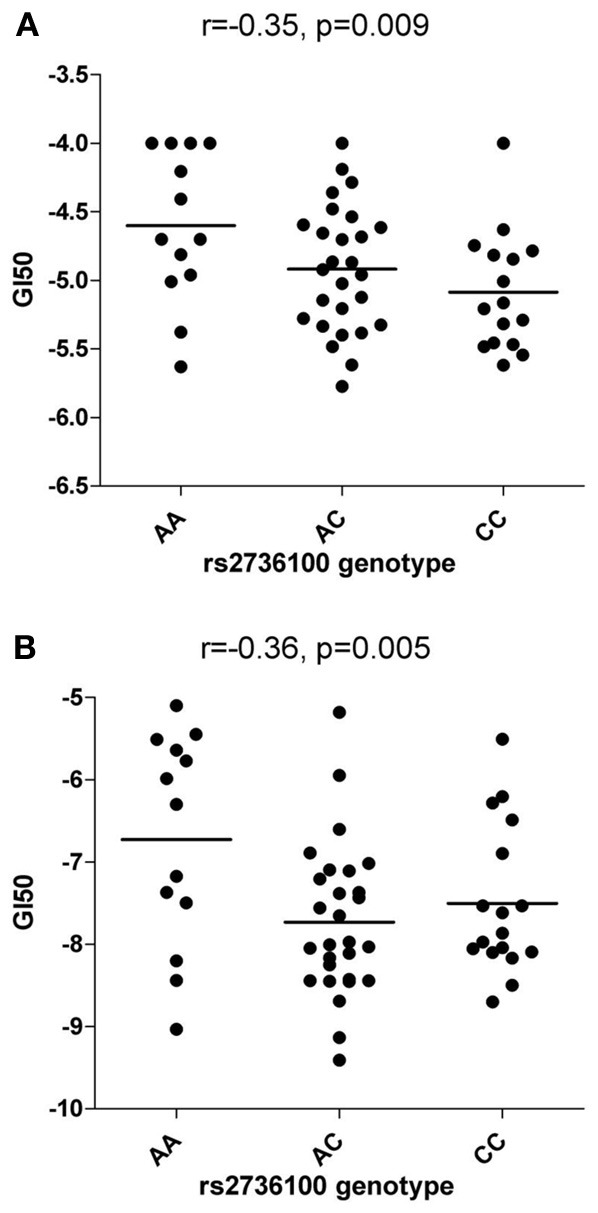
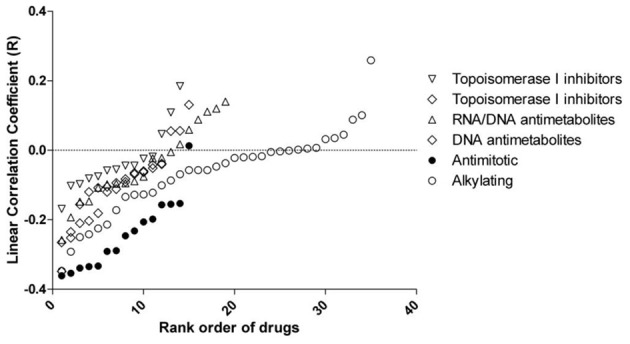
The C allele of the SNP was significantly correlated with increased sensitivity to RHPS4/BRACO19 with an additive effect (r = -0.35, p = 0.009) but not with Geldanamycin. The same allele was also significantly associated with sensitivity to antimitotic agents compared to other agents (p = 0.003). The highest correlation was observed between the SNP and paclitaxel (r = -0.36, p = 0.005). The telomere length was neither associated with rs2736100 nor with sensitivity to anti-cancer agents. The C allele of rs2736100 was significantly associated with increased mutation rate in TP53 gene (p = 0.004).
Our data suggested that the cancer risk allele of hTERT rs2736100 polymorphism may also affect the cancer cell response to both TERT inhibitor and anti-mitotic agents, which might be attributed to the elevated telomerase-independent activity of hTERT, as well as the increased risk for TP53 gene mutagenesis conferred by the polymorphism. Detailed mechanisms need to be further investigated.
rs2736100 单核苷酸多态性(SNP)位于人端粒酶逆转录酶(hTERT)基因的内含子 2 中。最近的全基因组关联研究(GWAS)一致支持该 SNP 与多种癌症风险之间的强关联。鉴于 hTERT 基因和该 SNP 在癌症生物学中的重要作用,我们假设 rs2736100 也可能导致对抗癌药物敏感性的易感性。在这项研究中,我们旨在研究 NCI-60 癌细胞系中 rs2736100 基因型与抗癌药物反应之间的相关性。
在 NCI-60 癌细胞系中对 hTERT rs2736100 进行了基因分型。使用实时 PCR 定量了每条细胞系的相对端粒长度(RTL)。然后将基因型与两种具有端粒酶抑制活性的药物的公开可用药物敏感性数据相关联:geldanamycin(HSP90 抑制剂)和 RHPS4/BRACO19(G-四链体稳定剂)以及另外 110 种具有既定作用机制的常用药物。还测试了 rs2736100 与 TP53 基因突变状态之间的关联。
SNP 的 C 等位基因与 RHPS4/BRACO19 的敏感性增加呈显著相关,具有加性效应(r = -0.35,p = 0.009),但与 geldanamycin 无关。与其他药物相比,同一等位基因也与抗有丝分裂药物的敏感性显著相关(p = 0.003)。观察到 SNP 与紫杉醇之间的相关性最高(r = -0.36,p = 0.005)。端粒长度既与 rs2736100 无关,也与抗癌药物的敏感性无关。rs2736100 的 C 等位基因与 TP53 基因突变率的增加显著相关(p = 0.004)。
我们的数据表明,hTERT rs2736100 多态性的癌症风险等位基因也可能影响癌细胞对 TERT 抑制剂和抗有丝分裂药物的反应,这可能归因于 hTERT 的端粒酶非依赖性活性升高,以及该多态性导致的 TP53 基因突变风险增加。需要进一步研究详细的机制。