Karampatakis Vasileios, Konidaris Vasileios, Michailidou Maria, Gerofotis Antonios, Daniilidis Michail
Laboratory of Experimental Ophthalmology, Aristotle University of Thessaloniki, Thessaloniki, Greece.
Am J Case Rep. 2013 Aug 12;14:318-21. doi: 10.12659/AJCR.883998. eCollection 2013.
Female, 60 FINAL DIAGNOSIS: Corneal ulceration Symptoms: Blurred vision Medication: Abatacept Clinical Procedure: - Specialty: Ophthalmology.
Management of emergency care.
To report a case of a patient with rheumatoid arthritis (RA) and associated peripheral corneal ulceration.
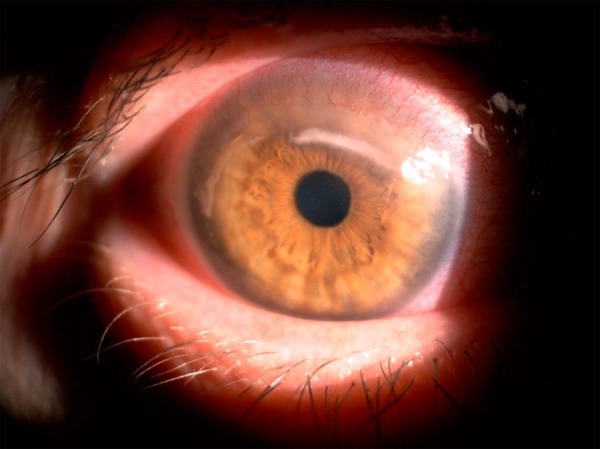
A 60-year-old woman with RA diagnosed 15 years ago, under immunosuppressive therapy (IV abatacept 250 mg/month), demonstrated blurring of vision in her RE (right eye). Visual acuity was 6/10 in the RE and 10/10 in the LE. Slit lamp examination revealed a paracentral superior corneal melt in the RE. Anterior chamber reaction was 2+. Laboratory investigations revealed positive anti-Ro and anti-La, anti-Extractable Nuclear Antigens (anti-ENA, ELISA), while anti-Sm, anti-Rnp, anti-Jo1 and anti-Scl70 were found negative. IgG and IgA serum immunoglobulins were found elevated, but IgE and IgM were within normal levels. Further evaluation for the underlying disease revealed highly elevated rheumatoid factor and C-reactive protein. The patient, who had been receiving anti-TNF during the last 6 months, underwent treatment with topical tobramycin and lubricants and oral prednisone 60 mg/day with tapering doses, to which methotrexate p.os. 15 mg/week was added. The condition improved within a few days after the initiation of prednisone treatment. Re-epithelization occurred 1 week after the onset of the immunosuppressive treatment. Only punctate fluorescein dye uptake was detected in the margins of the lesion.
The effective control of the underlying disease and early diagnosis of the dry eye syndrome in RA patients may prevent serious corneal complications such as corneal ulceration. The initiation of treatment with steroids and immunosuppresants was found to halt the progression of keratolysis, and assisted re-epithelization.
女性,60岁 最终诊断:角膜溃疡 症状:视力模糊 用药:阿巴西普 临床操作:- 专科:眼科。
急诊处理。
报告1例类风湿关节炎(RA)合并周边角膜溃疡患者。
一名60岁女性,15年前诊断为RA,接受免疫抑制治疗(静脉注射阿巴西普250毫克/月),右眼出现视力模糊。右眼视力为6/10,左眼视力为10/10。裂隙灯检查发现右眼中央上方角膜有溶解。前房反应为2+。实验室检查显示抗Ro和抗La、抗可提取核抗原(抗ENA,酶联免疫吸附测定)呈阳性,而抗Sm、抗Rnp、抗Jo1和抗Scl70为阴性。血清免疫球蛋白IgG和IgA升高,但IgE和IgM在正常水平。对基础疾病的进一步评估显示类风湿因子和C反应蛋白高度升高。该患者在过去6个月一直在接受抗TNF治疗,接受了局部妥布霉素和润滑剂治疗以及口服泼尼松60毫克/天并逐渐减量,同时加用口服甲氨蝶呤15毫克/周。泼尼松治疗开始后几天病情有所改善。免疫抑制治疗开始1周后角膜重新上皮化。病变边缘仅检测到点状荧光素染色。
有效控制RA患者的基础疾病并早期诊断干眼综合征,可预防严重的角膜并发症,如角膜溃疡。使用类固醇和免疫抑制剂治疗可阻止角膜溶解的进展,并有助于角膜重新上皮化。