Astori Audrey, Fredly Hanne, Aloysius Thomas Aquinas, Bullinger Lars, Mansat-De Mas Véronique, de la Grange Pierre, Delhommeau François, Hagen Karen Marie, Récher Christian, Dusanter-Fourt Isabelle, Knappskog Stian, Lillehaug Johan Richard, Pendino Frédéric, Bruserud Øystein
Inserm, U1016, Institut Cochin, F-75014, Paris, France.
Oncotarget. 2013 Sep;4(9):1438-48. doi: 10.18632/oncotarget.1195.
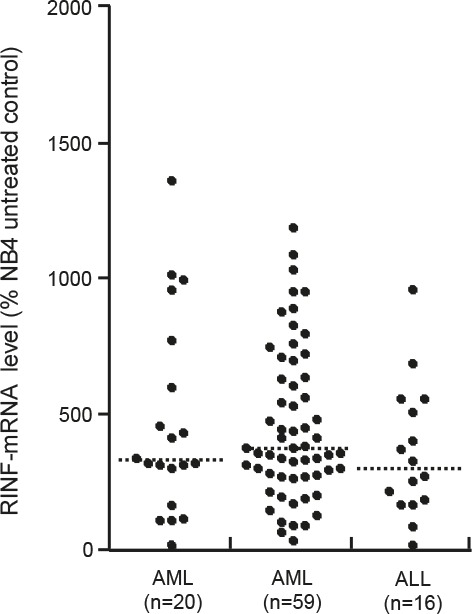
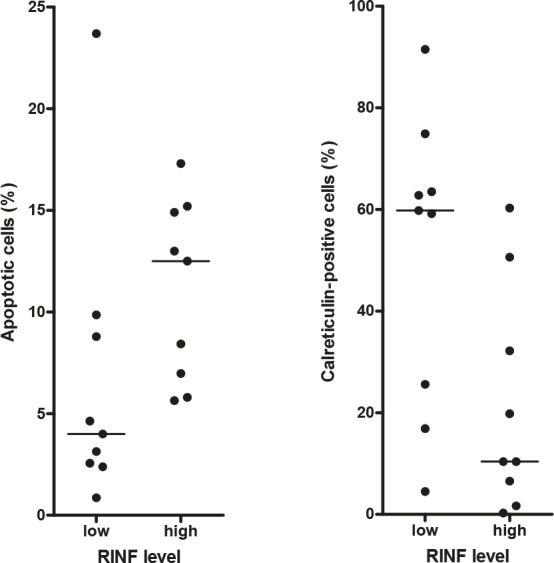
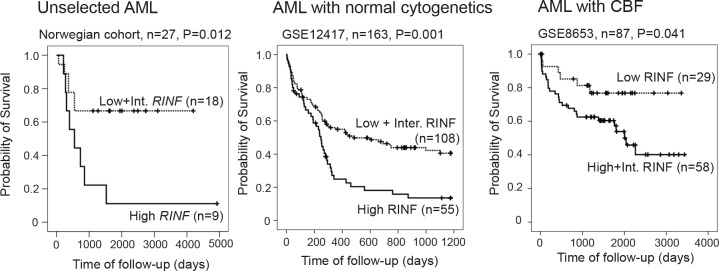
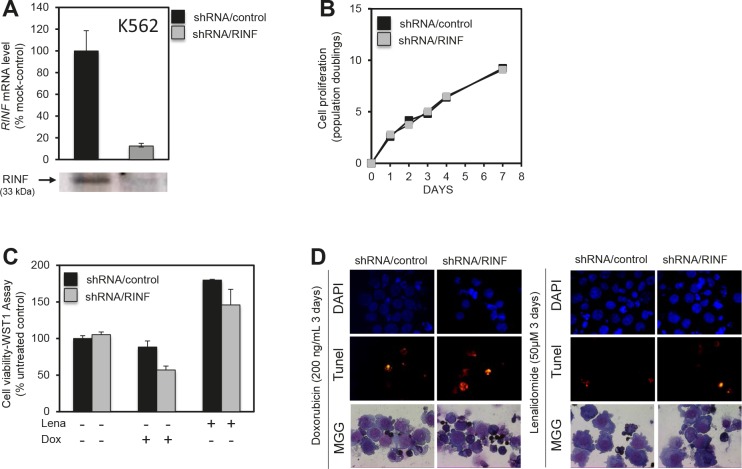
The retinoid-responsive gene CXXC5 localizes to the 5q31.2 chromosomal region and encodes a retinoid-inducible nuclear factor (RINF) that seems important during normal myelopoiesis. We investigated CXXC5/RINF expression in primary human acute myeloid leukemia (AML) cells derived from 594 patients, and a wide variation in CXXC5/RINF mRNA levels was observed both in the immature leukemic myeloblasts and in immature acute lymphoblastic leukemia cells. Furthermore, patients with low-risk cytogenetic abnormalities showed significantly lower levels compared to patients with high-risk abnormalities, and high RINF/CXXC5/ mRNA levels were associated with decreased overall survival for patients receiving intensive chemotherapy for newly diagnosed AML. This association with prognosis was seen both when investigating (i) an unselected patient population as well as for patients with (ii) normal cytogenetic and (iii) core-binding factor AML. CXXC5/RINF knockdown in AML cell lines caused increased susceptibility to chemotherapy-induced apoptosis, and regulation of apoptosis also seemed to differ between primary human AML cells with high and low RINF expression. The association with adverse prognosis together with the antiapoptotic effect of CXXC5/RINF suggests that targeting of CXXC5/RINF should be considered as a possible therapeutic strategy, especially in high-risk patients who show increased expression in AML cells compared with normal hematopoietic cells.
类视黄醇反应基因CXXC5定位于染色体5q31.2区域,编码一种类视黄醇诱导核因子(RINF),该因子在正常髓系造血过程中似乎很重要。我们研究了来自594例患者的原发性人类急性髓系白血病(AML)细胞中CXXC5/RINF的表达情况,发现在未成熟的白血病髓母细胞和未成熟的急性淋巴细胞白血病细胞中,CXXC5/RINF mRNA水平存在广泛差异。此外,与具有高危细胞遗传学异常的患者相比,具有低危细胞遗传学异常的患者其CXXC5/RINF水平显著较低,并且对于新诊断的AML接受强化化疗的患者,高RINF/CXXC5 mRNA水平与总生存期降低相关。在研究(i)未选择的患者群体以及(ii)细胞遗传学正常和(iii)核心结合因子AML患者时,均观察到这种与预后的关联。AML细胞系中CXXC5/RINF的敲低导致对化疗诱导的凋亡敏感性增加,并且原发性人类AML细胞中高RINF表达和低RINF表达之间的凋亡调节似乎也有所不同。CXXC5/RINF与不良预后的关联以及其抗凋亡作用表明,靶向CXXC5/RINF应被视为一种可能的治疗策略,尤其是在与正常造血细胞相比AML细胞中表达增加的高危患者中。