Thomas M J, Freeland T M, Strobl J S
Department of Pharmacology and Toxicology, West Virginia University Health Sciences Center, Morgantown.
Mol Cell Biol. 1990 Oct;10(10):5378-87. doi: 10.1128/mcb.10.10.5378-5387.1990.
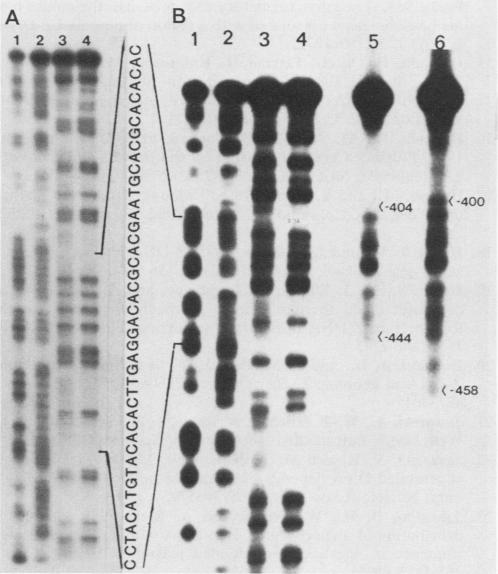
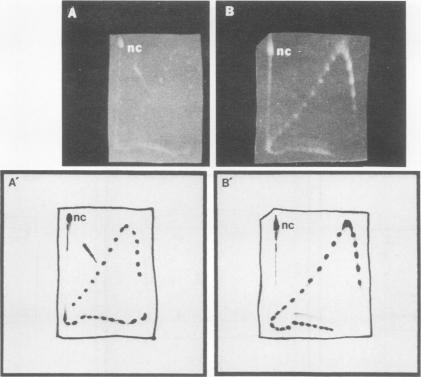
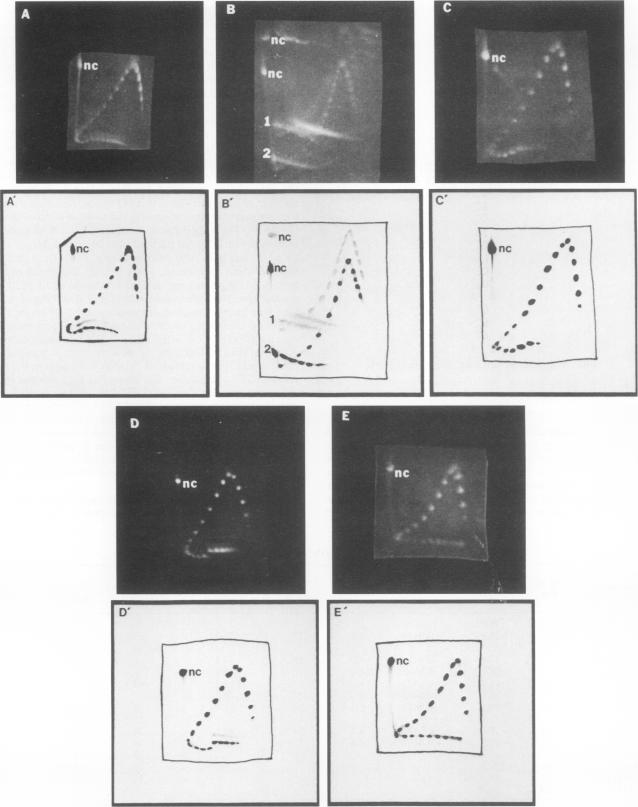
The complete DNA sequence of the 1.7 kilobase pairs (kbp) 5' of the rat growth hormone gene (rGH) has been determined and analyzed for Z-DNA-forming potential. Regions of alternating purine-pyrimidine (APP) sequences located between -1047 and -986 [(GT)31], between -445 and -433 bp, and between -426 and -403 bp relative to the rGH RNA transcription initiation site were identified and shown to form Z-DNA in negatively supercoiled plasmids by two-dimensional gel electrophoresis. Free-energy calculations indicated that Z-DNA forms most readily in the proximal Z-DNA regions. Diethyl pyrocarbonate footprinting of physiologically supercoiled plasmid DNA confirmed the presence of Z-DNA from -444 to -404 bp spanning the two most proximal APP sequences and a short non-APP sequence in between. DNA sequence analysis also predicted a region of DNA curvature near this proximal Z-DNA region. Formation of Z-DNA in the distal Z-DNA region consisting of a (GT)31 repeat was constrained at physiological plasmid superhelical densities. This may be related to the presence of DNA sequences (-1584 to -1559) 512 bp upstream of (GT)31 that undergo cruciform formation and thereby utilize the available free energy. Removal of 580 bp containing the cruciform region resulted in Z-DNA formation within (GT)31, thus demonstrating that deletion mutations can exert topological changes at a distance within the rGH 5'-flanking region. Methylation of two specific cytosines in the rGH 5'-flanking DNA that have been associated with inhibition of rGH promoter activity had no effect on Z-DNA formation. No evidence for DNA secondary structure formation within the rGH second exon-intron or 3'-flanking region was observed. We conclude that the rGH 5'-flanking region undergoes secondary-structure formation at physiological superhelical densities, thus providing a potential mechanism(s) for modulating rGH activity.
已确定大鼠生长激素基因(rGH)5'端1.7千碱基对(kbp)的完整DNA序列,并分析了其形成Z-DNA的潜力。相对于rGH RNA转录起始位点,在-1047至-986[(GT)31]之间、-445至-433 bp之间以及-426至-403 bp之间鉴定出交替嘌呤-嘧啶(APP)序列区域,并通过二维凝胶电泳显示其在负超螺旋质粒中形成Z-DNA。自由能计算表明,Z-DNA最容易在近端Z-DNA区域形成。生理超螺旋质粒DNA的焦碳酸二乙酯足迹法证实了从-444至-404 bp存在Z-DNA,该区域跨越两个最近端的APP序列以及其间的一段短非APP序列。DNA序列分析还预测了该近端Z-DNA区域附近存在DNA弯曲区域。由(GT)31重复序列组成的远端Z-DNA区域在生理质粒超螺旋密度下形成Z-DNA受到限制。这可能与(GT)31上游512 bp处的DNA序列(-1584至-1559)形成十字形结构并因此利用可用自由能有关。去除包含十字形区域的580 bp导致(GT)31内形成Z-DNA,从而表明缺失突变可在rGH 5'侧翼区域内远距离施加拓扑变化。rGH 5'侧翼DNA中与rGH启动子活性抑制相关的两个特定胞嘧啶的甲基化对Z-DNA形成没有影响。未观察到rGH第二外显子-内含子或3'侧翼区域内形成DNA二级结构的证据。我们得出结论,rGH 5'侧翼区域在生理超螺旋密度下会发生二级结构形成,从而为调节rGH活性提供了一种潜在机制。