1] Université Paris Est Créteil (UPEC), LIC EA 4393 (Laboratoire d'Investigation Clinique), F-94010 Créteil, France [2] Université Paris Est Créteil (UPEC), Faculté de médecine, département de médecine générale, F-94010 Créteil, France.
Br J Cancer. 2013 Sep 17;109(6):1437-44. doi: 10.1038/bjc.2013.476. Epub 2013 Aug 29.
Contextual socio-economic factors, health-care access, and general practitioner (GP) involvement may influence colonoscopy uptake and its timing after positive faecal occult blood testing (FOBT). Our objectives were to identify predictors of delayed or no colonoscopy and to assess the role for GPs in colonoscopy uptake.
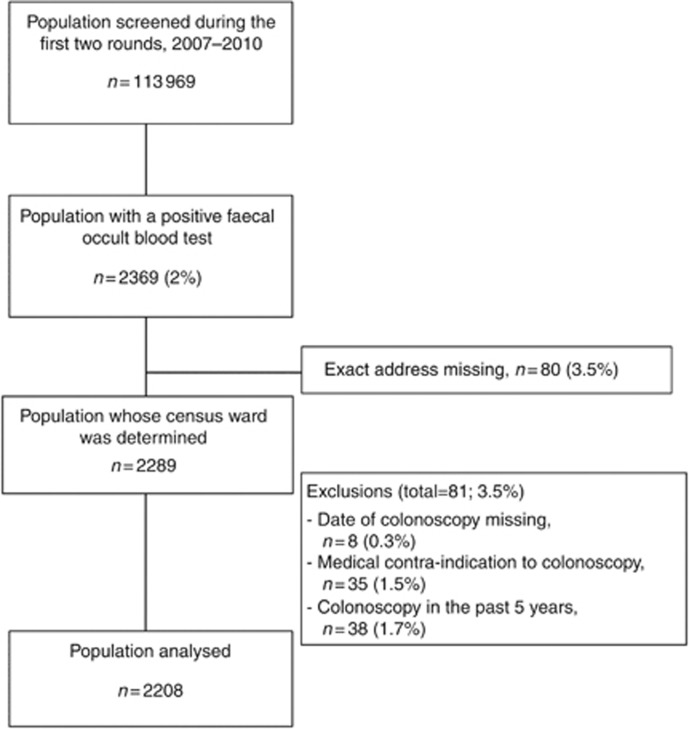
We included all residents of a French district with positive FOBTs (n = 2369) during one of the two screening rounds (2007-2010). Multilevel logistic regression analysis was performed to identify individual and area-level predictors of delayed colonoscopy, no colonoscopy, and no information on colonoscopy.
A total of 998 (45.2%) individuals underwent early, 989 (44.8%) delayed, and 102 (4.6%) no colonoscopy; no information was available for 119 (5.4%) individuals. Delayed colonoscopy was independently associated with first FOBT (odds ratio, (OR)), 1.61; 95% confidence interval ((95% CI), 1.16-2.25); and no colonoscopy and no information with first FOBT (OR, 2.01; 95% CI, 1.02-3.97), FOBT kit not received from the GP (OR, 2.29; 95% CI, 1.67-3.14), and socio-economically deprived area (OR, 3.17; 95% CI, 1.98-5.08). Colonoscopy uptake varied significantly across GPs (P=0.01).
Socio-economic factors, GP-related factors, and history of previous FOBT influenced colonoscopy uptake after a positive FOBT. Interventions should target GPs and individuals performing their first screening FOBT and/or living in socio-economically deprived areas.
背景社会经济因素、医疗保健可及性和全科医生(GP)的参与可能会影响结肠镜检查的接受程度及其在粪便潜血试验(FOBT)阳性后的时间安排。我们的目标是确定延迟或不进行结肠镜检查的预测因素,并评估 GP 在结肠镜检查接受程度中的作用。
我们纳入了在两次筛查轮次(2007-2010 年)中任一轮次 FOBT 阳性的法国某地区的所有居民(n=2369)。采用多水平逻辑回归分析确定个体和地区水平的预测因素,这些因素与延迟结肠镜检查、无结肠镜检查以及无结肠镜检查信息相关。
共有 998 人(45.2%)进行了早期结肠镜检查,989 人(44.8%)进行了延迟结肠镜检查,102 人(4.6%)未进行结肠镜检查;119 人(5.4%)未提供结肠镜检查信息。延迟结肠镜检查与首次 FOBT 独立相关(优势比(OR))1.61;95%置信区间(95% CI)1.16-2.25),无结肠镜检查和无信息与首次 FOBT(OR,2.01;95% CI,1.02-3.97)、未从 GP 处收到 FOBT 试剂盒(OR,2.29;95% CI,1.67-3.14)以及社会经济贫困地区(OR,3.17;95% CI,1.98-5.08)相关。GP 之间的结肠镜检查接受程度存在显著差异(P=0.01)。
社会经济因素、与 GP 相关的因素以及之前 FOBT 的历史影响了 FOBT 阳性后的结肠镜检查接受程度。干预措施应针对首次进行筛查性 FOBT 且/或居住在社会经济贫困地区的 GP 和个体。