Université Paris Est Créteil (UPEC), LIC EA4393 (Laboratoire d'Investigation Clinique), Créteil, France ; AP-HP, Hôpital Henri-Mondor, Department of Clinical Research and Public Health, Créteil, France ; AP-HP, Hôpital Henri-Mondor, Unité de Recherche Clinique (URC), Créteil, France.
PLoS One. 2013 Aug 26;8(8):e64733. doi: 10.1371/journal.pone.0064733. eCollection 2013.
In uncontrolled before-after studies, CONSORT was shown to improve the reporting of randomised trials. Before-after studies ignore underlying secular trends and may overestimate the impact of interventions. Our aim was to assess the impact of the 2007 STROBE statement publication on the quality of observational study reporting, using both uncontrolled before-after analyses and interrupted time series.
For this quasi-experimental study, original articles reporting cohort, case-control, and cross-sectional studies published between 2004 and 2010 in the four dermatological journals having the highest 5-year impact factors (≥ 4) were selected. We compared the proportions of STROBE items (STROBE score) adequately reported in each article during three periods, two pre STROBE period (2004-2005 and 2006-2007) and one post STROBE period (2008-2010). Segmented regression analysis of interrupted time series was also performed.
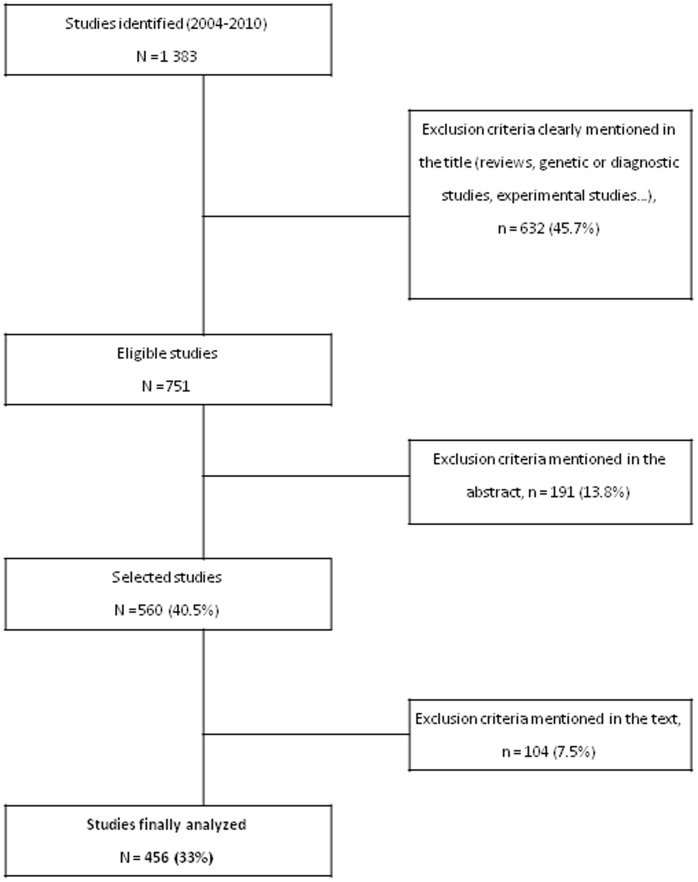
Of the 456 included articles, 187 (41%) reported cohort studies, 166 (36.4%) cross-sectional studies, and 103 (22.6%) case-control studies. The median STROBE score was 57% (range, 18%-98%). Before-after analysis evidenced significant STROBE score increases between the two pre-STROBE periods and between the earliest pre-STROBE period and the post-STROBE period (median score2004-05 48% versus median score2008-10 58%, p<0.001) but not between the immediate pre-STROBE period and the post-STROBE period (median score2006-07 58% versus median score2008-10 58%, p = 0.42). In the pre STROBE period, the six-monthly mean STROBE score increased significantly, by 1.19% per six-month period (absolute increase 95%CI, 0.26% to 2.11%, p = 0.016). By segmented analysis, no significant changes in STROBE score trends occurred (-0.40%; 95%CI, -2.20 to 1.41; p = 0.64) in the post STROBE statement publication.
The quality of reports increased over time but was not affected by STROBE. Our findings raise concerns about the relevance of uncontrolled before-after analysis for estimating the impact of guidelines.
在未控制的前后对照研究中,CONSORT 被证明可以提高随机试验的报告质量。前后对照研究忽略了潜在的长期趋势,可能高估了干预措施的影响。我们的目的是使用未控制的前后对照分析和中断时间序列来评估 2007 年 STROBE 声明发表对观察性研究报告质量的影响。
本准实验研究纳入了 2004 年至 2010 年在四个皮肤科期刊上发表的队列研究、病例对照研究和横断面研究的原始文章,这些期刊的 5 年影响因子均较高(≥4)。我们比较了在三个时期中,每篇文章中 STROBE 项目(STROBE 评分)的充分报告比例,三个时期分别为两个 STROBE 前时期(2004-2005 年和 2006-2007 年)和一个 STROBE 后时期(2008-2010 年)。还对中断时间序列进行了分段回归分析。
在纳入的 456 篇文章中,187 篇(41%)为队列研究,166 篇(36.4%)为横断面研究,103 篇(22.6%)为病例对照研究。STROBE 评分中位数为 57%(范围,18%-98%)。前后对照分析表明,在两个 STROBE 前时期和最早的 STROBE 前时期与 STROBE 后时期之间,STROBE 评分显著增加(2004-05 年中位数评分 48%与 2008-10 年中位数评分 58%,p<0.001),但在 STROBE 即刻前时期与 STROBE 后时期之间没有增加(2006-07 年中位数评分 58%与 2008-10 年中位数评分 58%,p=0.42)。在 STROBE 前时期,STROBE 评分每六个月显著增加 1.19%(绝对增加 95%CI,0.26%至 2.11%,p=0.016)。通过分段分析,STROBE 评分趋势没有明显变化(-0.40%;95%CI,-2.20 至 1.41;p=0.64)。
报告的质量随着时间的推移而提高,但不受 STROBE 影响。我们的发现引起了人们对未控制的前后对照分析用于估计指南影响的相关性的关注。