Department of Medicine, University of California San Francisco, San Francisco, California, United States of America ; Gladstone Institute of Virology and Immunology, San Francisco, California, United States of America.
PLoS One. 2013 Aug 21;8(8):e70344. doi: 10.1371/journal.pone.0070344. eCollection 2013.
Respondent-driven sampling (RDS) offers a recruitment strategy for hard-to-reach populations. However, RDS faces logistical and theoretical challenges that threaten efficiency and validity in settings worldwide. We present innovative adaptations to conventional RDS to overcome barriers encountered in recruiting a large, representative sample of men who have sex with men (MSM) who travel internationally.
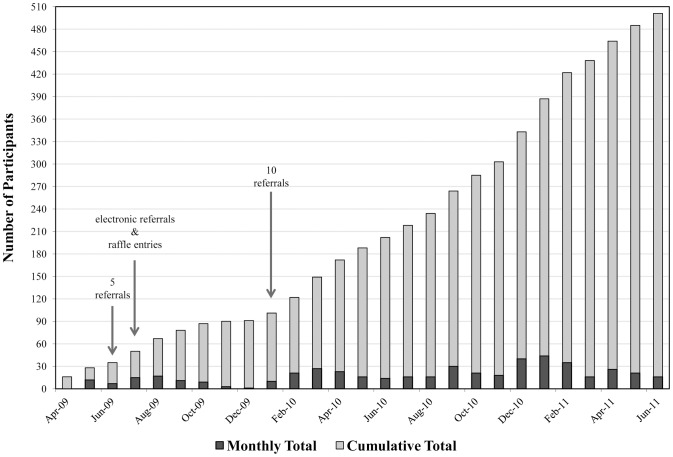
Novel methodological adaptations for the "International Travel Research to Inform Prevention" or "I-TRIP" study were offering participants a choice between electronic and paper coupons referrals for recruitment and modifying the secondary incentives structure from small cash amounts to raffle entries for periodic large cash prize raffle drawings. Staged referral limit increases from 3 to 10 referrals and progressive addition of 70 seeds were also implemented.
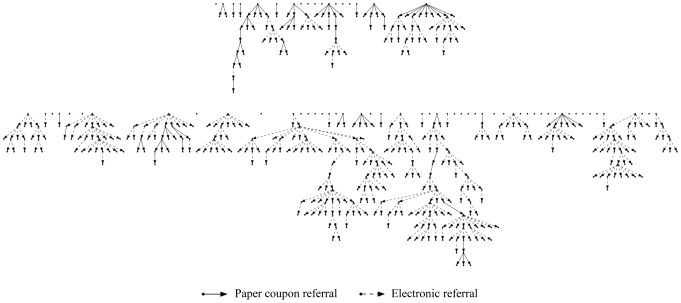
There were 501 participants enrolled in up to 13 waves of growth. Among participants with a choice of referral methods, 81% selected electronic referrals. Of participants who were recruited electronically, 90% chose to remain with electronic referrals when it was their turn to recruit. The mean number of enrolled referrals was 0.91 for electronic referrals compared to 0.56 for paper coupons. Median referral lag time, i.e., the time interval between when recruiters were given their referrals and when a referred individual enrolled in the study, was 20 days (IQR 10-40) for electronic referrals, 20 days (IQR 8-58) for paper coupons, 20 days (IQR 10-41) for raffle entries and 33 days (IQR 16-148) for small cash incentives.
The recruitment of MSM who travel internationally required maximizing known flexible tools of RDS while at the same time necessitating innovations to increase recruitment efficiency. Electronic referrals emerged as a major advantage in recruiting this hard-to-reach population who are of high socio-economic status, geographically diffuse and highly mobile. These enhancements may improve the performance of RDS in target populations with similar characteristics.
响应驱动抽样(RDS)为难以接触的人群提供了一种招募策略。然而,RDS 在全球范围内的实施中面临着后勤和理论上的挑战,这些挑战威胁着效率和有效性。我们提出了对传统 RDS 的创新改编,以克服在招募具有代表性的国际旅行男男性行为者(MSM)大样本时遇到的障碍。
“国际旅行研究以促进预防”或“I-TRIP”研究采用了新颖的方法学改编,为参与者提供了电子和纸质优惠券推荐的选择,用于招募,并将二级激励结构从少量现金改为定期大现金抽奖的抽奖入场券。还实施了从 3 次到 10 次推荐的分阶段推荐限制增加,以及 70 个种子的逐步增加。
共有 501 名参与者参加了多达 13 个阶段的增长。在有推荐方法选择的参与者中,81%选择了电子推荐。在通过电子方式招募的参与者中,当轮到他们招募时,90%选择继续使用电子推荐。电子推荐的平均入组推荐人数为 0.91,而纸质优惠券为 0.56。电子推荐的中位推荐滞后时间,即招募者收到推荐人与被推荐人入组研究之间的时间间隔,为 20 天(IQR 10-40),纸质优惠券为 20 天(IQR 8-58),抽奖入场券为 20 天(IQR 10-41),小额现金奖励为 33 天(IQR 16-148)。
招募国际旅行的 MSM 需要最大限度地利用 RDS 的已知灵活工具,同时需要创新以提高招募效率。电子推荐在招募这些高社会经济地位、地理分散和高度流动的难以接触人群方面具有明显优势。这些增强功能可能会提高 RDS 在具有类似特征的目标人群中的表现。