Department of Clinical Sciences, Polytechnic University of Marche, Ancona, Italy.
PLoS One. 2013 Aug 21;8(8):e71272. doi: 10.1371/journal.pone.0071272. eCollection 2013.
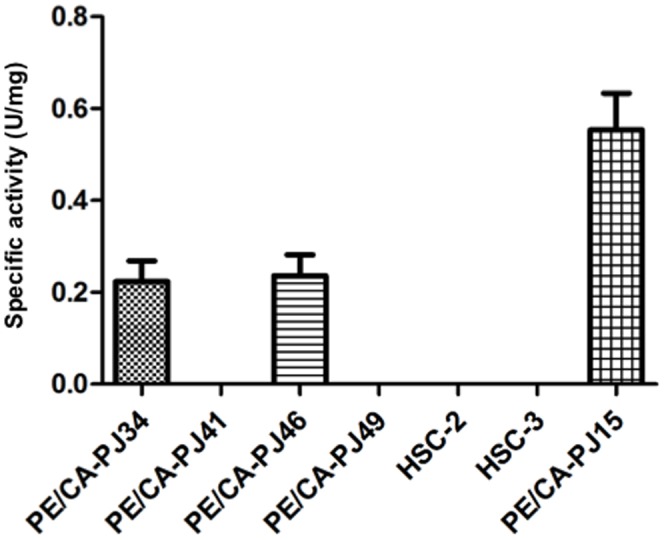
Oral squamous cell carcinoma (OSCC) is the most common type of oral cancer. Despite progress in the treatment of OSCC, overall survival has not improved substantially in the last three decades. Therefore, identification of reliable biomarkers becomes essential to develop effective anti-cancer therapy. In this study, we focused on the enzyme Nicotinamide N-methyltransferase (NNMT), which plays a fundamental role in the biotransformation of many xenobiotics. Although several tumors have been associated with abnormal NNMT expression, its role in cancer cell metabolism remains largely unknown. In this report, 7 human oral cancer cell lines were examined for NNMT expression by Real-Time PCR, Western blot and HPLC-based catalytic assay. Subsequently, we evaluated the in vitro effect of shRNA-mediated silencing of NNMT on cell proliferation. In vivo tumorigenicity of oral cancer cells with stable knockdown of NNMT was assayed by using xenograft models. High expression levels of NNMT were found in PE/CA PJ-15 cells, in keeping with the results of Western blot and catalytic activity assay. PE/CA PJ-15 cell line was stably transfected with shRNA plasmids against NNMT and analyzed by 3-(4,5-dimethylthiazol-2-yl)-2,5-diphenyl tetrazolium bromide (MTT) and soft agar Assays. Transfected and control cells were injected into athymic mice in order to evaluate the effect of NNMT silencing on tumor growth. NNMT downregulation resulted in decreased cell proliferation and colony formation ability on soft agar. In athymic mice, NNMT silencing induced a marked reduction in tumour volume. Our results show that the downregulation of NNMT expression in human oral carcinoma cells significantly inhibits cell growth in vitro and tumorigenicity in vivo. All these experimental data seem to suggest that NNMT plays a critical role in the proliferation and tumorigenic capacity of oral cancer cells, and its inhibition could represent a potential molecular approach to the treatment of oral carcinoma.
口腔鳞状细胞癌(OSCC)是最常见的口腔癌类型。尽管 OSCC 的治疗取得了进展,但在过去的三十年中,总体生存率并没有显著提高。因此,鉴定可靠的生物标志物对于开发有效的抗癌疗法至关重要。在这项研究中,我们专注于酶烟酰胺 N-甲基转移酶(NNMT),它在许多外源性物质的生物转化中起着基本作用。尽管有几种肿瘤与异常 NNMT 表达有关,但它在癌细胞代谢中的作用在很大程度上仍是未知的。在本报告中,通过实时 PCR、Western blot 和基于 HPLC 的催化测定法检查了 7 个人类口腔癌细胞系中的 NNMT 表达。随后,我们评估了 shRNA 介导的 NNMT 沉默对细胞增殖的体外影响。通过使用异种移植模型,评估了 NNMT 稳定敲低的口腔癌细胞的体内致瘤性。在 PE/CA PJ-15 细胞中发现了 NNMT 的高表达水平,与 Western blot 和催化活性测定的结果一致。PE/CA PJ-15 细胞系用针对 NNMT 的 shRNA 质粒稳定转染,并通过 3-(4,5-二甲基噻唑-2-基)-2,5-二苯基四氮唑溴盐(MTT)和软琼脂测定进行分析。转染和对照细胞被注射到裸鼠中,以评估 NNMT 沉默对肿瘤生长的影响。NNMT 下调导致细胞增殖和软琼脂集落形成能力下降。在裸鼠中,NNMT 沉默诱导肿瘤体积明显减小。我们的结果表明,下调人口腔癌细胞中的 NNMT 表达显著抑制体外细胞生长和体内致瘤性。所有这些实验数据似乎表明,NNMT 在口腔癌细胞的增殖和致瘤能力中起着关键作用,其抑制可能代表治疗口腔癌的一种潜在分子方法。