Dipartimento di Biologia e Biotecnologie "Lazzaro Spallanzani", Università di Pavia, Pavia, Italy.
PLoS One. 2013 Aug 21;8(8):e71390. doi: 10.1371/journal.pone.0071390. eCollection 2013.
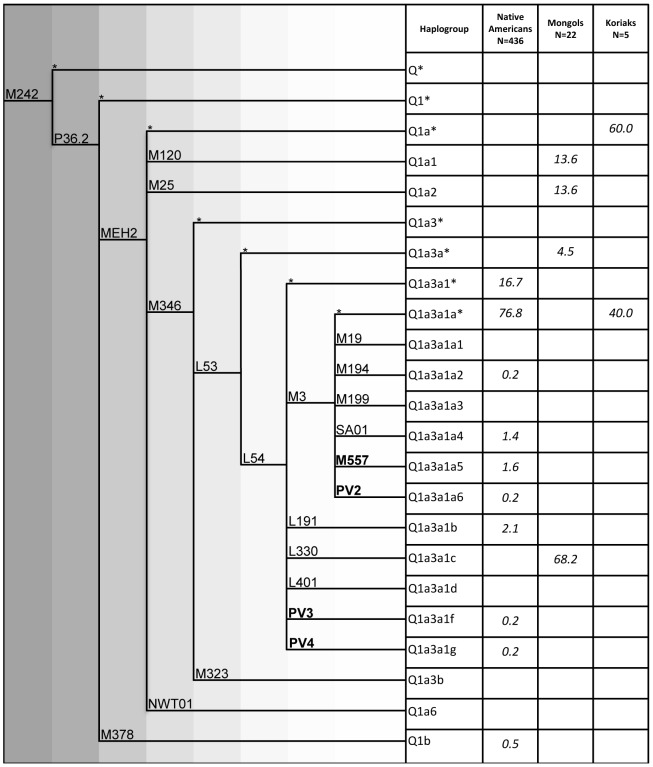
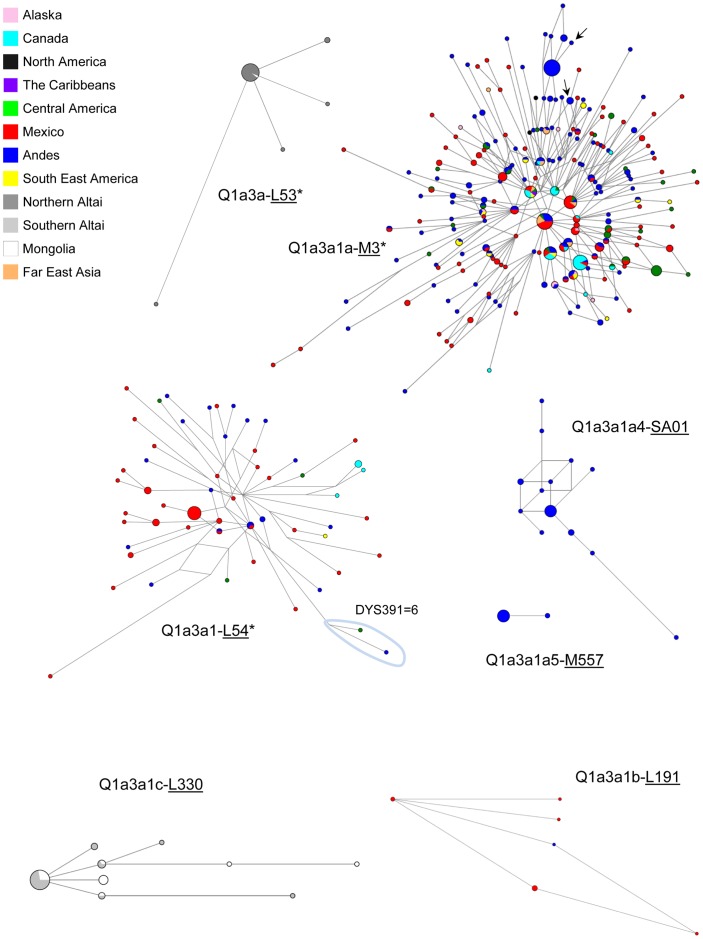
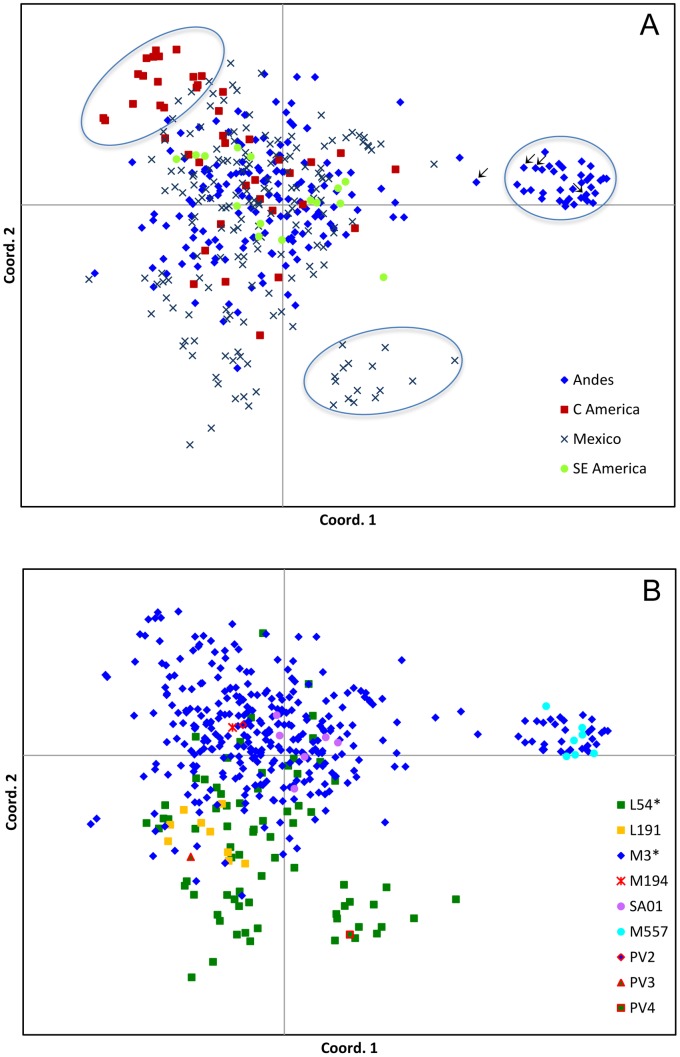
Recent progress in the phylogenetic resolution of the Y-chromosome phylogeny permits the male demographic dynamics and migratory events that occurred in Central and Southern America after the initial human spread into the Americas to be investigated at the regional level. To delve further into this issue, we examined more than 400 Native American Y chromosomes (collected in the region ranging from Mexico to South America) belonging to haplogroup Q - virtually the only branch of the Y phylogeny observed in modern-day Amerindians of Central and South America - together with 27 from Mongolia and Kamchatka. Two main founding lineages, Q1a3a1a-M3 and Q1a3a1-L54(xM3), were detected along with novel sub-clades of younger age and more restricted geographic distributions. The first was also observed in Far East Asia while no Q1a3a1-L54(xM3) Y chromosome was found in Asia except the southern Siberian-specific sub-clade Q1a3a1c-L330. Our data not only confirm a southern Siberian origin of ancestral populations that gave rise to Paleo-Indians and the differentiation of both Native American Q founding lineages in Beringia, but support their concomitant arrival in Mesoamerica, where Mexico acted as recipient for the first wave of migration, followed by a rapid southward migration, along the Pacific coast, into the Andean region. Although Q1a3a1a-M3 and Q1a3a1-L54(xM3) display overlapping general distributions, they show different patterns of evolution in the Mexican plateau and the Andean area, which can be explained by local differentiations due to demographic events triggered by the introduction of agriculture and associated with the flourishing of the Great Empires.
最近在 Y 染色体系统发生解析方面取得的进展使得人们能够在区域层面上研究人类首次进入美洲后发生在中美洲和南美洲的男性人口动态和迁徙事件。为了更深入地研究这个问题,我们检测了来自中美洲和南美洲的 400 多个属于单倍群 Q 的美洲原住民 Y 染色体(分布在从墨西哥到南美洲的地区),以及来自蒙古和堪察加的 27 个 Y 染色体。除了在中美洲和南美洲的现代美洲印第安人中观察到的 Y 谱系的几乎唯一分支 Q1a3a1a-M3 和 Q1a3a1-L54(xM3) 之外,还检测到了两个主要的起源谱系 Q1a3a1a1a-M3 和 Q1a3a1-L54(xM3),以及较年轻和分布范围更有限的新亚支系。第一个也在东亚观察到,而亚洲除了南西伯利亚特有的亚支系 Q1a3a1c-L330 外,没有发现 Q1a3a1-L54(xM3)Y 染色体。我们的数据不仅证实了古印第安人的祖先群体起源于南西伯利亚,而且证实了在白令海峡分化的两个美洲原住民 Q 起源谱系,支持它们同时到达中美洲,其中墨西哥是第一次迁徙浪潮的接收者,随后沿着太平洋海岸迅速向南迁徙到安第斯地区。尽管 Q1a3a1a-M3 和 Q1a3a1-L54(xM3) 显示出重叠的一般分布,但它们在墨西哥高原和安第斯地区表现出不同的进化模式,这可以通过由于农业的引入而引发的人口事件导致的局部分化来解释,这些事件与大帝国的繁荣有关。