Unilever R&D Colworth, Sharnbrook, Bedfordshire, MK44 1LQ, UK.
Unilever R&D Port Sunlight, Bebington, CH63 3JW, UK.
Int J Cosmet Sci. 2014 Feb;36(1):46-53. doi: 10.1111/ics.12091. Epub 2013 Oct 15.
In humans, the process of hair shedding, referred to as exogen, is believed to occur independently of the other hair cycle phases. Although the actual mechanisms involved in hair shedding are not fully known, it has been hypothesized that the processes leading to the final step of hair shedding may be driven by proteases and/or protease inhibitor activity. In this study, we investigated the presence of proteases and protease activity in naturally shed human hairs and assessed enzyme inhibition activity of test materials.
We measured enzyme activity using a fluorescence-based assay and protein localization by indirect immunohistochemistry (IHC). We also developed an ex vivo skin model for measuring the force required to pull hair fibres from skin.
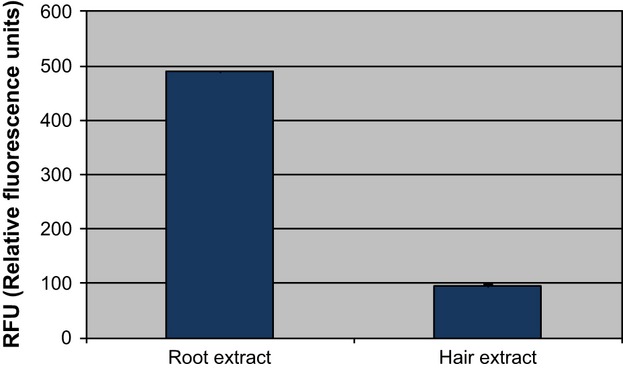
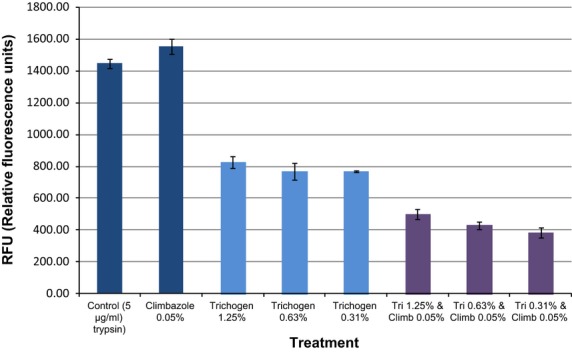
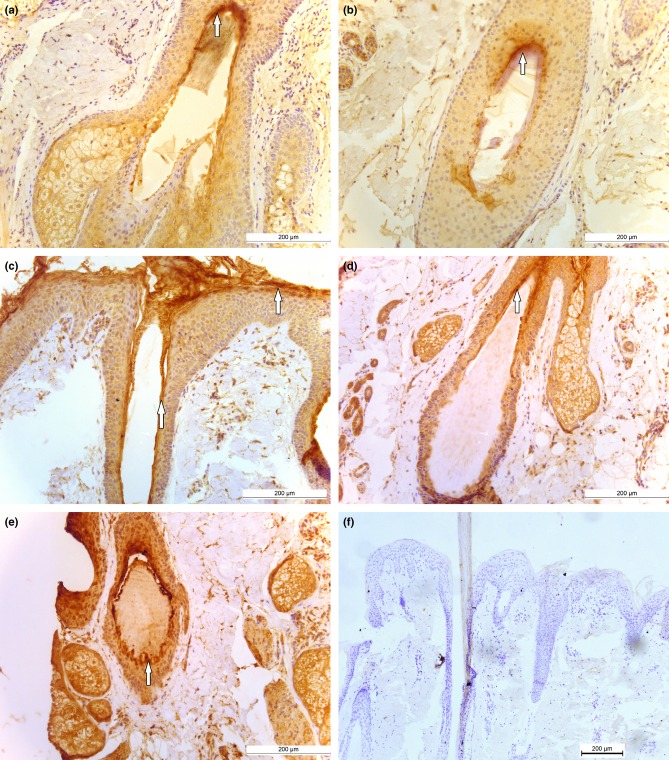
Our data demonstrate the presence of protease activity in the tissue material surrounding club roots. We also demonstrated the localization of specific serine protease protein expression in human hair follicle by IHC. These data provide evidence demonstrating the presence of proteases around the hair club roots, which may play a role during exogen. We further tested the hypothesis that a novel protease inhibitor system (combination of Trichogen) and climbazole) could inhibit protease activity in hair fibre club root extracts collected from a range of ethnic groups (U.K., Brazil, China, first-generation Mexicans in the U.S.A., Thailand and Turkey) in both males and females. Furthermore, we demonstrated that this combination is capable of increasing the force required to remove hair in an ex vivo skin model system.
These studies indicate the presence of proteolytic activity in the tissue surrounding the human hair club root and show that it is possible to inhibit this activity with a combination of Trichogen and climbazole. This technology may have potential to reduce excessive hair shedding.
在人类中,毛发脱落的过程称为外生,据信它独立于其他毛发周期阶段发生。尽管导致毛发最终脱落的过程的确切机制尚不完全清楚,但据推测,导致毛发最终脱落的过程可能是由蛋白酶和/或蛋白酶抑制剂活性驱动的。在这项研究中,我们调查了天然脱落的人类毛发中蛋白酶和蛋白酶活性的存在,并评估了测试材料的酶抑制活性。
我们使用荧光测定法测量酶活性,并通过间接免疫组织化学(IHC)进行蛋白质定位。我们还开发了一种体外皮肤模型,用于测量从皮肤中拔出毛发纤维所需的力。
我们的数据表明,在毛囊球根周围的组织材料中存在蛋白酶活性。我们还通过 IHC 证明了特定丝氨酸蛋白酶蛋白在人类毛囊中的表达定位。这些数据提供了证据,证明蛋白酶存在于毛发球根周围,这可能在外生过程中发挥作用。我们进一步测试了一个假设,即一种新型蛋白酶抑制剂系统(Trichogen 和克霉唑的组合)可以抑制从不同种族(英国、巴西、中国、第一代美国墨西哥人、泰国和土耳其)的男性和女性收集的毛发纤维球根提取物中的蛋白酶活性。此外,我们证明这种组合能够增加在体外皮肤模型系统中去除毛发所需的力。
这些研究表明,在人类毛发球根周围的组织中存在蛋白水解活性,并表明可以使用 Trichogen 和克霉唑的组合抑制这种活性。这项技术可能具有减少过度脱发的潜力。