Department of Advanced Biomedical Sciences, Pathology Section, School of Medicine and Surgery, University of Naples "Federico II", address: via S. Pansini, n.5, 80131, Naples, Italy.
Curr Med Chem. 2014;21(14):1569-82. doi: 10.2174/09298673113209990227.
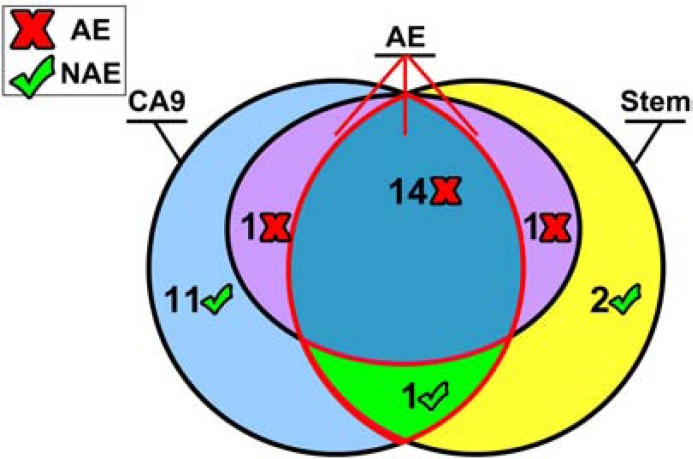
Intrinsic and acquired drug resistance of tumor cells still causes the failure of treatment regimens in advanced human cancers. It may be driven by intrinsic tumor cells features, or may also arise from micro environmental influences. Hypoxia is a microenvironment feature associated with the aggressiveness and metastasizing ability of human solid cancers. Hypoxic cancer cells overexpress Carbonic Anhydrase IX (CA IX). CA IX ensures a favorable tumor intracellular pH, while contributing to stromal acidosis, which facilitates tumor invasion and metastasis. The overexpression of CA IX is considered an epiphenomenon of the presence of hypoxic, aggressive tumor cells. Recently, a relationship between CA IX overexpression and the cancer stem cells (CSCs) population has been hypothesized. CSCs are strictly regulated by tumor hypoxia and drive a major non-mutational mechanism of cancer drug-resistance. We reviewed the current data concerning the role of CA IX overexpression in human malignancies, extending such information to the expression of the stem cells markers CD44 and nestin in solid cancers, to explore their relationship with the biological behavior of tumors. CA IX is heavily expressed in advanced tumors. A positive trend of correlation between CA IX overexpression, tumor stage/grade and poor outcome emerged. Moreover, stromal CA IX expression was associated with adverse events occurrence, maybe signaling the direct action of CA IX in directing the mesenchymal changes that favor tumor invasion; in addition, membranous/cytoplasmic co-overexpression of CA IX and stem cells markers were found in several aggressive tumors. This suggests that CA IX targeting could indirectly deplete CSCs and counteract resistance of solid cancers in the clinical setting.
肿瘤细胞的内在和获得性耐药仍然导致晚期人类癌症治疗方案的失败。它可能是由内在的肿瘤细胞特征驱动的,也可能是由微环境的影响引起的。缺氧是与人类实体瘤侵袭性和转移能力相关的微环境特征。缺氧的癌细胞过表达碳酸酐酶 IX(CAIX)。CAIX 确保了肿瘤细胞内的 pH 值有利,同时促进了基质酸中毒,从而促进了肿瘤的侵袭和转移。CAIX 的过表达被认为是存在缺氧、侵袭性肿瘤细胞的表型现象。最近,有人假设 CAIX 过表达与癌症干细胞(CSCs)群体之间存在关系。CSCs 受肿瘤缺氧的严格调控,并驱动癌症药物耐药的主要非突变机制。我们回顾了有关 CAIX 过表达在人类恶性肿瘤中的作用的现有数据,将这些信息扩展到实体瘤中干细胞标志物 CD44 和巢蛋白的表达,以探讨它们与肿瘤生物学行为的关系。CAIX 在晚期肿瘤中大量表达。CAIX 过表达、肿瘤分期/分级和不良预后之间呈正相关趋势。此外,基质 CAIX 表达与不良事件的发生相关,这可能表明 CAIX 在指导有利于肿瘤侵袭的间质变化中的直接作用;此外,在几种侵袭性肿瘤中发现 CAIX 和干细胞标志物的膜/细胞质共过表达。这表明针对 CAIX 可以间接耗尽 CSCs,并在临床环境中抵抗实体瘤的耐药性。