Department of Biology, University of Crete, Heraklion, Greece.
Curr Opin Pharmacol. 2013 Oct;13(5):763-8. doi: 10.1016/j.coph.2013.08.003. Epub 2013 Aug 28.
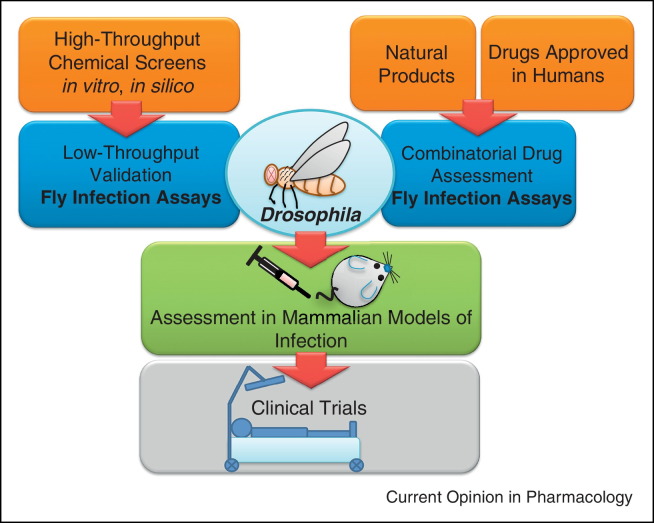
Following an expansion in the antibiotic drug discovery in the previous century, we now face a bottleneck in the production of new anti-infective drugs. Traditionally, chemical libraries are screened either using in vitro culture systems or in silico to identify and chemically modify small molecules with antimicrobial properties. Nevertheless, almost all compounds passing through in vitro screening fail to pass preclinical trials. Drug screening in Drosophila offers to fill the gap between in vitro and mammalian model host testing by eliminating compounds that are toxic or have reduced bioavailability and by identifying others that may boost innate host defence or selectively reduce microbial virulence in a whole-organism setting. Such alternative screening methods in Drosophila, while low-throughput, may reduce the cost and increase the success rate of preclinical trials.
在上个世纪抗生素药物发现的扩张之后,我们现在面临着新抗感染药物生产的瓶颈。传统上,化学文库的筛选是通过体外培养系统或计算机模拟进行的,以识别和化学修饰具有抗菌特性的小分子。然而,几乎所有通过体外筛选的化合物都无法通过临床前试验。利用果蝇进行药物筛选,可以通过消除有毒或生物利用度降低的化合物,并识别可能增强固有宿主防御或在整个生物体环境中选择性降低微生物毒力的化合物,从而填补体外和哺乳动物模型宿主测试之间的空白。这种在果蝇中的替代筛选方法,虽然通量较低,但可以降低临床前试验的成本并提高成功率。