Primate Genetics Laboratory, German Primate Center, Leibniz Institute for Primate Research, Göttingen, Germany.
PLoS One. 2013 Aug 29;8(8):e73647. doi: 10.1371/journal.pone.0073647. eCollection 2013.
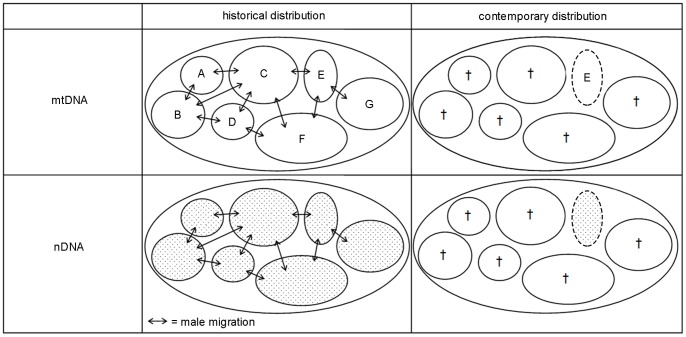
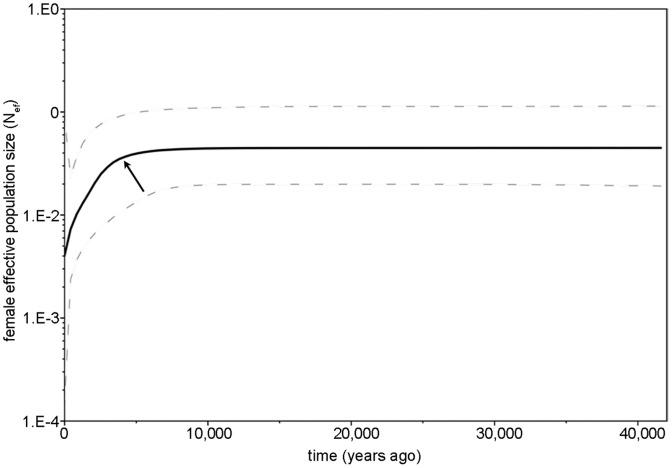
To evaluate the conservation status of a species or population it is necessary to gain insight into its ecological requirements, reproduction, genetic population structure, and overall genetic diversity. In our study we examined the genetic diversity of Rhinopithecus brelichi by analyzing microsatellite data and compared them with already existing data derived from mitochondrial DNA, which revealed that R. brelichi exhibits the lowest mitochondrial diversity of all so far studied Rhinopithecus species. In contrast, the genetic diversity of nuclear DNA is high and comparable to other Rhinopithecus species, i.e. the examined microsatellite loci are similarly highly polymorphic as in other species of the genus. An explanation for these differences in mitochondrial and nuclear genetic diversity could be a male biased dispersal. Females most likely stay within their natal band and males migrate between bands, thus mitochondrial DNA will not be exchanged between bands but nuclear DNA via males. A Bayesian Skyline Plot based on mitochondrial DNA sequences shows a strong decrease of the female effective population size (Nef) starting about 3,500 to 4,000 years ago, which concurs with the increasing human population in the area and respective expansion of agriculture. Given that we found no indication for a loss of nuclear DNA diversity in R. brelichi it seems that this factor does not represent the most prominent conservation threat for the long-term survival of the species. Conservation efforts should therefore focus more on immediate threats such as development of tourism and habitat destruction.
为了评估一个物种或种群的保护状况,有必要深入了解其生态需求、繁殖、遗传种群结构和整体遗传多样性。在我们的研究中,我们通过分析微卫星数据来评估滇金丝猴的遗传多样性,并将其与已有的线粒体 DNA 数据进行比较,结果表明,滇金丝猴的线粒体多样性是所有已研究的滇金丝猴物种中最低的。相比之下,核 DNA 的遗传多样性较高,与其他滇金丝猴物种相当,即所研究的微卫星位点与其他属的物种一样高度多态。线粒体和核遗传多样性差异的一个解释可能是雄性偏向的扩散。雌性很可能留在它们的出生地,而雄性在领地之间迁移,因此线粒体 DNA 不会在领地之间交换,但核 DNA 会通过雄性进行交换。基于线粒体 DNA 序列的贝叶斯天空线图显示,大约从 3500 到 4000 年前,雌性有效种群数量(Nef)开始急剧下降,这与该地区人口的增加以及农业的相应扩张相吻合。鉴于我们没有发现滇金丝猴核 DNA 多样性丧失的迹象,因此该因素似乎不是该物种长期生存的最突出的保护威胁。保护工作因此应更加关注旅游开发和栖息地破坏等直接威胁。