Sampson Dennis A, Krebs Robert A
Department of Biological, Geological, and Environmental Sciences, Cleveland State University, 2121 Euclid Ave, Cleveland, OH 44115-2406 USA.
Springerplus. 2013 Aug 14;2:383. doi: 10.1186/2193-1801-2-383. eCollection 2013.
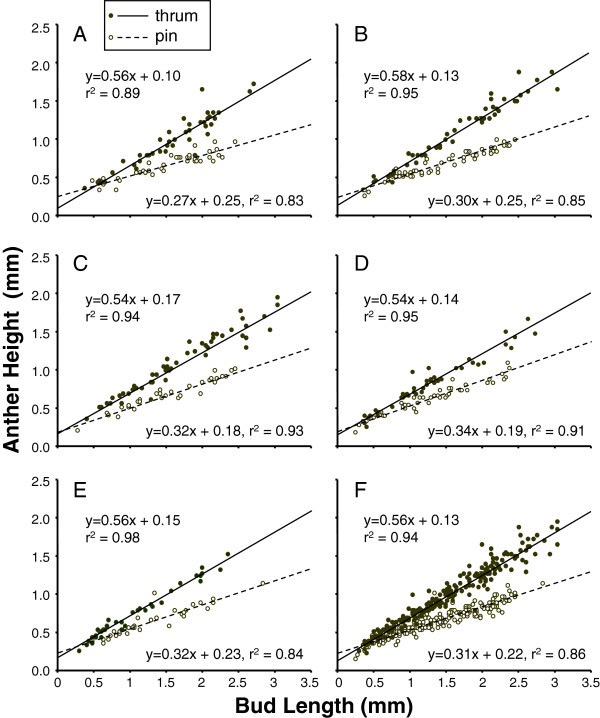
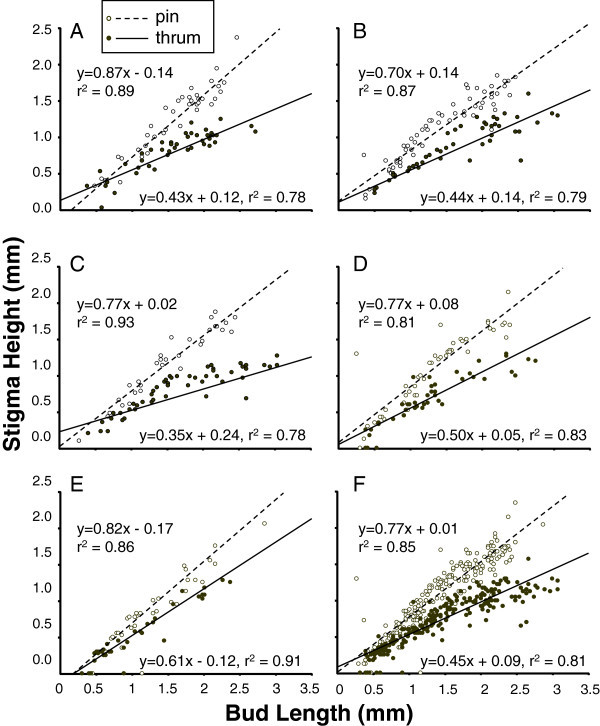
The development of distyly is thought to arise from differential growth patterns in the pin and thrum morphs. However, few detailed studies exist on the early floral development of distylous flowers, and fewer still look at variation in these traits among populations. Buds at multiple stages of development were collected from five populations of Hedyotis caerulea to quantify how pins and thrums diverge with respect to the initiation, rate, and termination of growth between the stamens and stigmas. The growth rate of anthers varied little spatially across five populations and temporally in both pins and thrums, although thrum anthers grew faster than pin anthers. Dimorphy in stigma height was more complex. Pin stigmas first grew at a faster rate than those of thrums, and late in bud development, growth of thrum styles slowed. These rate changes varied among populations, and they differed from the congeneric H. salzmanii. Similar differences between morphs are known in other heterostylous species, and such variation in growth pattern among related species has been used to infer independent evolution of distylous systems.
二型花柱的发育被认为源于针型和柱型形态中不同的生长模式。然而,关于二型花柱花的早期花发育的详细研究很少,研究不同种群间这些性状变异的更少。从五个蓝花耳草种群中收集处于多个发育阶段的芽,以量化针型和柱型在雄蕊和柱头生长的起始、速率和终止方面的差异。五个种群间花药的生长速率在空间上变化不大,在针型和柱型中随时间变化也不大,尽管柱型花药比针型花药生长得更快。柱头高度的二型性更为复杂。针型柱头最初的生长速率比柱型的快,在芽发育后期,柱型花柱的生长减缓。这些速率变化在不同种群间有所不同,并且与同属的萨尔兹曼耳草不同。在其他异型花柱物种中也已知形态间存在类似差异,并且相关物种间这种生长模式的变异已被用于推断二型花柱系统的独立进化。