Wegayehu Teklu, Adamu Haileeyesus, Petros Beyene
Department of Biology, College of Natural Sciences, Arba Minch University, Arba Minch, Ethiopia.
BMC Infect Dis. 2013 Sep 8;13:419. doi: 10.1186/1471-2334-13-419.
Giardia and Cryptosporidium are the most common causes of protozoan diarrhea that lead to significant morbidity and mortality worldwide. The purpose of this study was to determine the prevalence of Giardia duodenalis and Cryptosporidium species infections among children and cattle, and to assess the potential risk of zoonotic transmission.
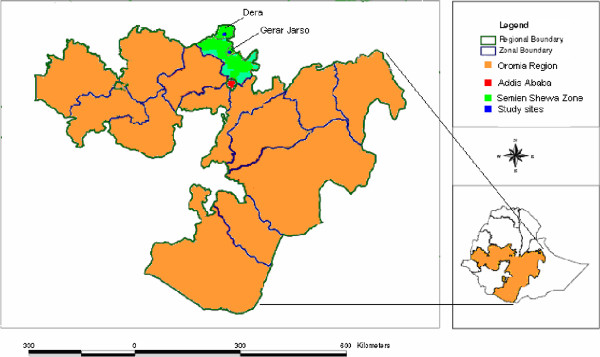
This cross-sectional study was conducted between January and April 2009 in Girar Jarso and Dera Districts of North Shewa Zone, Oromia Region, Ethiopia. A total of 768 stool specimens were collected and examined for intestinal parasites using direct wet mount with saline and formalin ether concentration methods. The modified Ziehl-Neelsen staining method was used for the detection of Cryptosporidium species. Statistical analysis was performed using SPSS software version 15.
Out of 384 children examined, 53 (13.8%) and 28 (7.3%) were positive for Giardia and Cryptosporidium infections, respectively. Similarly, of the total 384 cattle examined, 9 (2.3%) were positive for Giardia duodenalis and 30 (7.8%) were positive for Cryptosporidium infection. The prevalence of giardiasis was significantly higher among children who had close contact with cattle 33 (18.7%) compared to children who had no contact with cattle 20 (9.6%) (P < 0.05). Higher number of Cryptosporidium infection was also recorded in children who had close contact with cattle 15 (8.5%). Difference in prevalence of giardiasis and cryptosporidiosis among children was not statistically significant between males and females. On the other hand, difference in the prevalence of giardiasis among children was statistically significant between age groups.
Higher prevalence of Giardia duodenalis infection detected among children was significantly associated with contact with cattle and manure that the children had. Further analysis using molecular techniques is needed to explain the existence of zoonotic transmission in the study area.
贾第虫和隐孢子虫是导致全球严重发病和死亡的原生动物性腹泻的最常见病因。本研究的目的是确定儿童和牛中十二指肠贾第虫和隐孢子虫物种感染的患病率,并评估人畜共患病传播的潜在风险。
本横断面研究于2009年1月至4月在埃塞俄比亚奥罗米亚地区北谢瓦州的吉拉尔·贾尔索和德拉区进行。共收集了768份粪便标本,采用生理盐水直接涂片和福尔马林乙醚浓缩法检查肠道寄生虫。改良齐尔-尼尔森染色法用于检测隐孢子虫物种。使用SPSS软件15版进行统计分析。
在384名接受检查的儿童中,分别有53名(13.8%)和28名(7.3%)贾第虫和隐孢子虫感染呈阳性。同样,在总共384头牛中,9头(2.3%)十二指肠贾第虫呈阳性,30头(7.8%)隐孢子虫感染呈阳性。与未接触牛的儿童(20名,9.6%)相比,与牛密切接触的儿童中贾第虫病的患病率显著更高(33名,18.7%)(P < 0.05)。与牛密切接触的儿童中隐孢子虫感染数量也更高(15名,8.5%)。儿童中贾第虫病和隐孢子虫病患病率在男性和女性之间无统计学显著差异。另一方面,儿童中贾第虫病患病率在不同年龄组之间有统计学显著差异。
在儿童中检测到的十二指肠贾第虫感染的较高患病率与儿童与牛及牛粪的接触显著相关。需要使用分子技术进行进一步分析,以解释研究区域内人畜共患病传播的存在情况。