Weintrob Amy C, Murray Clinton K, Lloyd Bradley, Li Ping, Lu Dan, Miao Zhuang, Aggarwal Deepak, Carson M Leigh, Gaskins Lakisha J, Tribble David R
Infectious Disease Clinical Research Program, The Uniformed Services University of the Health Sciences, Department of Preventive Medicine and Biometrics, Bethesda, MD, USA.
MSMR. 2013 Aug;20(8):17-22.
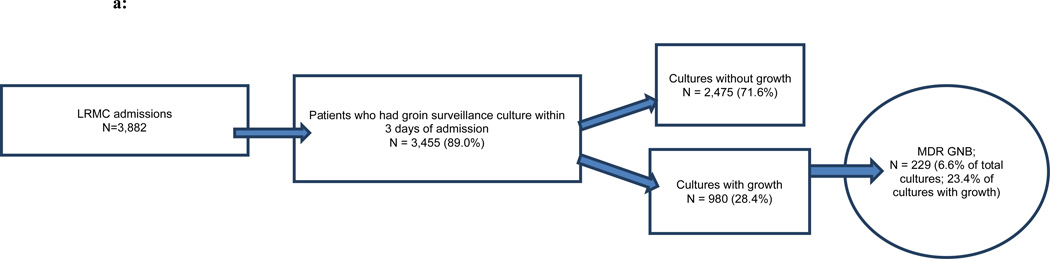
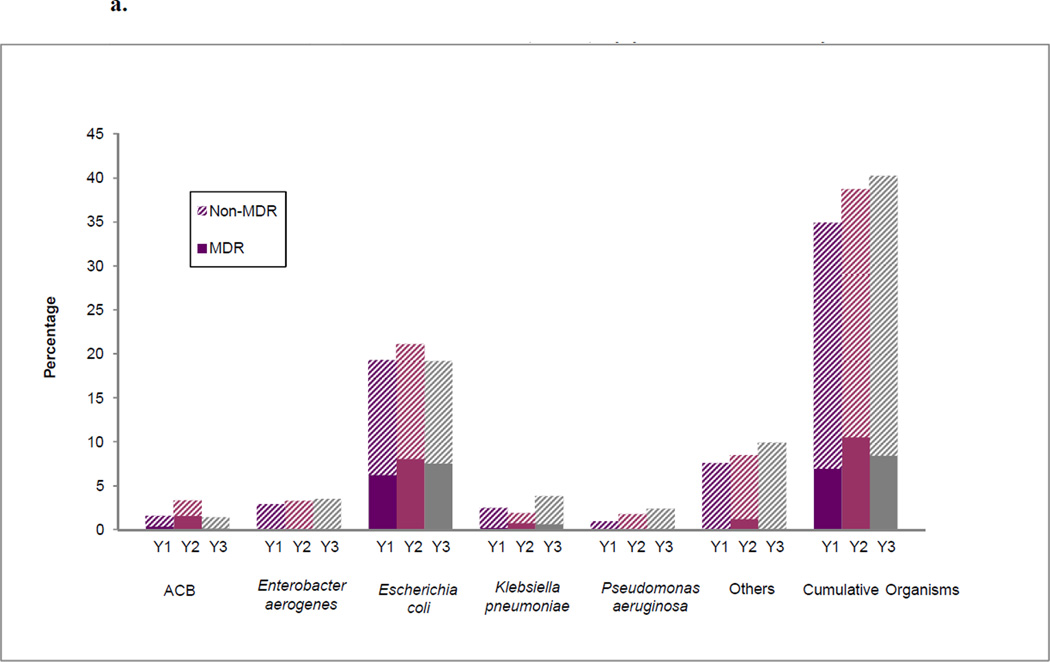
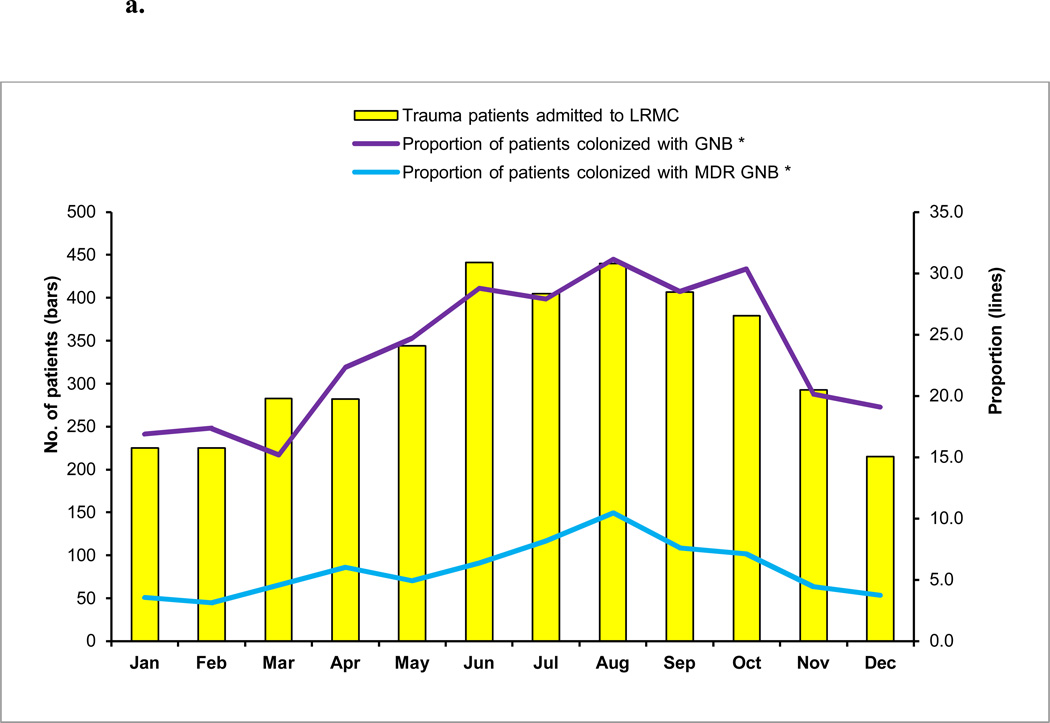
In response to the high rates of colonization and infection by multidrug-resistant gram-negative bacilli (MDR GNB), many military treatment facilities (MTFs) have implemented additional infection control practices, such as active surveillance cultures for asymptomatic colonization. Results of surveillance cultures (June 2009 - May 2012) collected from patients at Landstuhl Regional Medical Center (Landstuhl RMC), Germany, and three U.S. MTFs were analyzed to evaluate trends in MDR GNB colonization over time and across facilities. At Landstuhl RMC, 6.6 percent of patients were colonized on admission with MDR GNB compared to 12.4 percent of patients admitted to the participating U.S. MTFs. Escherichia coli was the predominant organism, representing 82.4 percent of MDR isolates at Landstuhl RMC and 67.1 to 83.3 percent at U.S. MTFs. Other common MDR GNB included Acinetobacter calcoaceticus-baumannii complex and Klebsiella pneumoniae. Although Pseudomonas aeruginosa was often isolated from the surveillance cultures, it was never multidrug-resistant. Annual rates of MDR GNB colonization were not significantly different over the three-year period. Ongoing research includes assessment of predictive factors for MDR GNB colonization and the relationship between colonization and infection.
针对多重耐药革兰氏阴性杆菌(MDR GNB)的高定植率和感染率,许多军事治疗机构(MTF)已实施了额外的感染控制措施,如对无症状定植进行主动监测培养。对从德国兰施图尔地区医疗中心(Landstuhl RMC)以及三个美国军事治疗机构的患者中收集的监测培养结果(2009年6月至2012年5月)进行分析,以评估MDR GNB定植随时间推移及不同机构间的趋势。在兰施图尔地区医疗中心,6.6%的患者入院时被MDR GNB定植,而参与研究的美国军事治疗机构中这一比例为12.4%。大肠杆菌是主要菌种,在兰施图尔地区医疗中心占MDR分离株的82.4%,在美国军事治疗机构中占67.1%至83.3%。其他常见的MDR GNB包括醋酸钙不动杆菌-鲍曼不动杆菌复合体和肺炎克雷伯菌。虽然铜绿假单胞菌经常从监测培养中分离出来,但它从未出现多重耐药。在三年期间,MDR GNB定植的年发生率没有显著差异。正在进行的研究包括评估MDR GNB定植的预测因素以及定植与感染之间的关系。