Department of Oral Microbiology, Faculty of Medicine, Medical University of Gdansk, Gdansk, Poland.
Department of Dental Techniques and Masticatory System Dysfunctions, Faculty of Medicine, Medical University of Gdansk, Gdansk, Poland.
Front Cell Infect Microbiol. 2023 Nov 16;13:1265777. doi: 10.3389/fcimb.2023.1265777. eCollection 2023.
The colonization of the oral cavity by potentially pathogenic antimicrobial-resistant bacteria in adolescents and its consequences is very poorly understood. The present study focused on the occurrence of oral colonization by Gram-negative bacilli (GNB) and their multidrug resistance, including the production of extended-spectrum β-lactamases (ESBLs) and carbapenemases, among healthy adolescents and risk factors associated with GNB colonization.
This study was conducted as part of "A program for the early detection of risk factors for lifestyle diseases SOPKARD-Junior" (SOPKARD-Junior). Oral samples were collected from 182 adolescents from four public elementary schools in Sopot, Poland, aged 13-14 years. Bacterial strains were identified by the MALDI-TOF MS method. Screening of antimicrobial resistance was performed using a disk diffusion method. The NG-Test CARBA-5 was used to detect and differentiate the five most widely distributed carbapenemases. Demographic and clinical data were collected and statistical analysis of risk factors was performed.
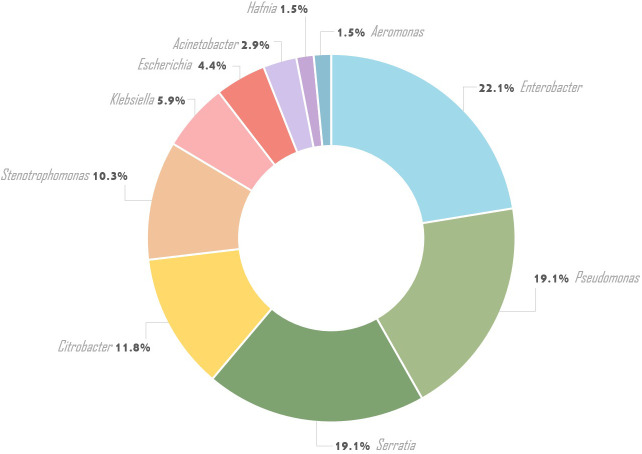
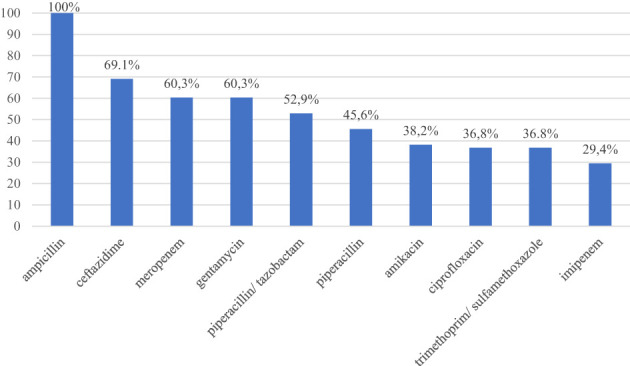
A total of 68 out of 182 (37.4%) healthy adolescents was documented oral colonization with Gram-negative bacilli, including 50/182 (27.5%) multidrug resistant (MDR-GNB) strains. Over 60% of oral carriage concerned three main genera spp., spp., and spp., which were detected in 22.1%, 19.1%, and 19.1% of participants, respectively. spp., , spp., spp., spp., spp., and spp. were also isolated. The antimicrobial resistance to ampicillin (100%), ceftazidime (69.1%), meropenem (60.3%), gentamycin (60.3%), piperacillin/tazobactam (52.9%), and piperacillin (45.6%) were the most common. Among 73.5% GNB strains multidrug resistance was observed, including all spp. strains. Among MDR-GNB, 30.4% were resistant to four groups of antibiotics, half of the MDR spp. strains were resistant to 10 groups of antibiotics. Extended-spectrum β-lactamases were produced by , spp., and spp. (7.4%). Colonization by ESBLs-positive GNB strains was significantly associated with recurrent respiratory infections, nasal congestion, and bronchitis (p<0.05).
Our study revealed high oral carriage of multi-drug resistant Gram-negative bacilli in healthy adolescents and the association of ESBL-producing strains with respiratory infections. Further studies on oral colonization with GNB are necessary due to the possibility of distinct infections and the acquisition of antibiotic resistance by resident microbiota.
青少年口腔中潜在致病性抗菌药物耐药菌的定植及其后果尚未得到充分认识。本研究重点关注健康青少年口腔中革兰氏阴性杆菌(GNB)定植及其多重耐药性,包括产超广谱β-内酰胺酶(ESBLs)和碳青霉烯酶的情况,以及与 GNB 定植相关的危险因素。
本研究作为“早期发现生活方式疾病危险因素计划 SOPKARD-Junior(SOPKARD-Junior)”的一部分进行。从波兰索波特的四所公立小学的 182 名 13-14 岁青少年中采集口腔样本。采用 MALDI-TOF MS 法鉴定细菌株。采用纸片扩散法进行抗菌药物耐药性筛查。使用 NG-Test CARBA-5 检测和区分五种分布最广的碳青霉烯酶。收集人口统计学和临床数据,并进行危险因素的统计分析。
共有 68 名(37.4%)健康青少年被记录口腔定植革兰氏阴性杆菌,其中 50/182 株(27.5%)为多重耐药(MDR-GNB)菌株。超过 60%的口腔携带涉及三个主要属,即 spp., spp.和 spp.,分别在 22.1%、19.1%和 19.1%的参与者中检出。还分离出 spp., spp., spp., spp., spp., spp.和 spp.。对氨苄西林(100%)、头孢他啶(69.1%)、美罗培南(60.3%)、庆大霉素(60.3%)、哌拉西林/他唑巴坦(52.9%)和哌拉西林(45.6%)的抗菌药物耐药性最为常见。在 73.5%的 GNB 菌株中观察到多重耐药性,包括所有 spp.菌株。在 MDR-GNB 中,有 30.4%的菌株对四组抗生素耐药,其中一半的 MDR spp.菌株对 10 组抗生素耐药。产 ESBLs 的 GNB 菌株由 spp., spp.和 spp.产生(7.4%)。产 ESBLs 的 GNB 菌株的定植与复发性呼吸道感染、鼻塞和支气管炎显著相关(p<0.05)。
我们的研究表明,健康青少年口腔中存在高度的多重耐药革兰氏阴性杆菌定植,产 ESBLs 菌株与呼吸道感染有关。由于常驻菌群可能引起不同的感染和获得抗生素耐药性,因此有必要对 GNB 的口腔定植进行进一步研究。